MERV Ratings: Choosing a Furnace Filter Without Choking Airflow
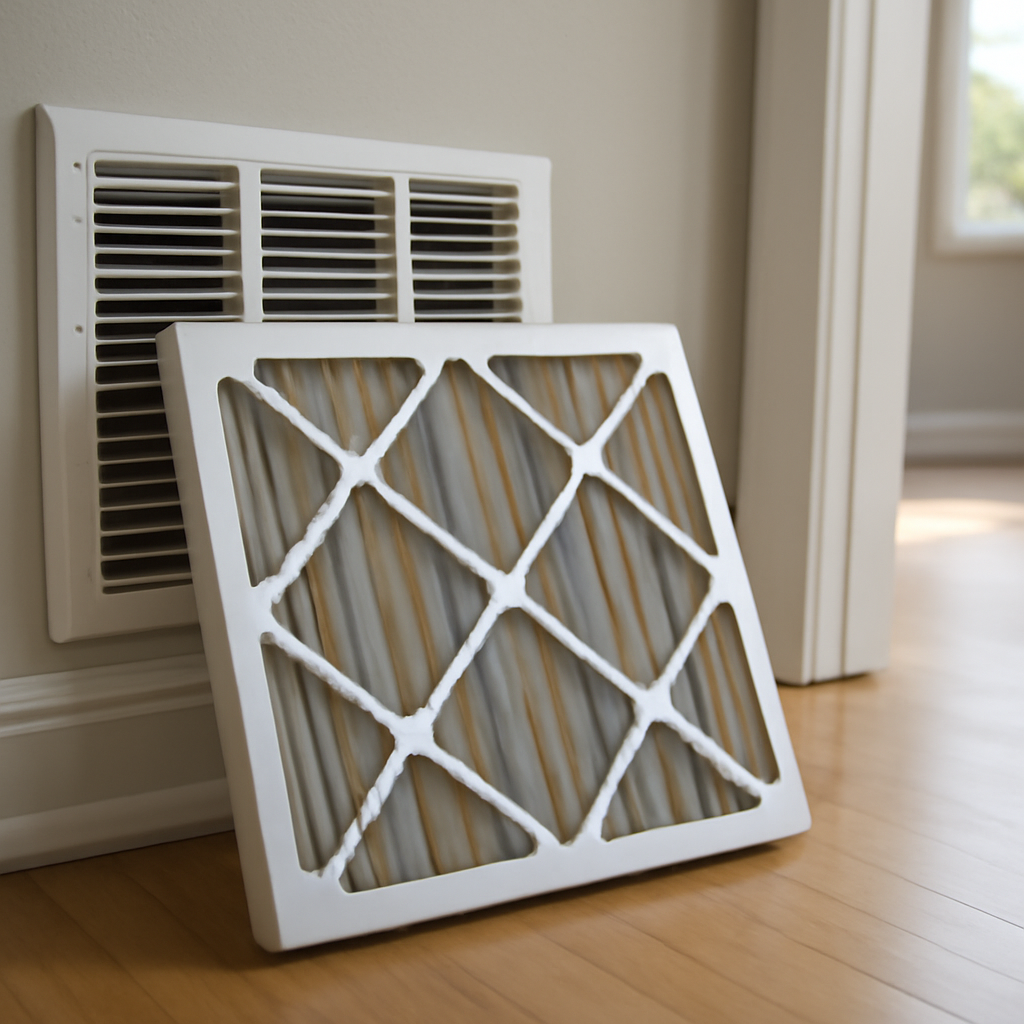
Filter packaging is crowded with numbers, colors and claims, and the MERV rating is the one figure that comes from a national consensus test standard rather than a brand’s own scale. Understanding it helps homeowners pick a furnace or HVAC filter that actually captures the particles they care about without starving the blower of air. This guide explains the MERV scale and its particle-size bands, compares the common MERV 8, 11 and 13 choices, covers pressure drop and filter thickness, shows how to size a filter correctly, and looks at wildfire smoke season on the Colorado Front Range. It summarizes EPA guidance current as of 2026; anyone with asthma or other respiratory conditions should talk with a physician about their specific needs.
Part of our Heating, Cooling & Ventilation guide — start there for the full picture →
What a MERV Rating Measures
MERV stands for Minimum Efficiency Reporting Value. According to EPA, MERVs report an air filter’s ability to capture particles between 0.3 and 10 microns, and the rating is derived from a test method developed by ASHRAE, the American Society of Heating, Refrigerating and Air-Conditioning Engineers. The higher the rating, the better the filter is at trapping specific sizes of particles.
The test sorts particles into three size bands and reports the minimum average capture efficiency in each:
- 3.0 to 10.0 microns: larger particles such as pollen, dust mite debris and much household dust.
- 1.0 to 3.0 microns: finer dust, some mold spores and other small particles.
- 0.3 to 1.0 microns: the fine range that includes much of the particle size class of greatest health concern, including many smoke particles.
A MERV number is not a single percentage. It is a grade that tells you how a filter performed across those bands, and it is most useful for comparing filters against each other.
Other rating systems on the shelf
Store brands often print their own scale alongside or instead of MERV. EPA’s Guide to Air Cleaners in the Home lists the Filter Performance Rating (FPR) and Microparticle Performance Rating (MPR) as examples, notes that MERV is based on a national consensus standard while FPR and MPR are proprietary, and says that for all rating methods a higher rating means higher removal efficiency for most particle sizes. When comparing brands, look for the MERV figure, which is usually somewhere on the package or the manufacturer’s spec sheet.
The MERV 1–16 Scale, Band by Band
EPA’s MERV page publishes a table summarizing the average capture efficiency at each rating. A few landmarks are worth knowing:
- MERV 1–4: less than 20% capture in the 3.0–10.0 micron band. These are the thin fiberglass filters that mainly protect equipment from lint and large debris.
- MERV 5–7: capture in the 3.0–10.0 micron band rises from at least 20% to at least 50%.
- MERV 8: at least 20% in the 1.0–3.0 micron band and at least 70% in the 3.0–10.0 micron band.
- MERV 11: the first rating with a requirement in the finest band: at least 20% for 0.30–1.0 microns, at least 65% for 1.0–3.0, and at least 85% for 3.0–10.0.
- MERV 13: at least 50% for 0.30–1.0 microns, at least 85% for 1.0–3.0, and at least 90% for 3.0–10.0.
- MERV 16: at least 95% in all three bands.
HEPA filters sit outside this scale. EPA’s table lists HEPA at 99.97% or greater capture of 0.30-micron particles and describes HEPA filters as a type of pleated mechanical filter that is common in portable air cleaners.
MERV 8 vs MERV 11 vs MERV 13
These three ratings cover most of the pleated filters sold for homes, and the choice between them is where most buying decisions happen.
MERV 8
A common default in new construction and a frequent recommendation from equipment manufacturers. It does a reasonable job on larger dust and pollen and protects the blower and coil from debris. It has no required capture in the finest particle band, so its contribution to reducing fine particles such as smoke is limited.
MERV 11
A middle step. It adds some capture of the smallest band while usually creating less resistance than a MERV 13 of the same thickness. For households concerned about allergens, or for systems where a technician is unsure about going higher, it is a common compromise.
MERV 13
EPA’s guidance on choosing a furnace or HVAC filter is direct: select a filter rated at least MERV 13, or as high a rating as your system fan and filter slot can accommodate. The Guide to Air Cleaners in the Home explains that filters rated MERV 13 and above must demonstrate at least 50% removal efficiency for the smallest particles tested. EPA also states that most furnaces and HVAC systems can accommodate a MERV 13 filter without creating equipment problems, provided the filter is replaced frequently, while noting that it can be difficult to tell because systems are not commonly labeled with filter recommendations.
Why higher is not automatically better
A higher-rated filter usually has denser media, which can increase resistance to airflow. Whether that matters depends on the blower, the duct system, the filter’s thickness and surface area, and how dirty the filter gets between changes. That is why EPA repeatedly qualifies its advice with “as high a rating as your system fan and filter slot can accommodate” and suggests consulting a professional HVAC technician when unsure.
Pressure Drop, Airflow and the Blower
Every filter resists airflow to some degree. HVAC professionals call this resistance pressure drop, and it adds to the resistance from ducts, coils, registers and returns. Residential blowers are designed to move a certain volume of air against a certain total resistance; push that resistance too high and airflow falls.
Reduced airflow can show up as weak air at registers, rooms that heat or cool unevenly, a cooling coil that gets too cold and may frost, or a furnace that runs hotter than intended and trips its high-limit safety switch. Some modern variable-speed blowers ramp up to maintain airflow, which can mean more fan noise and electricity use. These effects are system-specific, so the safest reference is the furnace or air handler’s installation manual, which often lists allowable external static pressure or recommends specific filter types. An HVAC technician can measure static pressure across the filter and the system to see whether there is headroom for a higher-rated filter.
A clogged filter of any rating creates far more resistance than a clean one. A badly loaded MERV 8 can restrict airflow more than a fresh MERV 13. If the blower seems strained, noisy or slow to move air, our guide to the furnace blower motor covers the signs of trouble, and our article on return air vents explains why undersized or blocked returns compound the problem.
1-inch vs 4-inch media
Filter thickness changes the picture. A 4- or 5-inch media filter in a dedicated cabinet has far more pleated surface area than a 1-inch filter of the same face size. More area means the air moves through the media more slowly, which generally lowers resistance at a given MERV and spreads dust loading so the filter lasts longer. EPA notes that filters commonly come in thicknesses of 1 to 5 inches.
Many homes have only a 1-inch slot at the furnace or in a return grille. Upgrading to a media cabinet is a common HVAC retrofit for households that want MERV 13 filtration with less airflow penalty. Costs depend on space around the furnace and the duct configuration.
Sizing a Filter: Nominal vs Actual
Filter sizes are printed as nominal dimensions, such as 16x25x1, which are rounded labels. The actual dimensions are usually a little smaller so the filter slides into the slot; a nominal 1-inch filter is often closer to three-quarters of an inch thick. Both sets of numbers are typically printed on the frame.
A filter that is too small lets air bypass around the edges, carrying unfiltered dust straight into the blower and coil. EPA’s guidance is to make sure the filter fits snugly so air does not leak around it and that you do not have to bend or crush it to make it fit. Practical tips:
- Copy the size from the existing filter’s frame, then measure the slot to confirm.
- Check the airflow arrow and point it toward the blower, in the direction air travels.
- Look for missing slot covers or open gaps around the filter door, which let air bypass the filter entirely.
- For return-grille filters, confirm every return grille that holds a filter has one in place.
Replacement Intervals
EPA’s Guide to Air Cleaners in the Home tells homeowners to replace filters according to the manufacturer’s recommendations, notes that manufacturers typically recommend replacement every 60 to 90 days, and advises changing them more often if they appear heavily soiled at replacement. ENERGY STAR’s maintenance checklist recommends inspecting, cleaning or changing air filters once a month in a central air conditioner, furnace or heat pump, and warns that a dirty filter can increase energy costs and damage equipment, leading to early failure.
Those two pieces of advice fit together: check monthly, replace when the filter is loaded or on the manufacturer’s schedule, whichever comes first. Homes with pets, ongoing renovation, a lot of foot traffic from unpaved areas or wildfire smoke tend to load filters faster. Thicker media filters usually last longer than 1-inch filters. Our furnace filter replacement guide walks through the steps.
Filters, Ducts and the Rest of the System
A filter only cleans air that passes through it. Leaky return ducts in an attic, crawl space or garage can pull in dusty, unconditioned air downstream of the filter, bypassing it completely. Sealing those leaks often matters as much as the filter choice, and our guide to duct sealing covers the common methods.
Duct cleaning is a separate question. It can make sense after renovation dust, pest activity or visible debris, but it does not replace good filtration and sealing. Our article on air duct cleaning explains when it is worth considering.
EPA’s furnace and HVAC guidance also points out a practical limit: furnace and HVAC filters filter the air only when the system is operating, and in most cases systems run only when heating or cooling is needed. Running the fan longer increases filtration, though EPA notes that longer run times increase electricity costs and may affect humidity control during cooling season.
Washable, electrostatic and electronic options
Some homes use washable or reusable electrostatic filters instead of disposable pleated ones. Their performance varies widely between products, and many do not publish a MERV rating at all, which makes comparison difficult. If one is used, it has to be cleaned and fully dried on the schedule the maker specifies, because a damp or dirty reusable filter can restrict airflow. Electronic air cleaners installed in the ductwork are another category with their own maintenance needs. EPA notes that ozone generators sold as air cleaners intentionally produce ozone gas and that no federal government agency has approved them for use in occupied spaces. When a product’s rating is unclear, a disposable pleated filter with a printed MERV number is the easiest option to evaluate and replace.
HEPA is a different class
True HEPA filtration is rarely practical in a standard residential furnace slot because of the resistance it adds; whole-house HEPA systems typically use a separate bypass unit with its own fan. For room-level filtration, EPA notes that portable air cleaners often achieve a high clean air delivery rate by using a HEPA filter. Our HEPA filter guide covers how those devices compare with central filtration.
Wildfire Smoke on the Front Range
Smoke from fires in Colorado and neighboring states has become a recurring summer and fall concern along the Front Range. EPA’s wildfire and indoor air quality guidance recommends that homes with a central HVAC system find out whether it has a fresh air intake and, if so, learn how to close it or switch to recirculate mode. It also recommends making sure the HVAC filter is in good condition, fits snugly and is replaced at the frequency the manufacturer recommends, and suggests considering an upgrade to a MERV 13 or higher filter if the system can accommodate it.
Many Front Range homes use evaporative (swamp) coolers. EPA’s guidance on these is specific: if you can safely access the cooler, completely cover its outside air intakes with 4-inch-thick high-efficiency MERV 13 furnace filters, and if that is not possible, use the cooler sparingly during smoky conditions because it can bring more smoke inside. It also notes that portable air cleaners and high-efficiency HVAC filters can remove smoke particles from indoor air.
Filters load quickly during smoke events, so it is worth having spares on hand before fire season and checking them more often while smoke lingers.
Testing, Inspection and Costs
Choosing a higher filter rating is a reasonable step, but it does not tell you what is actually in the air. Where there are persistent symptoms, musty odors or concerns about specific pollutants, an indoor air quality test can help identify whether particles, moisture, combustion gases or other sources are the issue. EPA is clear that filters do not solve mold problems; mold comes from a moisture problem that has to be fixed at the source.
During a home inspection, inspectors typically open readily accessible filter compartments and note missing, dirty or poorly fitting filters, airflow concerns and service history where visible. Our heating and cooling inspection section covers what else is evaluated, and the main guide to hiring a home inspector explains how to choose one.
As rough 2026 ranges, treat these as estimates that vary by brand, size and retailer:
- 1-inch pleated MERV 8: often a few dollars to around ten dollars each, less in multipacks.
- 1-inch MERV 11 or 13: typically somewhat more per filter.
- 4- or 5-inch media filters: usually cost more per filter but are changed less often.
- Adding a media filter cabinet: commonly a few hundred dollars or more installed, depending on space and ductwork.
- Static pressure test by an HVAC technician: often part of a routine service visit.
References
- What Is a MERV Rating? — U.S. Environmental Protection Agency
- Guide to Air Cleaners in the Home — U.S. Environmental Protection Agency
- Wildfires and Indoor Air Quality — U.S. Environmental Protection Agency
- Maintenance Checklist — ENERGY STAR
Frequently asked questions
What MERV rating is best for a home furnace?
EPA recommends a filter rated at least MERV 13, or as high as the system fan and filter slot can accommodate. If it is unclear if your equipment can handle it, an HVAC technician can check airflow and static pressure.
Will a MERV 13 filter damage my furnace?
EPA says most furnaces and HVAC systems can accommodate a MERV 13 filter without problems, provided it is replaced frequently. A thicker media filter reduces resistance, and a clogged filter of any rating can restrict airflow.
Is MERV 16 the same as HEPA?
No. HEPA is a separate class that captures at least 99.97% of 0.30-micron particles. True HEPA is rarely practical in a standard furnace slot and is more common in portable air cleaners.
How often should a MERV 11 or 13 filter be changed?
Follow the filter manufacturer's schedule, often 60 to 90 days per EPA, and check monthly as ENERGY STAR suggests. Replace sooner if it looks heavily loaded, especially during wildfire smoke.
Why does the filter size printed on the frame not match my measurement?
The large printed size is nominal and rounded; the actual size is slightly smaller so it fits the slot. Match the nominal size and confirm the filter sits snugly with no gaps.
Want someone to look at the furnace, filter slot and ductwork before you close on a Front Range home? Reach out here to connect with a vetted local inspector.