Certified Asbestos Removal Contractor: Homeowner Guide
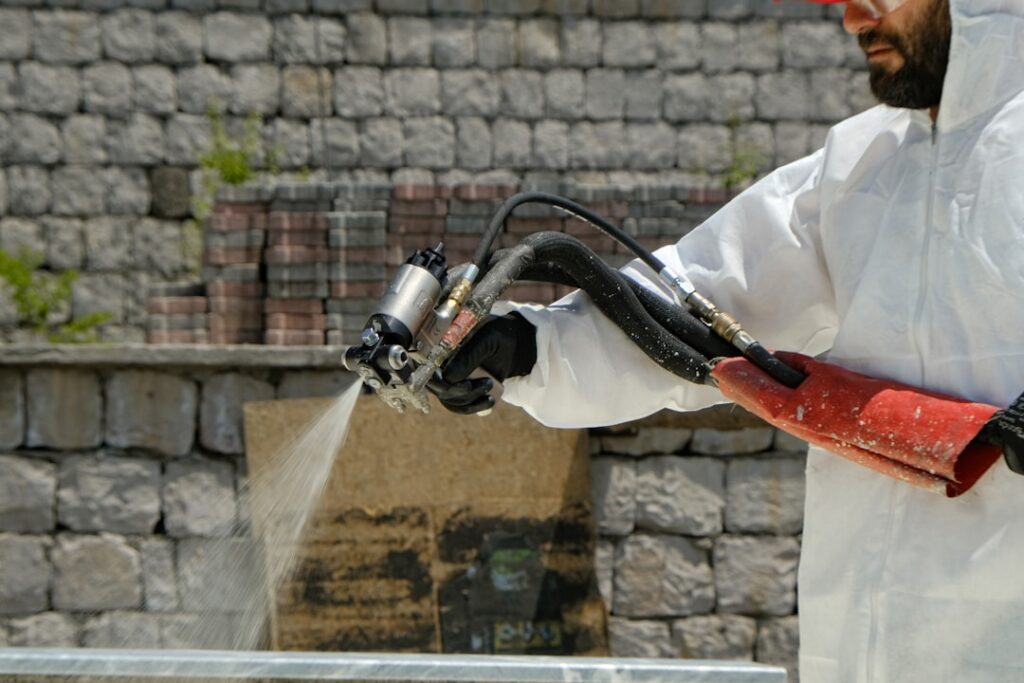
A certified asbestos removal contractor occupies a specific regulatory category defined by federal AHERA accreditation, state contractor licensing, and EPA NESHAP work-practice rules. The term “certified” in this context is not marketing; it refers to documented training and licensure that can be verified through public agency registries. Homeowners hiring for residential abatement work need to know what certifications matter, how to verify them, and which red flags warrant walking away. This guide summarizes EPA, OSHA, and CDPHE guidance current as of 2026 — verify any specific contractor’s credentials through the appropriate agency before signing.
Part of our How to Become a Home Inspector guide — start there for the full picture →
Is this mold, asbestos, or water damage? Get a free instant screen
Upload a clear photo of the suspect area. You'll get an instant AI screening opinion and what to do next. This is screening guidance, not a professional determination.
Screening guidance only. AI can be wrong. Confirm asbestos, mold type, or lead with lab testing or a licensed professional before acting.
What “certified” means in the asbestos removal context
Certification in asbestos work has two distinct meanings. First, individual workers, supervisors, project designers, and inspectors hold AHERA accreditations earned through specific federal training courses with annual refreshers. Second, the contracting firm itself holds a state-issued asbestos abatement contractor license that requires bonding, insurance, and documented personnel. Both forms of certification are verifiable through public records: state agencies publish licensed contractor lists, and personnel cards are kept on site during projects. A contractor calling itself “certified” without documenting both is misusing the term.
The AHERA Model Accreditation Plan
The federal Asbestos Hazard Emergency Response Act of 1986 established the Model Accreditation Plan (MAP), which sets training standards across five worker categories. Worker (laborer) accreditation requires a 32-hour initial course plus 8-hour annual refresher. Supervisor (competent person) accreditation requires 40 hours initial plus 8 hours annual. Project designer accreditation requires 24 hours initial plus 8 hours annual. Building inspector requires 24 hours initial plus 4 hours annual. Management planner requires an additional 16 hours beyond inspector. Each level is documented on a wallet-sized card.
State contractor licensing layered on AHERA
AHERA accreditation covers personnel; state licensing covers the firm. Most states require asbestos contractors to hold a license issued by the state environmental or health agency. Requirements typically include financial responsibility (bonding or pollution insurance), a list of accredited personnel, an annual fee, and ongoing compliance with notification rules. Colorado’s CDPHE Asbestos Abatement Contractor license is a representative example: annual renewal, bonding requirement, and publication of disciplinary records. Verification through the state registry takes minutes.
How to verify state-level licensing
Every state with an asbestos licensing program publishes a current contractor list. In Colorado, CDPHE’s Air Pollution Control Division publishes the list on its website, searchable by company name or license number. In other states, the equivalent agency may be the state Department of Environmental Quality or the state health department. The verification reveals license status (current, expired, suspended), license category (contractor, designer, inspector, monitor), and any disciplinary history. Operating without a current license carries civil penalties in the tens of thousands of dollars per violation.
How to verify worker AHERA accreditation
Worker AHERA accreditation cards are issued by the training provider after course completion and annual refresher. Reputable contractors carry the cards on site and can show them on request. The card shows the worker’s name, the accreditation category, the issuing training provider, and the expiration date. Asking to see cards before work begins is a reasonable request; reluctance to show cards is a red flag. Some states maintain a registry of accredited personnel; in Colorado, CDPHE publishes worker registrations alongside contractor licenses. See our asbestos contractor vetting guide for the full verification workflow.
EPA NESHAP work-practice rules
Certified contractors operate under EPA NESHAP work-practice rules codified at 40 CFR Part 61 Subpart M. The rules require wet methods to suppress fiber release, containment to prevent visible emissions, HEPA filtration on negative-air machines, and trained personnel in respiratory protection. Projects exceeding the federal threshold (260 linear feet, 160 square feet, 35 cubic feet of regulated ACM) require 10-working-day advance notification to EPA or the delegated state agency. NESHAP applies to commercial buildings and to residential properties on demolition projects.
OSHA worker protection requirements
OSHA’s asbestos construction standard, 29 CFR 1926.1101, requires personal exposure monitoring, respiratory protection, training, medical surveillance, recordkeeping, and engineering controls during asbestos work. Certified contractors comply with all of these as part of standard practice. Workers exposed above the OSHA Permissible Exposure Limit (PEL) of 0.1 fibers per cubic centimeter as an 8-hour time-weighted average must enroll in OSHA-mandated medical surveillance. Homeowners do not directly verify OSHA compliance, but OSHA’s establishment search tool returns the contractor’s inspection history.
Pollution liability insurance verification
Certified contractors carry pollution liability insurance specific to abatement work, with limits typically between $1 million and $5 million per occurrence. Homeowners request a certificate of insurance from the contractor’s carrier, with the homeowner named as additional insured. The certificate should list pollution coverage and asbestos work specifically, not just general liability. Verification by calling the issuing carrier’s commercial-lines desk takes minutes and confirms the policy is in force at the listed limits.
The project design conflict-of-interest rule
Most state programs require the project designer who writes the abatement specification to be from a different firm than the abatement contractor who performs the work. The rule prevents the contractor from writing specs that favor its own pricing. Designer fees typically run $500 to $2,000 for residential projects. Homeowners pay the designer directly, separately from the contractor. The separation produces apples-to-apples bidding when three contractors quote against the same design document. Our residential asbestos survey guide covers the design phase in detail.
Three-quote comparison process
For projects above $5,000, three quotes from certified contractors is the standard due-diligence step. Each quote should reflect the same project design. Quotes that differ by more than 30 percent on the same scope typically reflect different interpretations of the work or different cost structures. Asking each contractor for two recent project references, sample completion reports, and disposal manifests builds confidence in the comparison. Selecting the lowest quote without verifying scope consistency is a common cause of project cost overruns.
Independent third-party air monitoring
Independent air monitoring, hired by the homeowner rather than by the contractor, is standard on responsibly managed projects. The industrial hygienist takes background, area, and clearance samples. Independent monitoring runs $400 to $1,500. Some contractors offer in-house monitoring at lower cost, but independent monitoring removes the conflict of interest in the clearance decision and is the standard practice on commercial work. Homeowners typically retain independent monitoring on any project above $10,000 in total budget.
Disposal documentation as a closeout deliverable
Asbestos waste manifests follow the waste from generator through transporter to disposal facility, with each link signing the form. Homeowners retain copies as proof of proper disposal, protecting against long-tail liability if waste is later traced. Certified contractors include disposal manifests in the closeout package, delivered within 30 days of project completion. Missing or vague manifests are a red flag: improperly disposed waste creates liability that follows the generator (the property owner) regardless of who actually mishandled the material.
Pricing benchmarks for certified contractor work
Certified contractor pricing tracks the national range. Popcorn ceiling abatement runs $3 to $7 per square foot. Pipe insulation runs $8 to $20 per linear foot. Floor tile and mastic runs $5 to $15 per square foot. Whole-house residential projects commonly land in the $5,000 to $25,000 range. The “certified” label does not by itself add a premium; uncertified work is not legal, so the comparison is between certified contractors, not between certified and uncertified options. Quotes outside the benchmark range warrant scope review.
Five red flags that disqualify a contractor
First, refusal to share license number, AHERA cards, or certificate of insurance. Second, a quote dramatically lower than competing bids on the same scope, particularly when the contractor is willing to start before the 10-day NESHAP notification window. Third, dismissal of independent air monitoring or insistence on in-house monitoring only. Fourth, vague disposal manifest commitments. Fifth, a pattern of unresolved complaints in state agency disciplinary records or BBB filings. Any one of these is a sufficient reason to walk away.
OSHA inspection history as a vetting signal
OSHA’s establishment search tool returns the inspection history of any contractor by company name and ZIP code. Multiple recent violations under 29 CFR 1926.1101 (construction asbestos) or 29 CFR 1910.1001 (general industry) warrant follow-up questions. Most established contractors have some history; pattern violations on respiratory protection, decontamination, or worker monitoring are more concerning than isolated administrative findings. The tool is free, public, and takes five minutes to use.
Why “certified” matters more than “experienced”
Experience without certification is not legal in asbestos work. A contractor that has performed asbestos work for 20 years without a current state license is not a value option; it is an unlawful operation that creates regulatory and liability exposure for the property owner. The first verification is always the current state license. Experience matters on top of certification, not as a substitute for it. Front Range homeowners can cross-reference contractor credentials against the CDPHE asbestos contractor registry. The parent pre-1978 housing hazard guide covers the regulatory framework end to end.
Continuing-education requirements
Certified workers and supervisors maintain accreditation through annual 8-hour refresher courses delivered by EPA-approved training providers. The refreshers cover regulatory updates, recent OSHA inspection findings, new work-practice guidance, and any state-specific rule changes. Workers who miss the annual refresher must re-take the full initial 32- or 40-hour course to recertify, which is a significant time and cost commitment. Reputable contractors invest in their workers’ continuing education and treat it as a non-negotiable. Asking how the firm handles refreshers is a reasonable probing question during the vetting conversation.
How federal AHERA certification ports across states
AHERA accreditation issued under EPA’s Model Accreditation Plan is recognized across state lines. A worker accredited in Colorado can work on a project in Wyoming or Utah without re-certifying. State licensing of the contracting firm itself is not portable; the firm must hold a license in each state where it operates. This is why some asbestos contractors work in multiple states under a single AHERA workforce but multiple state licenses, while others stay within a single state and avoid the multi-state licensing overhead. Multi-state firms typically have larger crew capacity and broader geographic reach.
If you’re in the Front Range and want a connection to a vetted certified asbestos abatement contractor, reach out through our contact page.
References
- EPA NESHAP for asbestos demolition and renovation — U.S. Environmental Protection Agency
- OSHA asbestos construction standard — Occupational Safety and Health Administration
- CDPHE asbestos contractor licensing program — Colorado Department of Public Health and Environment
- CDC NIOSH asbestos worker resources — National Institute for Occupational Safety and Health
Frequently asked questions
What credentials define a certified asbestos removal contractor?
A current state asbestos abatement contractor license, AHERA-accredited workers and supervisors, and pollution liability insurance specific to abatement activities. All three are verifiable through state regulatory agencies and the contractor's insurance carrier.
How do I verify AHERA accreditation?
AHERA accreditation cards are issued by the training provider after course completion and annual refresher. Reputable contractors carry the cards on site. Some states also publish a registry of accredited personnel alongside the contractor license registry.
Is experience a substitute for certification?
No. Asbestos abatement work without a current state license is unlawful regardless of experience level. Verification of the current license is the first step; experience matters on top of certification, not as a substitute for it.
What insurance should a certified contractor carry?
Pollution liability insurance with limits of $1 million to $5 million per occurrence, specifically listing asbestos work as covered. Standard general liability insurance excludes pollution coverage, which is what asbestos abatement work requires.
Asbestos test kits
Asbestos can only be confirmed by a lab. A mail-in kit gets you a sealed sample container and accredited analysis — never sand or disturb suspect material first.
| Product | Why | Buy |
|---|---|---|
| Asbestos Test Kit (mail-in lab) | Includes PPE + sealed mailer. | Amazon |
| Pro-Lab Asbestos Test Kit | Widely available; lab fee separate. | Amazon |