Mold Test Kit Home Depot: A Homeowner Buyer Guide
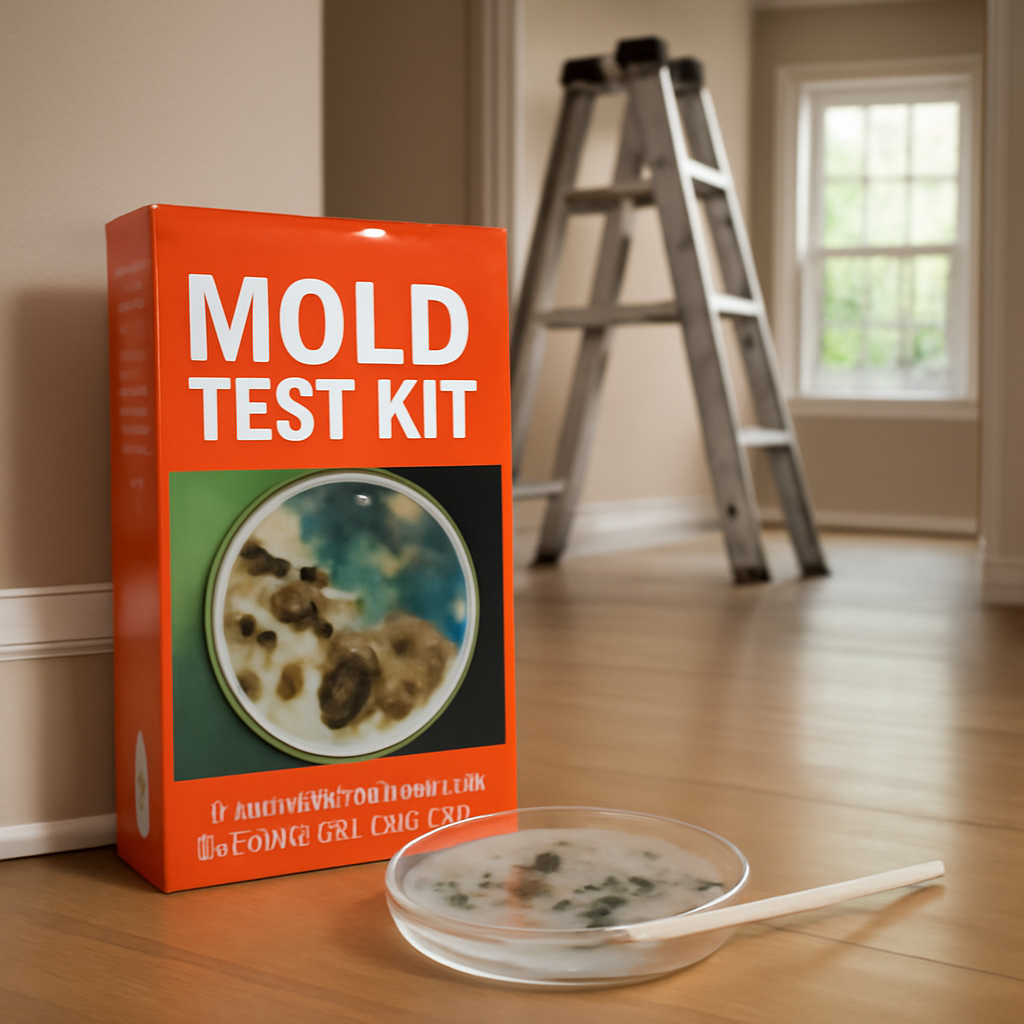
Searching for a mold test kit Home Depot carries usually leads homeowners to a small shelf of consumer DIY products — Pro-Lab brand petri-dish kits, “DIY Mold Test” cassette tape-lift kits, and a few air-pump bundles priced between fifteen and forty dollars. Home Depot is one of several retailers selling these kits; the same products show up at independent hardware stores, garden centers, and online marketplaces. The methodology behind the kit matters more than the storefront. This guide summarizes EPA and CDC guidance current as of 2026 — consult a certified mold inspector for testing decisions and your physician for symptom evaluation. Before you reach for any consumer kit, understand what the kit actually measures, what it cannot tell you, and when a lab-grade ERMI dust analysis is the smarter spend.
Part of our Mold Testing & Inspection guide — start there for the full picture →
Is this mold, asbestos, or water damage? Get a free instant screen
Upload a clear photo of the suspect area. You'll get an instant AI screening opinion and what to do next. This is screening guidance, not a professional determination.
Screening guidance only. AI can be wrong. Confirm asbestos, mold type, or lead with lab testing or a licensed professional before acting.
What kinds of mold test kits do big-box retailers carry?
Consumer mold test kits sold at major home-improvement retailers generally fall into three buckets. The cheapest are settle-plate kits — a Petri dish prefilled with malt-extract agar that you expose to room air for an hour. The middle tier uses adhesive tape-lift cassettes to sample visible growth. The higher-end consumer category bundles a small air pump with a cassette to draw a fixed volume of air across a sticky slide. All three can ship with a prepaid lab envelope where the homeowner mails the sample for microscopy identification and a written report.
None of these kits matches what a certified mold assessor brings to a site visit. Professionals use Air-O-Cell cassettes paired with a calibrated rotameter pump, post-remediation verification protocols, and reference outdoor “blank” samples — a workflow consumer kits cannot replicate. The retailer-shelf kit gives a snapshot. A professional workflow gives a defensible comparison.
How accurate are the consumer kits stocked on retail shelves?
Settle-plate kits suffer the worst signal-to-noise problem. The U.S. EPA does not recommend petri-dish sampling for mold identification because viable mold spores settle on agar at a rate that depends on humidity, draft, and dust load — not on how much mold actually grows in the wall cavity. A kit left open for an hour in a normal house will almost always grow something; that something is rarely diagnostic. Tape-lift kits sampling visible growth are more useful, but only when there is already visible growth to sample.
Air-cassette kits with pumps are closer to professional methodology, but the consumer versions sample at lower flow rates and shorter intervals. The lab report typically lists spore-type counts per cubic meter and flags whether common indoor markers (Cladosporium, Penicillium/Aspergillus group, Stachybotrys) exceed typical indoor ranges. The CDC notes that no federal “safe” indoor mold spore limit exists, which means the lab interpretation is comparative — not pass/fail.
When is a DIY kit the right call?
Consumer kits make sense in three scenarios. First, when a homeowner sees visible growth and wants the species identified before deciding between DIY cleanup and professional remediation. Second, when a tenant or buyer needs documentation for a landlord conversation or a real-estate negotiation and a quick paper trail is more useful than a perfect dataset. Third, when curiosity about a specific room — a damp basement corner, a recently flooded bathroom — outweighs the cost of a fifteen-dollar petri dish.
For health-driven testing — chronic respiratory symptoms, suspected hidden contamination behind walls, post-water-damage verification — consumer kits underperform. The right tool is an ERMI (Environmental Relative Moldiness Index) dust sample, processed by a qPCR lab using 36 indicator species. A homeowner can collect the ERMI sample at home with a Swiffer-style cloth and mail it; pricing runs $250-$450. The same homeowner can also browse the InspectandTest mold inspection hub for a deeper walkthrough of methodology trade-offs.
How to use a consumer mold test kit correctly
Read the instructions twice before opening the sealed sample medium. Three rules apply across most kits. Close HVAC vents and windows for at least two hours before sampling to stabilize the indoor air. Sample the room in question, then collect a second sample from outdoor air on the same day as a comparison baseline — without an outdoor reference, the indoor result has no context. Label every dish or cassette with room, date, and elapsed exposure time.
Avoid sampling during cleaning, vacuuming, or right after a shower; spore counts spike with disturbance. Do not place a Petri dish on a heat register or directly under HVAC supply. Send the sample to the lab the same day if possible — delayed shipping lets contaminant species outcompete the originally captured organisms. The mold sample testing methodology guide covers the workflow homeowners get wrong most often.
What the lab report actually tells you
A typical consumer-kit lab report lists detected genera, spore-count ranges, and a comparison to “typical” indoor levels. Reports rarely give species-level identification (genus-level only) and almost never quantify mycotoxin presence. Stachybotrys chartarum — the so-called “black mold” — gets flagged when detected because it indicates chronic moisture and cellulose substrate; finding zero Stachybotrys spores does not rule out hidden growth elsewhere.
EPA guidance is clear that visible mold and the moisture causing it are the priority — not spore counts. A report showing elevated Penicillium/Aspergillus without visible growth points toward hidden moisture, often inside a wall cavity or below a subfloor. That is the moment to call a certified inspector for moisture-meter and thermal-imaging investigation rather than buy another kit.
Cost comparison: retail kit vs ERMI vs professional inspection
Retail consumer kit (settle plate or tape lift): $15-$40 including mail-in lab fee. Retail consumer kit with air pump: $40-$80 plus lab fee. ERMI dust sample (mailed direct to lab like EnviroBiomics or Mycometrics): $250-$450 for the qPCR assay. Professional mold assessment with Air-O-Cell sampling, three to five sampling locations, outdoor blank, written report, and verbal walk-through: $400-$800 in the Denver metro and Front Range markets.
The price gap is real, but the data gap is bigger. A $35 retail kit answers “is mold present in this one spot at this one moment.” A $600 professional assessment answers “where is the moisture, how widespread is contamination, and what does cleanup require.” Choose the spend that matches the decision in front of you.
When to skip the kit and call a professional
Five trigger conditions argue for skipping consumer testing entirely. Visible growth covering more than ten square feet of contiguous surface. Persistent musty odor with no visible source. Family members with diagnosed mold allergy, asthma, or immunocompromised status. A recent water-damage event (flood, pipe burst, roof leak) where the affected materials sat wet for more than 48 hours. A real-estate transaction where the inspection contingency requires documented findings.
In any of those cases, the right next step is an in-person assessment by a credentialed inspector — InterNACHI’s IAC2 mold credential or the ACAC’s Council-Certified Microbial Investigator designation are the two most common. Front Range homeowners can use the InspectandTest contact page to get a connection to a local vetted inspector.
How retail kits compare on packaging promises
Packaging copy on consumer mold kits often promises more than the methodology can deliver. Phrases like “professional-grade results” and “lab-certified identification” appear on petri-dish kits that the EPA does not endorse for identification work. Reading the fine print on the back of the box matters. Look for three details: the sample type (settle plate, tape lift, or air cassette), whether lab analysis is included in the box price or sold separately, and whether the lab is AIHA-accredited. AIHA accreditation matters because non-accredited microscopy can misidentify spore morphology, especially distinguishing Aspergillus from Penicillium where the chains look similar under low magnification.
Brand reputation also varies. Pro-Lab kits dominate the retail shelf because they ship with an in-house IAQA-member lab. DIY Mold Test Inc. uses an external accredited lab. Some private-label kits sold under regional store brands do not name a lab at all and should be treated with caution. A homeowner shopping in person can flip the box and check for an AIHA or NVLAP logo near the lab address.
Front Range moisture conditions and retail kit limitations
Colorado’s semi-arid climate produces a misleading sense of safety around mold. Average outdoor humidity in Denver runs 30-40 percent annually, well below national averages, but that aggregate hides the local microclimates that drive growth. Finished basements sit below grade with French drains, sump pits, and concrete walls that exchange moisture from surrounding soil. South-facing bathrooms without bath fans accumulate condensation on cold winter mornings. Crawlspaces under poorly graded lots collect snowmelt every spring. Each of these microclimates can support mold growth even when the whole-house humidity reading sits at 35 percent.
Consumer kits from a big-box retailer were designed for humid-climate generalities, not Colorado microclimates. A petri dish placed in a Boulder kitchen will likely show low background mold; placed eighteen inches above a Lakewood sump pit, it will saturate the agar. Sampling location dwarfs sampling methodology in importance — a fact most box-text instructions skip entirely. Homeowners targeting basement, crawlspace, or wet-room investigation should use a tape-lift or air-cassette kit close to the suspect surface, not in the middle of a living room.
What to do with results that come back “elevated”
The lab report arrives in the mail or by email seven to fourteen days after the sample ships. An “elevated” reading is not a remediation order. Step one is to read the comparative context — does the report show indoor counts higher than the outdoor reference? If outdoor counts equal or exceed indoor counts, mold inside the home is likely tracked in from outside, not growing inside. Step two is to look at the species mix. Cladosporium dominates outdoor air across most of the U.S. and often shows up indoors at parity. Penicillium/Aspergillus and Stachybotrys are the species that point inward toward chronic moisture.
Step three is to act on whichever of the two findings shows up: visible growth or chronic moisture. If the report points to an unidentified moisture source and there is no visible growth, the right next move is a moisture-meter and thermal-imaging walkthrough by an inspector. If the report confirms what was already visible, skip a second consumer test and proceed straight to remediation planning. A second kit run at the same location, the same day, often returns different counts — which is why a single elevated result should be treated as a flag for further investigation, not a final diagnosis. Homeowners frequently retest several times hoping for a cleaner result; that pattern wastes money and delays the moisture fix that the report was actually pointing toward.
Storage, shipping, and shelf-life mistakes that ruin results
Consumer kits sit on retail shelves for months, sometimes years. The agar in a settle-plate kit dries out past its useful date when stored at room temperature beyond the printed shelf life — typically twelve to eighteen months from manufacture. Tape-lift cassettes use a sticky adhesive that degrades with heat; a kit that sat in a sun-warmed delivery truck loses adhesion before it ever reaches the homeowner. Check the expiration date stamped on the box before purchase, and if buying online, request a recent lot number.
Shipping the sample back to the lab introduces its own variables. A petri dish sealed in a USPS Priority envelope and exposed to summer heat will favor heat-tolerant species like Aspergillus over moisture-loving Stachybotrys, skewing the species ratio. Ship Monday through Wednesday to avoid weekend warehouse storage, and never expose the return envelope to direct sun on a porch. These practical handling details rarely appear in box instructions but routinely show up in lab-call quality-control notes.
References
- EPA: Should I Have the Mold Tested or Sampled? — U.S. Environmental Protection Agency
- CDC: About Mold — U.S. Centers for Disease Control and Prevention
- InterNACHI: Mold Inspection Standards — International Association of Certified Home Inspectors
- NIEHS: Mold and Health — National Institute of Environmental Health Sciences
Frequently asked questions
Does Home Depot sell mold test kits?
Most large home-improvement retailers stock a small selection of consumer mold test kits, typically Pro-Lab petri-dish kits and DIY Mold Test tape-lift cassettes. Inventory varies by store and season. The methodology of the kit matters more than which retailer sells it.
Are consumer mold test kits accurate?
Settle-plate kits have poor signal-to-noise and the EPA does not recommend them for identification. Tape-lift kits work for visible growth. Air-cassette kits with pumps are closer to professional methodology but still less rigorous than a calibrated Air-O-Cell sample.
How much does a DIY mold test cost?
Settle-plate and tape-lift kits run $15-$40 including the mail-in lab analysis. Air-pump consumer kits run $40-$80 plus lab fees. ERMI dust analysis from a specialty lab runs $250-$450 and gives qPCR species data.
When should you skip DIY testing?
Skip consumer kits when growth exceeds 10 square feet, when there is persistent musty odor without a source, after a water-damage event, or when an occupant has diagnosed mold allergy or asthma. Those situations need a credentialed in-person assessment.
Front Range homeowners weighing whether a retail mold test kit is enough — or whether a professional assessment is the smarter spend — can reach out through our contact page for a connection to a vetted inspector in Denver, Boulder, or the surrounding counties.
DIY mold test kits
A test kit can confirm whether a suspect patch is mold and (with lab analysis) what type — though visible mold over ~10 sq ft generally warrants a professional.
| Product | Why | Buy |
|---|---|---|
 DIY Mold Test (lab included) DIY Mold Test (lab included) | Surface + air-sampling options. | Amazon — $49.99 |
 Healthful Home 5-Minute Mold Test Healthful Home 5-Minute Mold Test | Rapid screening strips. | Amazon — $35.47 |
 Mold Test Plates (DIY petri dishes) Mold Test Plates (DIY petri dishes) | Settle-plate style sampling you culture at home. | Amazon — $22.99 |