Asbestos Lab Test: What Homeowners Need to Know
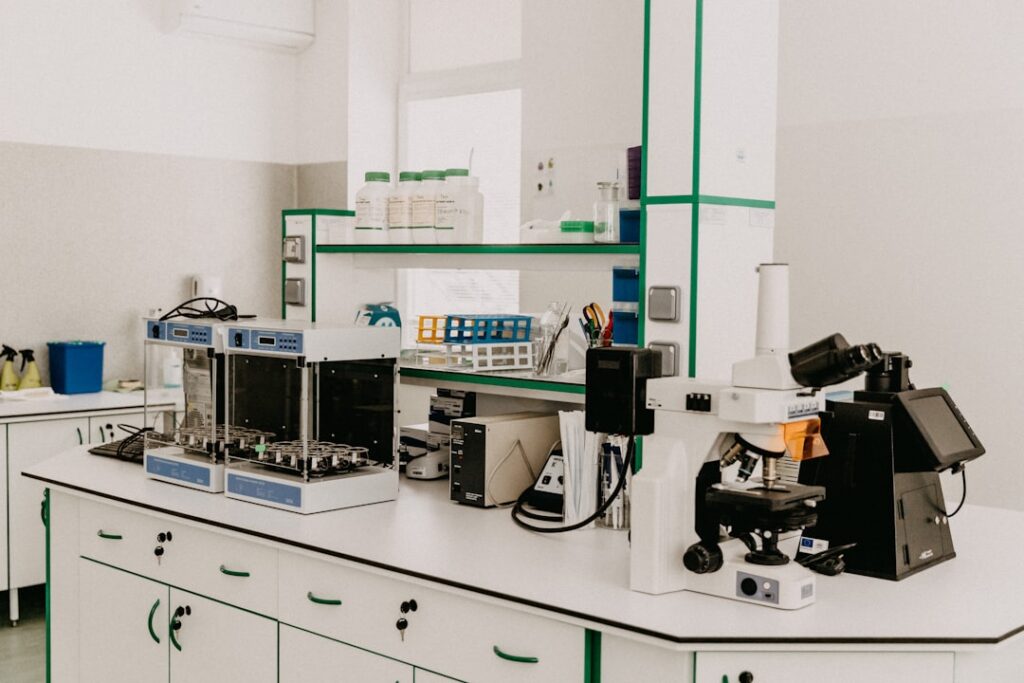
Once a homeowner has collected a suspect material sample, the work moves to the lab. The lab is where the actual asbestos identification happens — sample bags by themselves are just bagged debris until a microscopist confirms what they contain. Understanding the lab side helps homeowners pick the right facility, ask the right questions on the chain-of-custody form, and read the certificate correctly when it comes back. This guide walks through the asbestos lab test in detail: methodology, accreditation, sample handling, turnaround, and how to interpret a result. It summarizes EPA, NIST, and OSHA guidance current as of 2026 — always work with a licensed abatement professional for any removal.
Part of our Asbestos in the Home guide — start there for the full picture →
Is this mold, asbestos, or water damage? Get a free instant screen
Upload a clear photo of the suspect area. You'll get an instant AI screening opinion and what to do next. This is screening guidance, not a professional determination.
Screening guidance only. AI can be wrong. Confirm asbestos, mold type, or lead with lab testing or a licensed professional before acting.
What an Asbestos Lab Test Actually Measures
An asbestos lab test identifies and quantifies asbestos minerals in a submitted sample. The six regulated asbestos minerals are chrysotile, amosite, crocidolite, anthophyllite, tremolite, and actinolite. The lab reports each detected mineral by name with an estimated percent by volume in the bulk sample, or a fiber count per cubic centimeter in air samples. The report also notes non-asbestos fibers (cellulose, fiberglass, mineral wool), binders, and matrix material so the buyer of the test understands what else is in the sample.
Two analytical methods dominate the market. Polarized light microscopy with dispersion staining (PLM-DS) per EPA Method 600/R-93/116 is the standard for bulk samples. Transmission electron microscopy (TEM) per EPA AHERA protocol or ISO 10312 is the confirmatory method for air samples, low-concentration bulks, and dust wipes. PLM is fast and cheap. TEM is slow and expensive but resolves fibers an order of magnitude finer than PLM can see.
NVLAP Accreditation: What It Means and Why It Matters
The National Voluntary Laboratory Accreditation Program (NVLAP) is administered by the National Institute of Standards and Technology (NIST). NVLAP accredits asbestos labs for bulk PLM and air TEM analysis under documented quality-management systems. Accreditation requires the lab to maintain a quality manual, participate in proficiency testing rounds twice per year, calibrate microscopes regularly, document analyst training, and submit to NIST audits.
An accredited lab posts its NVLAP lab code on its website and on every test certificate. Homeowners and contractors can verify a lab’s accreditation at nvlap.nist.gov before submitting samples. The verification is free and takes about thirty seconds. Submitting samples to an unaccredited lab is legal but produces a result that will not be accepted for regulatory clearance, real-estate disclosure, or in many contractor change-orders.
AIHA-LAP as an Alternative Accreditation
The American Industrial Hygiene Association Laboratory Accreditation Programs (AIHA-LAP) accredits labs for environmental microbiology, industrial hygiene chemistry, and asbestos analysis. AIHA-LAP accreditation is widely accepted as equivalent to NVLAP for asbestos work. A lab may carry both, or may carry just one. Both meet the regulatory bar for asbestos confirmation in most jurisdictions. The accredited labs explained guide covers the differences in more depth, and the asbestos and lead pillar establishes the broader regulatory context.
How a Lab Handles a Submitted Sample
When the sealed sample bag arrives, the lab logs it into chain-of-custody software with a unique sample ID, the client’s name, and the submitted description. The bag is moved to a negative-pressure sample preparation room with HEPA filtration. An analyst opens the bag inside a Class I negative-pressure hood to prevent any released fibers from contaminating other samples or the lab environment.
For PLM, the analyst removes a representative portion of the sample, mounts it on a glass slide with refractive-index oils, and examines it under a polarized light microscope at 100x to 400x. The analyst identifies fibers by morphology, refractive index, birefringence, sign of elongation, and dispersion staining colors. Each suspect fiber is compared against the standard optical properties of the six regulated asbestos minerals. Quantification uses point counting per 400 grid points across the slide, producing a percent estimate.
For TEM, sample preparation is more involved. The analyst dissolves or ashes the matrix material, deposits residue on a TEM grid, and examines fibers at 10,000x to 25,000x magnification. Fibers are identified by morphology, selected-area electron diffraction (SAED), and energy-dispersive X-ray spectroscopy (EDS) chemical composition. TEM resolves fibers thinner than 0.25 micrometers — too small for PLM to see.
Turnaround Times and Pricing
Standard PLM bulk turnaround at most accredited labs is three to five business days from sample receipt. Rush options stack on top: 48-hour rush adds $15 to $30 per sample, 24-hour rush adds $25 to $50, and same-day or 6-hour rush adds $50 to $100. Standard pricing for PLM bulk in 2026 runs $25 to $50 per sample, with volume discounts kicking in around 10 to 20 samples.
TEM costs more across the board. Standard TEM bulk runs $75 to $150 per sample with a 5-to-10-business-day turnaround. TEM air samples run $100 to $200 per filter with similar turnaround. AHERA clearance air samples for school renovation projects use a different counting protocol and price slightly higher.
Most labs offer mail-in service with prepaid return shipping included in their kit price. Local labs in major metros allow walk-in drop-off, which can shave a day off turnaround. The local lab guide includes pointers on finding walk-in facilities in major metros.
Reading the Lab Certificate
A standard PLM certificate lists each sample by its client-supplied ID, the analyst’s findings for each mineral type as a percent by volume, the non-asbestos components, and the lab’s confidence note. A sample showing “Chrysotile 8%, Cellulose 12%, Calcium carbonate 80%” is a positive result for chrysotile asbestos at a regulated concentration. A sample showing “No asbestos detected” or “ND” means the analyst found no asbestos fibers down to the lab’s reporting limit (typically <0.1% or <1%).
The certificate also lists the analytical method (usually “EPA 600/R-93/116 PLM”), the analyst’s name and signature, the date of analysis, and the NVLAP or AIHA-LAP accreditation number. The chain-of-custody form is attached or referenced. Some labs include photomicrographs for positive samples. The lab will not interpret the result for the client — interpretation is the homeowner’s, inspector’s, or abatement contractor’s responsibility.
Choosing a Lab for a Single Homeowner Sample
Most homeowners submit one to four samples for a project. For that volume, the choice criteria are accreditation, turnaround, and shipping logistics. Accreditation should be NVLAP, AIHA-LAP, or both — verified online. Turnaround should match the project timeline; rush service is worth the surcharge if a closing date or contractor schedule is on the line. Shipping should include prepaid return materials so the homeowner does not pay outbound postage on a hazardous sample.
Reputation matters less for small-volume residential work than for commercial-clearance projects. Any NVLAP-accredited lab will produce defensible results on a clear-cut sample. The differences emerge on edge cases — samples with low fiber loadings, complex matrices, or borderline results — where some labs are more conservative in their reporting and others lean toward calling marginal samples positive. For homeowner sampling, this rarely matters.
When the Lab Recommends Additional Analysis
Some PLM results trigger a recommendation for TEM confirmation. The most common scenario is a floor-tile or joint-compound sample where the matrix interferes with PLM identification — the lab can see fibers but cannot definitively call them asbestos at the PLM resolution limit. A “TEM recommended” footnote on a PLM certificate is the lab’s signal that the result is uncertain and that paying $75 to $150 for TEM would resolve the question.
For air samples after a known disturbance, PCM-to-TEM upgrade is common. PCM counts all fibers without identifying them; TEM identifies the asbestos fibers among the total count. A high PCM result that turns out to be mostly cellulose under TEM may not require a clearance hold; a moderate PCM result that is mostly chrysotile under TEM means the space is not clear.
PLM vs TEM in Detail
Polarized Light Microscopy and Transmission Electron Microscopy occupy different positions in the asbestos identification workflow, and understanding the difference helps homeowners and inspectors choose the right test for the situation. PLM is the workhorse method for bulk samples and follows EPA Method 600/R-93/116, which the EPA bulk asbestos sampling resource describes as the standard analytical procedure for building materials. The technique uses a microscope equipped with polarizing filters to identify mineral fibers based on optical properties: refractive index, pleochroism, sign of elongation, and extinction angle. An analyst counts fibers, identifies the asbestos type (chrysotile, amosite, crocidolite, tremolite, actinolite, anthophyllite), and reports the percentage of each in the sample.
PLM’s strengths are speed, cost, and adequacy for most residential bulk samples. PLM can reliably identify asbestos at concentrations down to roughly 1 percent in homogeneous samples and 5 to 10 percent in complex matrices such as floor tile and joint compound. Its limitations appear at the lower end of the concentration range and in matrices where binder materials obscure the fibers under visible light. Floor tile, vinyl sheet flooring, certain plasters, and skim-coat joint compounds frequently push PLM to the edge of its detection limit, which is why a PLM report on these materials often includes a recommendation for TEM confirmation.
Transmission Electron Microscopy is the higher-resolution option and is required by EPA methodology for several specific scenarios. The technique uses an electron beam transmitted through ultra-thin sample sections to image fibers at scales well below visible-light resolution. TEM can detect asbestos at concentrations below 1 percent in bulk samples, can identify individual asbestos fibers in air samples, and can analyze settled dust samples for asbestos content. EPA AHERA clearance testing for schools requires TEM specifically because of the post-abatement context: after a project is complete, the question is whether residual airborne fiber concentrations meet a strict threshold, and PCM is insufficient because it cannot distinguish asbestos fibers from other fiber types. TEM also includes selected-area electron diffraction and energy-dispersive X-ray spectroscopy capabilities that confirm chemical composition of the fibers identified.
Chain-of-Custody Standards for Transactional Testing
When asbestos testing supports a real-estate transaction, the documentation around the sample matters as much as the analytical result. Chain-of-custody is the written record that traces each sample from the field collection point through delivery to the lab, with every transfer between people and locations signed, dated, and timed. The OSHA asbestos standards establish related sample-integrity expectations for occupational testing, and the residential transactional context borrows the same framework. A documented chain-of-custody establishes that the sample analyzed was the sample collected, that no substitution occurred, that storage conditions were appropriate, and that the result on the certificate corresponds to the specific material and location described in the report.
Labs handling transactional samples typically require several specific elements on the chain-of-custody form: the sampler’s name and credential, the date and time of collection, the precise sampling location described in enough detail to be reproducible (room, position within room, distance from reference points), the material type as identified in the field, the sample handling and storage between collection and submission, the courier or shipping method, and the recipient signature with date and time at the lab. The associated documentation generally references ASTM E1368 for residential and commercial asbestos surveys, which describes the survey methodology that underpins defensible transactional reporting.
From a buyer or seller perspective, the practical implication is that the lab certificate alone is not the complete deliverable. A defensible report for a real-estate disclosure includes the certificate, the chain-of-custody form, photographs of the sampled material in situ before collection, a sample-location map keyed to the certificate, the sampler’s credentials, and a narrative summary that ties findings to recommended actions. Inspectors who skip the photographic and mapping elements produce documentation that is awkward to use during contingency negotiations because neither party can confirm which specific material the result references. Investing in the full documentation package adds little to total project cost and protects both sides during the closing process.
References
- EPA Sampling and Analysis Methods for Asbestos — U.S. Environmental Protection Agency
- OSHA Asbestos Standards — Occupational Safety and Health Administration
- CDC NIOSH Asbestos Information — Centers for Disease Control and Prevention
- American Lung Association Asbestos Guide — American Lung Association
Frequently asked questions
What does an asbestos lab test cost in 2026?
Standard PLM analysis runs $25 to $50 per sample. TEM confirmation runs $75 to $150 per sample. Most retail kits bundle one sample analysis into a $30 to $50 kit price, with additional samples billed per analysis.
How long does an asbestos lab test take?
Three to five business days is standard for PLM bulk. Rush options range from 6-hour same-day at $50 to $100 surcharge down to 48-hour rush at $15 to $30 surcharge. TEM takes longer, typically 5 to 10 business days.
Can I verify a lab's NVLAP accreditation?
Yes, at nvlap.nist.gov. Search by lab name or NVLAP lab code. The verification is free and takes seconds. Always confirm before sending samples — accreditation can lapse if a lab fails proficiency testing.
What is the difference between PLM and TEM?
PLM is optical microscopy at 100-400x magnification, fast and inexpensive, used for bulk samples. TEM is electron microscopy at 10,000x or more, slower and more expensive, used for air samples and low-concentration bulk confirmations. PLM is the EPA-standard first pass.
Front Range homeowners deciding whether to send samples to a regional lab can reach out through our contact page for guidance on accredited Denver-area facilities.
Asbestos test kits
Asbestos can only be confirmed by a lab. A mail-in kit gets you a sealed sample container and accredited analysis — never sand or disturb suspect material first.
| Product | Why | Buy |
|---|---|---|
| Asbestos Test Kit (mail-in lab) | Includes PPE + sealed mailer. | Amazon |
| Pro-Lab Asbestos Test Kit | Widely available; lab fee separate. | Amazon |