What Is Black.mold: A Plain-Language Definition Guide
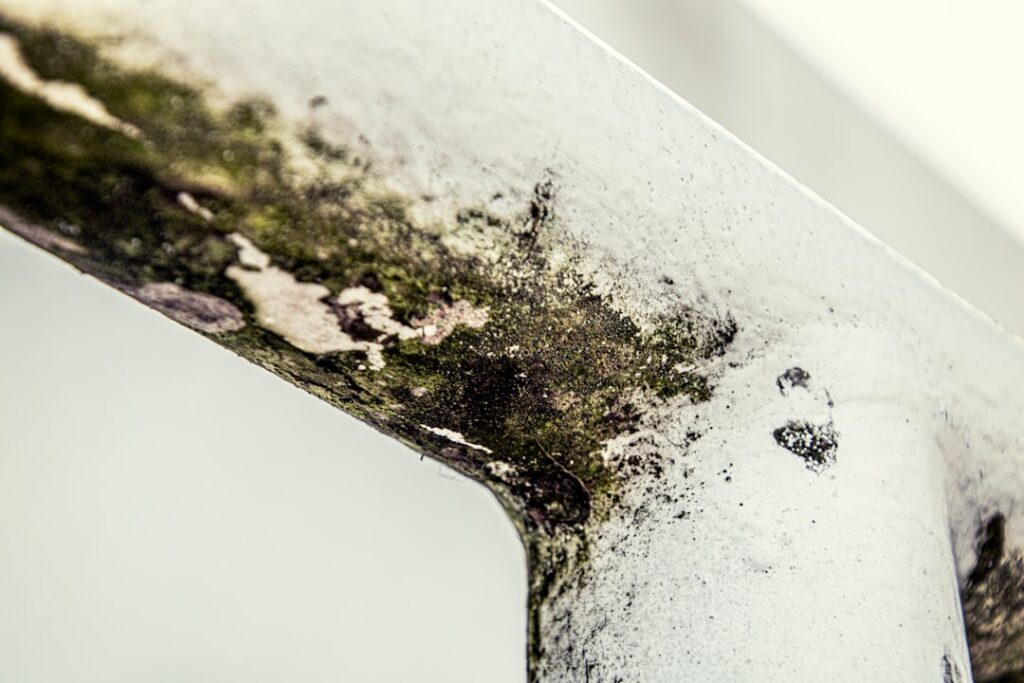
The phrase “black mold” is a popular shorthand, not a species name. When homeowners ask what is black mold, they are usually pointing at dark staining on drywall, grout, or framing and asking whether they have the dangerous one. The honest answer is that color does not identify a fungus, several common indoor genera can appear dark, and the question that matters more than species is whether the colony is active, what is feeding it, and how much material it has affected. This guide summarizes EPA, CDC, and NIEHS guidance on indoor mold and is general information for homeowners. It is not medical advice. If anyone in the household has symptoms they believe relate to mold exposure, a physician handles diagnosis and treatment — this article stays on the building.
Is this mold, asbestos, or water damage? Get a free instant screen
Upload a clear photo of the suspect area. You'll get an instant AI screening opinion and what to do next. This is screening guidance, not a professional determination.
Screening guidance only. AI can be wrong. Confirm asbestos, mold type, or lead with lab testing or a licensed professional before acting.
What Black Mold Actually Refers To
In common usage, “black mold” most often refers to Stachybotrys chartarum, a dark-pigmented mold that grows on chronically wet, cellulose-rich materials such as paper-faced drywall, wood, and ceiling tile. Stachybotrys has been the focus of public attention because it can produce mycotoxins under certain growth conditions and because its dark color is visually striking. The CDC notes that while Stachybotrys chartarum can grow indoors when materials are wet for a sustained period, it is far from the only mold that appears dark, and the popular association between color and danger is not a reliable identification method. Cladosporium, Aspergillus niger, Alternaria, and others can all present in dark shades on indoor materials.
For practical homeowner purposes, the operational meaning of black mold is: dark, visibly growing fungal colonies on indoor surfaces, large enough to see, in locations that have been wet. That definition is enough to drive the right response — investigate the moisture source, document the affected area, and decide between self-remediation and professional cleanup — without needing to know the exact genus.
Why Color Is Not Identification
Mold color comes from pigments in the spores, the hyphae, and any substrate the colony has absorbed. Color can shift with moisture content, age of the colony, and lighting. Two colonies of the same species can look different in different rooms. Two colonies of different species can look identical. Reliable species identification requires microscopy on a sample, performed by a microbiology lab. The black mold with white fuzz identification guide on this site walks through how a single colony can present multiple colors at different stages.
For most homeowner decisions, species identification is not the bottleneck. EPA’s remediation guidance recommends treating all visible indoor mold growth as a problem to be removed, regardless of species, because all of them require moisture and all of them produce spores that can affect indoor air quality. The remediation steps are the same whether the colony turns out to be Stachybotrys, Aspergillus, or Cladosporium.
What Black Mold Needs to Grow
All indoor molds, including the ones that present as black, need four conditions: a moisture source, a food source, a hospitable temperature, and time. In residential settings, food and temperature are essentially always available. Most building materials contain cellulose or some organic matrix that supports growth, and indoor temperatures are within the broad range that supports fungal metabolism. That leaves moisture as the controllable variable. EPA’s Brief Guide to Mold, Moisture, and Your Home identifies moisture control as the single most important factor in preventing indoor mold problems. Time matters because colonies progress through stages — germination, hyphal extension, sporulation — and a wet substrate that is dried within 24 to 48 hours generally does not develop a visible colony.
The guide to what makes black mold grow ranks substrate-moisture combinations by risk and explains why paper-faced drywall behind a slow plumbing leak is one of the most reliable colonies a homeowner will ever find.
Where It Most Often Appears in Homes
Black mold turns up in predictable locations because moisture sources are predictable. Bathrooms — around showers, behind toilets, on bath-fan housings. Kitchens — under sinks, behind dishwashers, around refrigerator water lines. Laundry rooms — supply hose connections, drain standpipes, dryer-vent termination. Basements — perimeter walls, sump-pump basins, the bottom of finished-wall framing. Attics — bath-fan vents that terminate in the attic, roof-leak paths, condensation on the underside of sheathing. Window perimeters — sill-corner condensation in single-pane assemblies. Crawlspaces — vapor-barrier failures, plumbing penetrations, rim joists. Each location has a characteristic moisture signature, and reading the signature is how an inspector attributes the colony to a source.
What It Looks Like
Black mold colonies typically present as dark patches with irregular edges, sometimes with a velvety or fuzzy texture, sometimes with a slimy or wet appearance depending on moisture state. On paper-faced drywall, growth often starts on the back side of the gypsum and progresses through the paper to the room-facing surface; by the time the room side shows staining, the back side is usually heavily colonized. On grout and caulk, colonies appear as dark lines along the joint. On framing lumber, they appear as patches following the grain. On HVAC components, they appear on cooling-coil drain pans, in flexible duct corrugations, and around filter housings with chronic condensation. Our progression timeline for early-stage black mold shows what each phase looks like.
Health Framing
This is the boundary line. CDC and NIEHS state that some occupants of damp or moldy buildings experience respiratory symptoms, mucous-membrane irritation, and worsening of asthma. They also state that establishing a causal link between a specific person’s symptoms and a specific indoor exposure requires medical evaluation. Healthy adults generally tolerate brief, low-level mold exposures without lasting effects. Infants, elderly people, immunocompromised individuals, and people with chronic respiratory conditions may be more susceptible. None of this is a substitute for a physician’s evaluation. The reason this article is framed around the building rather than the body is that the building is where homeowners have agency. For symptoms, see a physician.
Why “Toxic Black Mold” Is a Loaded Phrase
The phrase “toxic black mold” entered popular usage decades ago and has stayed there. It conflates two different ideas. The first is that certain molds, including Stachybotrys chartarum, can produce mycotoxins under specific growth conditions. The second is that any dark mold a homeowner finds is therefore toxic and dangerous. The first idea has scientific basis. The second does not follow from it. Mycotoxin production is conditional, exposure pathways indoors are complex, and dose, duration, and individual susceptibility all matter. EPA’s position is that indoor mold growth is a problem to be removed regardless of species, which is a much more useful operating principle than trying to grade the danger of a specific colony.
How Black Mold Is Confirmed
If species identification is genuinely needed — for example, in an insurance dispute or a legal matter — a microbiology lab can analyze a bulk sample (a swab or tape lift collected from the visible colony) or an air sample (cassette traps collected during an inspection). Results return as a list of genera detected with quantitative concentrations and, in some cases, species-level identification. For most homeowner remediation projects, this step is optional. The decision to remove affected drywall, dry the cavity, and fix the moisture source does not change with the lab result.
The Right Response
EPA’s framework is the same regardless of which dark mold is on the wall. Find and correct the moisture source. Contain the work area. Remove porous materials with embedded growth. Clean semi-porous and non-porous materials with appropriate methods. Dry the cavity. Verify with post-work assessment. For areas smaller than about 10 square feet with the moisture source corrected and proper personal protective equipment used, a homeowner can usually handle the project. Larger areas, HVAC contamination, category-three water sources, and immunocompromised occupants are reasons to bring in a remediation contractor.
When to Get a Professional Inspection
If the visible colony is larger than a few square feet, if the moisture source is hidden, if multiple rooms show signs, or if remediation has already been attempted and growth returned, an inspector adds value. The inspection produces a written, source-attributed scope that a remediation contractor cannot quietly inflate. The house black mold overview on this site lays out the inspector-to-contractor handoff in detail.
References
- About Mold — Centers for Disease Control and Prevention
- A Brief Guide to Mold, Moisture, and Your Home — U.S. Environmental Protection Agency
- Mold Health Information — National Institute of Environmental Health Sciences
- Mold Course Chapter 2: Why and Where Mold Grows — U.S. Environmental Protection Agency
Front Range homeowners trying to confirm what is on a wall and what to do about it can connect with a vetted inspector through our contact page for a written assessment.