Mold Testing in Johnstown, Colorado | InspectandTest
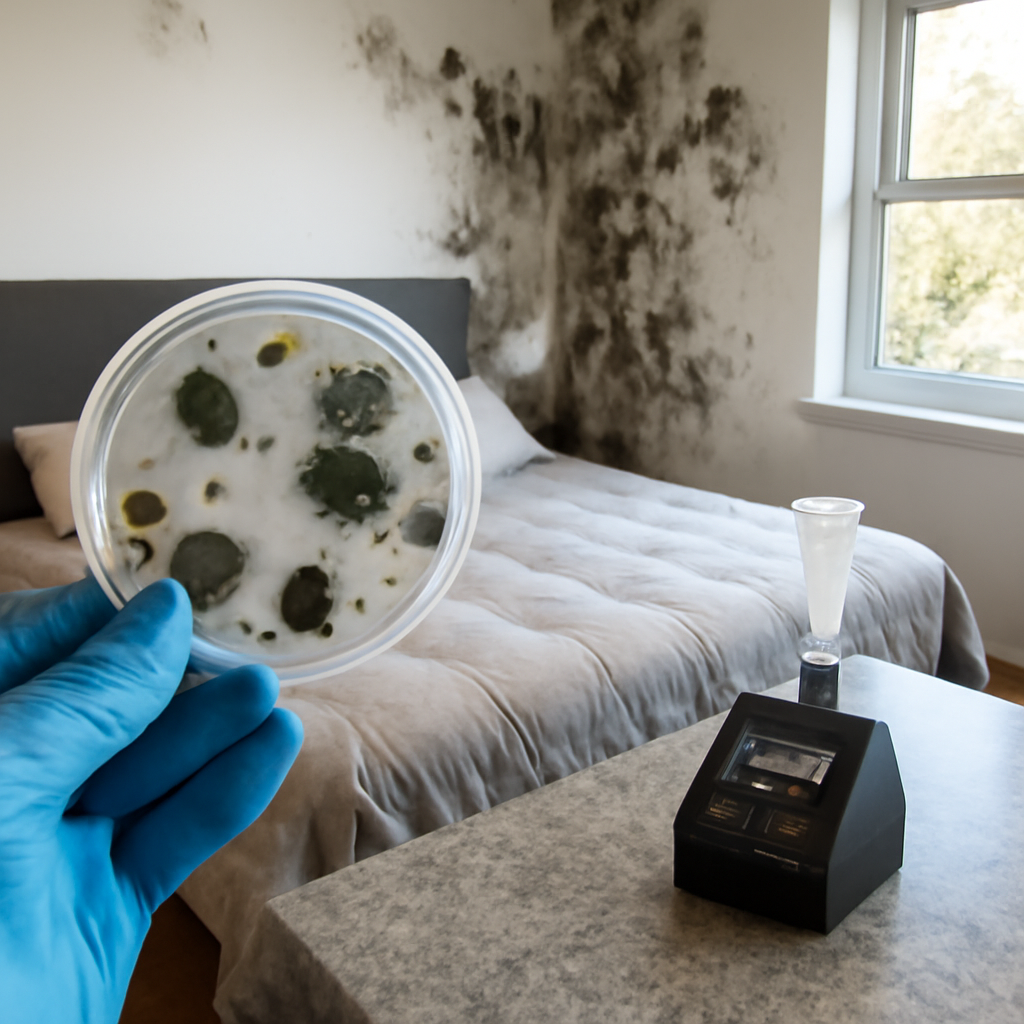
Johnstown is a fast-growing northern Colorado town at the I-25 and US-34 Centerra interchange, straddling Weld and Larimer counties, where new finished-basement subdivisions like Thompson River Ranch and Pintail Commons share the map with a historic Old Town core. Whether the source is a tight new home’s slow-drying basement or an older home’s crawlspace, mold testing johnstown homeowners arrange measures the spore types and concentrations in the air or on a surface, turning a suspicion into a number you can act on. This page explains the testing methods, what the lab results mean, and what local sampling costs. The guidance reflects EPA and CDC mold recommendations current as of 2026; a qualified professional should interpret results for your specific home.
Is this mold, asbestos, or water damage? Get a free instant screen
Upload a clear photo of the suspect area. You'll get an instant AI screening opinion and what to do next. This is screening guidance, not a professional determination.
Screening guidance only. AI can be wrong. Confirm asbestos, mold type, or lead with lab testing or a licensed professional before acting.
Mold testing in Johnstown: what to know
Mold testing is the laboratory side of a mold investigation. Where an inspection finds moisture and visible growth, testing samples the air or a surface and sends it to a lab that identifies the spore genera present and estimates their concentration. The most common method is an air sample, in which a calibrated pump draws a measured volume of air across a spore-trap cassette; the lab compares indoor counts against an outdoor control taken the same day. A surface sample, by swab or tape lift, confirms whether a stain is actually mold and which type.
Testing matters in Johnstown because both the new and old housing stock can change indoor air. A tight subdivision home exchanges little air with the outdoors, so a quietly damp finished-basement wall can build spore counts above the outdoor baseline. An evaporative cooler can raise humidity enough to favor growth in summer. The outdoor control sample is essential here because Colorado’s plains air carries its own seasonal spores; without that comparison, an indoor count is just a number with no context. For the underlying science, our plain-language mold hub covers the fundamentals.
It is worth being clear about what testing does and does not do. Testing quantifies spores; it does not locate the moisture feeding them. That is why testing usually follows or accompanies an inspection. A homeowner who smells a musty finished basement is best served by a mold inspection in Johnstown first to find the source, with targeted sampling added to confirm what is airborne and to document conditions before and after any cleanup.
Why Johnstown homes need mold testing
The first driver is the new-build finished basement. Johnstown’s rapid growth produced tight subdivision homes in Thompson River Ranch, Pintail Commons, and Rocksbury whose finished lower levels isolate indoor air from the outdoors. When a basement wall wicks spring snowmelt or Big Thompson corridor moisture, spores accumulate in the very rooms families use as offices and bedrooms, and air sampling is what reveals whether that has happened beyond a visible patch.
The second driver is the evaporative cooler and the plains-summer humidity it can create. A swamp cooler adds moisture to the air by design, and in a poorly ventilated Johnstown home that can push humidity into the range mold favors. Air sampling taken during cooling season, under normal operating conditions, captures whether the cooler’s humidity is translating into elevated indoor spore counts, which is a specifically local question testing can answer.
The third driver is the same set of situations that justify sampling anywhere: a visible problem of unclear extent, a musty odor with no visible source, and post-remediation clearance. In Old Town’s older homes, a damp crawlspace or a past roof leak can leave a musty signature that air sampling confirms or clears. After any cleanup, a follow-up air sample documents that indoor counts returned to outdoor-comparable levels, which matters in a Johnstown transaction where a buyer wants proof rather than assurance. In each case the value is converting uncertainty into a defensible measurement.
What a Johnstown mold test covers
A professional sampling visit is structured so results are comparable and defensible. The technician documents conditions, takes an outdoor control, then collects indoor samples in the rooms of concern and often a clean reference room. Chain-of-custody paperwork accompanies the cassettes to an accredited environmental lab.
Air sampling with spore traps
A calibrated pump pulls a set air volume across a spore-trap cassette over a few minutes. The lab counts and identifies spores under microscopy, reporting genera such as Cladosporium, Aspergillus, Penicillium, and Stachybotrys with concentrations. The indoor-to-outdoor comparison gives the result meaning: counts that mirror outdoors suggest normal infiltration, while indoor counts dominated by a genus absent outdoors point to an indoor source. In a closed Johnstown home, especially one running a swamp cooler, that contrast is usually clear.
Surface and clearance sampling
Swab and tape-lift samples confirm whether a discoloration is mold and which type, useful for an ambiguous basement or crawlspace stain. After remediation, a clearance air sample verifies the cleanup worked, which matters when a buyer wants proof. Pairing testing with a thermal imaging inspection in Johnstown can point sampling toward the cool, damp wall areas most likely to be the source.
Mold testing cost in Johnstown
Individual lab samples in the northern Colorado market generally run about $40 to $100 each once analysis is included, so a typical visit with an outdoor control and two indoor air samples lands around $200 to $400. When testing is bundled with a visual inspection, the combined fee is usually $400 to $700 depending on home size and the number of samples. Post-remediation clearance testing is priced similarly per sample.
Set that against the alternative of guessing. An unconfirmed musty odor can lead a homeowner to either over-remediate, tearing out finished basement walls or crawlspace materials that did not need it, or to ignore a real problem that keeps growing. A few hundred dollars of targeted sampling tells you which situation you are in, which is why testing is most cost-effective when aimed by an inspection rather than scattered blindly across a large Thompson River Ranch home or an Old Town property.
Homeowners often compare professional testing to a hardware-store settling-plate kit. The kits are inexpensive but produce results no lab will stand behind: no calibrated air volume, no outdoor control, and no chain of custody, so they cannot tell you whether an indoor count is elevated relative to the day’s outdoor air. For a real concern or a transaction, the professional spore-trap test with an accredited lab is the result that holds up, and the modest premium over a DIY kit buys data you can actually act on.
Colorado regulations and disclosure
Colorado neither licenses mold professionals nor sets a numeric mold action level, so there is no legal threshold a lab result must clear. Interpretation rests on the indoor-versus-outdoor comparison and professional judgment, which makes lab accreditation and sampling method the things to scrutinize. A result is only as good as the protocol that produced it.
Disclosure still gives testing practical weight. Colorado’s Seller’s Property Disclosure asks sellers to report known mold and water intrusion, so a documented test, especially a post-remediation clearance sample, becomes useful evidence in a Johnstown sale. A seller can show counts returned to normal after a repair; a buyer can confirm a musty basement or crawlspace is or is not a live problem before closing. In both cases the accredited lab report carries more negotiating weight than any verbal assurance.
Mold testing by Johnstown neighborhood and season
Where a Johnstown home sits and when a sample is taken both shape what the lab number means, so a well-designed test adapts to the address and the calendar rather than applying one template everywhere. In the new subdivisions of Thompson River Ranch and Pintail Commons, the tight finished basements isolate indoor air sharply, which actually helps interpretation: when a wall has wicked spring snowmelt or Big Thompson corridor moisture, the indoor-to-outdoor contrast stands out clearly, and a single outdoor control paired with two indoor samples across the lower level usually captures whether spores have spread beyond a visible patch. Placement near walkout walls, window wells, and sump pits is where the sampling earns its keep in these builds.
In Rocksbury and the other newer pockets, the evaporative cooler turns timing into a deliberate choice. A swamp cooler raises indoor humidity by design, so a sample taken during cooling season, with the cooler running under normal operation, answers the specifically local question of whether that added moisture is translating into elevated indoor spore counts. A winter sample in the same home, with the cooler off and the furnace running, tells a different story, which is why a tester who understands the local cooling style picks the season that matches the concern rather than sampling at random.
Old Town Johnstown’s older homes shift the sampling toward different spaces. A damp crawlspace or a past roof leak in an early-1900s home can leave a musty signature that surface swabs and a crawlspace-area air sample confirm or clear, and an outdoor control remains essential because the surrounding plains air carries its own seasonal spores. Across all of these, the most informative window is after a wet stretch, snowmelt, a run of summer storms, or a humid cooling spell, with the home closed under normal operation, since that captures the realistic worst case a dry-day reading would understate. For a transaction in any Johnstown neighborhood, a post-remediation clearance sample taken the same way documents that counts returned to outdoor-comparable levels, giving a buyer proof rather than assurance.
Neighborhoods and areas served
Mold testing is relevant across Johnstown’s neighborhoods, from the new subdivisions of Thompson River Ranch, Pintail Commons, Rocksbury, and Mountain View to the historic Old Town core. Sampling priorities concentrate in finished-basement living space and near evaporative-cooler-served rooms in the new builds, and around crawlspaces and older roof areas in Old Town.
Coverage commonly extends into adjacent Loveland, Milliken, Windsor, and Berthoud, which share Johnstown’s mix of new-build growth and older cores. Owners weighing nearby options can review our broader pages on mold testing across Weld County for the regional picture, and mold testing in Loveland for a comparable adjacent city.
How to choose a Johnstown mold testing provider
Confirm the provider uses calibrated air-sampling equipment, always takes a same-day outdoor control, and submits samples to an accredited environmental lab with chain-of-custody documentation. A result without an outdoor comparison or from an unaccredited lab is hard to defend, so those two points separate dependable testing from theater. Ask to see a sample report so you know the lab identifies genera and concentrations rather than just reporting present or absent.
Independence matters as much in testing as in inspection. A provider who tests and also sells remediation has a reason to read borderline numbers as alarming, so favor a tester who keeps those roles separate or is transparent about the distinction. The best providers explain when sampling is worthwhile and when it is not, decline to over-sample a home, and frame results in the indoor-versus-outdoor context rather than quoting a scary raw count. That judgment is what makes a Johnstown testing result trustworthy enough to act on.
References
- Mold and indoor air quality guidance — U.S. Environmental Protection Agency
- Mold and your health — Centers for Disease Control and Prevention
- Mold and health effects — U.S. Environmental Protection Agency
Johnstown’s tight new homes and older crawlspaces trap whatever moisture releases, so confirming what is in the air with accredited testing beats guessing. To connect with a vetted local mold testing provider, get in touch through our contact page.