Black Mold Removal Company: What Homeowners Need to Know
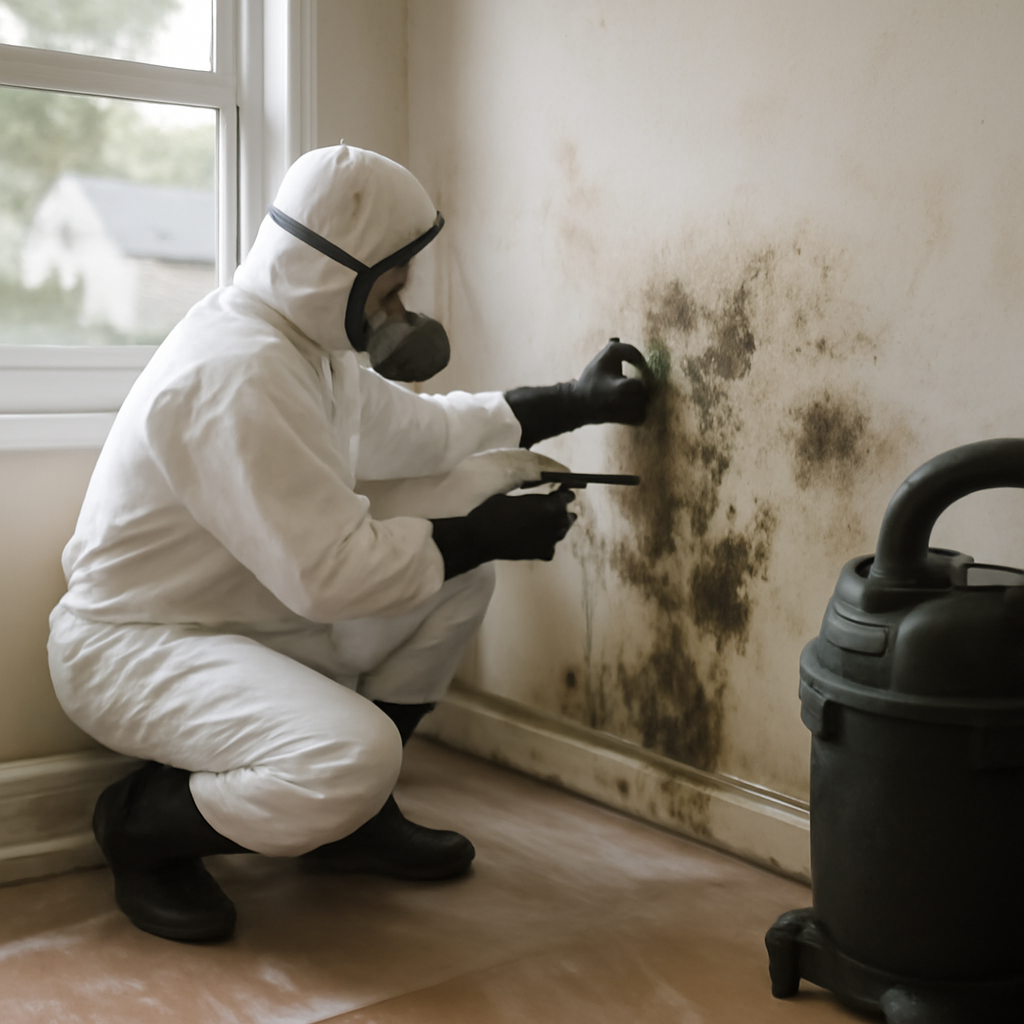
A black mold removal company is a remediation firm with specific experience handling Stachybotrys chartarum and similar dark-pigmented molds that grow on chronically wet cellulose materials. The term “black mold” is colloquial — many molds appear dark, and only laboratory identification confirms Stachybotrys — but the remediation methodology is real and follows tighter containment, PPE, and verification protocols than ordinary mold work. This guide summarizes EPA and CDC guidance current as of 2026 plus IICRC S520 industry references. For health symptoms, consult your physician; for species confirmation or scope decisions, consult a certified mold professional.
Is this mold, asbestos, or water damage? Get a free instant screen
Upload a clear photo of the suspect area. You'll get an instant AI screening opinion and what to do next. This is screening guidance, not a professional determination.
Screening guidance only. AI can be wrong. Confirm asbestos, mold type, or lead with lab testing or a licensed professional before acting.
What a black mold removal company specifically does
A black mold removal company should do everything a standard remediation company does, plus four additional protections specific to Stachybotrys-suspected work. The first is enhanced containment using double-layered 6-mil polyethylene barriers and decontamination chambers for any work area larger than 30 square feet. The second is full-body PPE — Tyvek or comparable disposable coveralls, P100 or full-face respirators rather than N95, gloves taped to suit sleeves. The third is HEPA-filtered negative-air machines sized for at least four air changes per hour in the containment zone. The fourth is post-clearance TEM (transmission electron microscopy) testing in addition to or instead of standard spore-trap analysis when occupant health is a concern.
The reason for the tighter protocol is that Stachybotrys produces mycotoxins (specifically trichothecenes) under certain growth conditions, and the spores are heavier and less likely to remain airborne — meaning they settle on surfaces during demolition unless containment is robust. EPA and CDC guidance both note that toxin exposure assessment is not standardized for residential settings, but the precautionary approach is the industry norm.
Stachybotrys identification: what it actually looks like
Stachybotrys chartarum colonies appear as dark olive-green to nearly black slimy patches on chronically wet drywall paper, ceiling tile, wallpaper backing, or wood. The colony has a wet or shiny texture when actively growing; older or dried colonies turn powdery. Visual identification alone is not definitive — Cladosporium, Aspergillus, Alternaria, and even some Penicillium species can appear similarly dark. A laboratory analysis of a tape-lift sample is the only way to confirm species.
A reputable black mold removal company will not commit to “Stachybotrys remediation” pricing without lab confirmation — but they will follow the precautionary protocol whenever visible growth is dark and located on a chronically wet cellulose substrate, regardless of species ID. The protocol is conservative because the cost of under-protecting occupants exceeds the cost of slightly over-protecting them.
Containment and air management in detail
The defining feature of black mold removal is the containment zone. Standard IICRC S520 Level III containment requires critical barriers around the work area, a decontamination chamber at the entry, negative air pressure maintained through HEPA-filtered air scrubbers, and exhaust routed outside the building when feasible. Pressure should be measurable with a manometer at the chamber boundary and recorded on the daily project log.
HEPA air scrubbers should be sized for at least four air changes per hour, which for a typical basement remediation means two 500-CFM units running continuously during demolition. Filters should be changed when pressure drop exceeds manufacturer specifications, typically every 80 to 120 hours of runtime. A firm that runs a single under-sized scrubber on a large Stachybotrys job is cutting a core protective measure.
PPE and worker protection
OSHA does not have a mold-specific standard, but the agency’s respiratory protection standard (29 CFR 1910.134) applies to remediation workers handling visible microbial growth. For Stachybotrys-suspected work, full-face P100 respirators or PAPRs (powered air-purifying respirators) are typical. Disposable Tyvek coveralls, nitrile gloves taped to suit sleeves, and disposable booties complete the ensemble. Workers should exit through the decontamination chamber, removing outer PPE before entering clean zones.
This level of PPE is not theater — it reduces worker exposure during demolition and reduces tracking of contaminated debris into clean parts of the building. Homeowners should never enter the containment zone during active work, regardless of how brief the visit feels. Photos and video updates from the project manager are the appropriate way to monitor progress.
Encapsulation and structural framing
After demolition of porous materials, framing that has been HEPA-vacuumed and damp-wiped is sometimes treated with an encapsulant — a thick paint-like coating that locks down residual surface staining and provides a sealed substrate for new drywall. Encapsulants are not a substitute for removal; they are a finishing step after removal. A firm that proposes encapsulation INSTEAD of removal is selling a cover-up, not a remediation.
Legitimate uses of encapsulation include sealing cleaned attic rafters where surface staining remains visible, sealing cleaned concrete foundation walls, and sealing structural framing in crawlspaces where complete removal of stained wood is impractical. The encapsulant manufacturer should be EPA-registered, and the product data sheet should be part of the project file.
Post-clearance TEM testing
Standard post-remediation verification uses spore-trap cassettes analyzed by direct microscopic exam, which counts and identifies spore genera. For Stachybotrys-specific clearance, some hygienists recommend supplemental analysis using transmission electron microscopy (TEM), which can detect smaller hyphal fragments and may resolve mycotoxin presence on settled dust samples sent to specialized labs. TEM analysis is more expensive ($400 to $1,200 per sample) and slower (5 to 10 business days), so it is typically reserved for jobs where occupant health concerns justify the additional cost.
The decision to use TEM should be driven by the hygienist, not the remediation company. The hygienist should remain independent of the remediator throughout the project. Our how to define the best remediation company near you walks through the independent-verification model in more detail.
Pricing for Stachybotrys-protocol remediation
Black mold removal costs more than ordinary remediation because of the additional containment, PPE, and verification steps. A small bathroom or closet job under 30 square feet typically runs $2,500 to $5,000 under Stachybotrys protocol, versus $1,500 to $3,500 under standard protocol. A mid-size basement remediation between 100 and 300 square feet typically runs $6,000 to $15,000. Large multi-zone or whole-home jobs can exceed $25,000.
The cost differential is largely PPE consumables (disposable suits per technician per day), HEPA filter replacements, and the additional clearance testing. Reconstruction costs are similar across protocols. For broader context on company-level comparisons, see our national evaluation framework.
Insurance coverage for black mold
Standard homeowners’ policies treat black mold the same as other mold — covered only when triggered by a sudden, accidental water event, capped under a $5,000 to $10,000 sub-limit, and excluded for long-term seepage and condensation. The species designation does not unlock additional coverage. Some insurers may push for fungal-species-specific exclusions during underwriting, but that is a policy-level conversation rather than a claim-level one.
Filing a successful claim for black mold remediation requires the same documentation as any mold claim: a source-event paper trail, a line-item remediation scope, and an independent clearance report. The species ID adds nothing to the claim itself but may matter for any future personal-injury or disclosure issue.
When to seek out a black mold specialist
For visible dark mold on a chronically wet substrate (drywall paper, ceiling tile, plywood subfloor) that has been wet for more than 48 to 72 hours, the precautionary call is to engage a firm with explicit Stachybotrys experience. Ask for references from prior Stachybotrys-protocol jobs and verify the firm’s IICRC S520 firm registration. Smaller jobs where the moisture event is recent and the substrate is non-porous usually do not require Stachybotrys protocol.
For broader context on identifying when mold growth has reached a stage requiring specialty intervention, our mold inspection and testing hub walks through the moisture-mapping and visual-identification decision tree.
How long Stachybotrys-protocol projects actually take
The protocol upgrade adds time as well as cost. A small bathroom job that would close in two days under standard protocol typically runs three to four days under Stachybotrys protocol — additional setup time for double containment and decontamination chamber, additional demolition time for controlled cutting in small sections, and additional drying time before clearance. Mid-size basement projects that would close in five to seven business days under standard protocol typically run seven to ten business days under Stachybotrys protocol.
The extended timeline is largely a function of controlled demolition pace and HEPA vacuum cycle time. Stachybotrys protocol cuts demolition in two- to three-foot sections with continuous HEPA vacuuming between sections, which is slower than standard demolition pace. Additional drying time is often built in because the antimicrobial application is more thorough and the framing needs longer to reach baseline moisture content under tighter containment.
Reconstruction sequencing after Stachybotrys work
Reconstruction after Stachybotrys protocol remediation should not start until the independent clearance report has been received and reviewed. The temptation to begin drywall installation immediately after the remediation crew leaves should be resisted, because if clearance fails, the new drywall will need to come back down. Most reputable remediation firms make this sequencing explicit in their scope and refuse to coordinate reconstruction until clearance has passed.
The reconstruction scope itself should match the demolition footprint. If the remediator removed bottom-wall drywall to a height of 36 inches across 80 linear feet, the rebuild should restore exactly that section. New insulation should match the original R-value. Vapor barriers, when present in the original assembly, should be replaced. Surface finishes should match adjoining surfaces. Mismatched reconstruction scopes are a common source of post-job disputes and resale paper-trail complications.
Worker fit-testing and respirator program documentation
For Stachybotrys-protocol projects, the firm should maintain documented respirator fit-test records for each technician on site. OSHA’s respiratory protection standard requires annual fit-testing for any worker wearing a respirator, and the records should be available on request. Homeowners signing larger contracts may ask to see the fit-test log for the technicians assigned to their project as a final verification that the firm operates under a formal respiratory protection program rather than handing out respirators casually.
The fit-test program also indicates whether the firm runs a serious worker-safety program. Firms that have invested in fit-testing infrastructure typically have invested in other compliance elements (training records, accident-reporting procedures, medical-evaluation tracking) as well. Firms that cannot produce fit-test records often cannot produce the other compliance documentation either, and the gap usually correlates with weaker on-site execution.
Documenting the building’s pre-job baseline
Before active demolition begins, the homeowner should have a documented record of the building’s pre-job condition. Photos of the affected area from multiple angles, the moisture map produced during assessment, and (for high-stakes projects) pre-job air samples analyzed at an AIHA-accredited lab. This baseline matters if anyone later disputes whether the remediation work made the building cleaner or simply moved the contamination around.
For Stachybotrys-protocol jobs in particular, the pre-job documentation often shapes any future medical or insurance conversation. A physician evaluating possible exposure-related symptoms benefits from knowing what the building looked like before remediation. An insurance underwriter asking about prior mold claims during a renewal can be answered with the pre-and-post documentation set. The cost of pre-job documentation is small ($400 to $800 for residential air samples plus photo records); the value it provides over the following five to ten years often exceeds that investment.
References
- CDC Stachybotrys chartarum and Other Molds — Centers for Disease Control and Prevention
- EPA Mold Remediation in Schools and Commercial Buildings — U.S. Environmental Protection Agency
- NIEHS Mold Exposure Health Overview — National Institute of Environmental Health Sciences
- OSHA Mold Worker Protection Resources — Occupational Safety and Health Administration
Front Range homeowners facing a suspected black mold remediation can get in touch through our contact page for help vetting Stachybotrys-experienced firms.
Mold removal & cleanup picks
For a small, contained patch (under ~10 sq ft) these EPA-friendly removers handle surface mold. Larger or recurring growth warrants a professional assessment first.
| Product | Why | Buy |
|---|---|---|
 RMR-86 Instant Mold Stain Remover RMR-86 Instant Mold Stain Remover | Fast-acting on stains; ventilate and wear PPE. | Amazon — $25.99 |
 Concrobium Mold Control Concrobium Mold Control | No-bleach formula that also helps prevent regrowth. | Amazon — $13.48 |
 Mold Armor Mold & Mildew Remover Mold Armor Mold & Mildew Remover | Widely stocked bathroom/surface remover. | Amazon — $22.98 |