Professional Mold Removal Services: Pro vs DIY Logic
Professional mold removal services exist on a spectrum from independent IICRC-certified remediators to nationwide restoration franchises. Homeowners weighing whether to hire one or handle the cleanup themselves face a decision that depends on contamination size, material type, hidden growth, and moisture source. The wrong call in either direction wastes money or worsens exposure. This guide summarizes EPA, CDC, and IICRC S520 guidance current as of 2026 to help with the pro-versus-DIY decision and is not a substitute for site-specific assessment or medical advice.
Is this mold, asbestos, or water damage? Get a free instant screen
Upload a clear photo of the suspect area. You'll get an instant AI screening opinion and what to do next. This is screening guidance, not a professional determination.
Screening guidance only. AI can be wrong. Confirm asbestos, mold type, or lead with lab testing or a licensed professional before acting.
Professional mold removal services: when they are required
The EPA’s mold remediation guidance, primarily written for schools and commercial buildings but widely referenced for residential work, identifies professional scope when contamination exceeds roughly 10 contiguous square feet, when growth is hidden behind drywall or in HVAC, when the moisture source is unknown or ongoing, or when occupants report symptoms that improve away from home. Below those thresholds, DIY cleanup is often appropriate.
The 10-square-foot rule
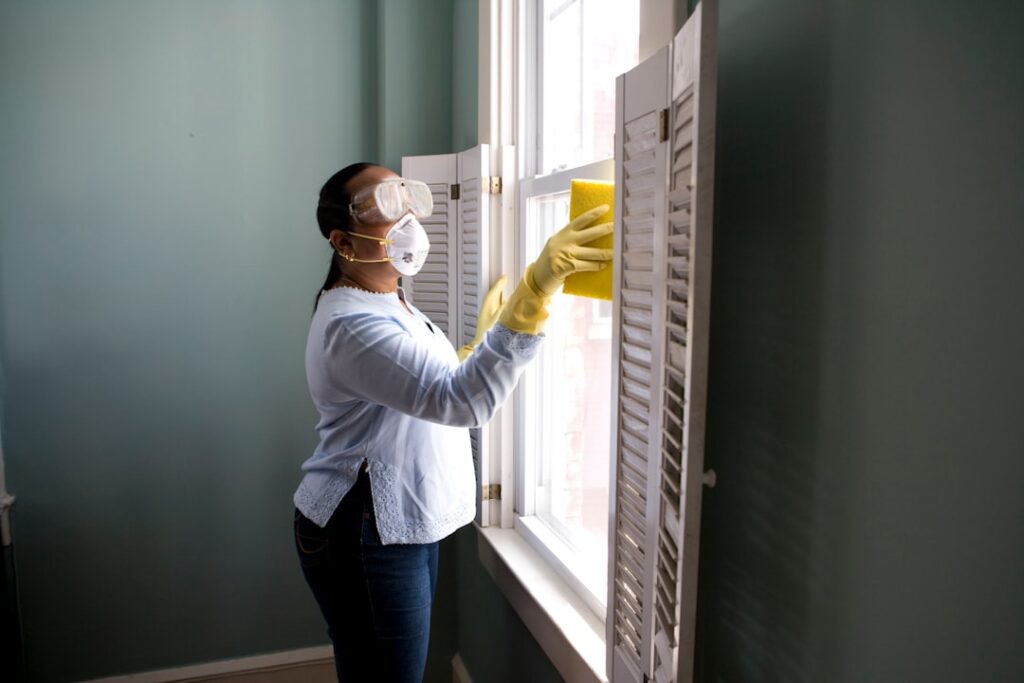
Ten square feet is roughly a 3-by-3 patch. It is a guideline, not a hard regulation, and most agencies use it as a soft threshold for triggering professional involvement. The reasoning is practical: larger areas require containment to prevent cross-contamination of clean spaces, and DIY containment is rarely effective without HEPA-filtered negative air. Below 10 square feet on non-porous surfaces with a known moisture source, homeowner cleanup using N95, gloves, eye protection, detergent, and water is reasonable.
Porous versus non-porous materials
Non-porous surfaces (tile, glass, sealed metal, finished hardwood) can usually be cleaned. Porous surfaces (drywall, carpet, ceiling tile, raw wood, insulation) typically need to be removed when contaminated. The CDC notes that mold hyphae penetrate porous materials and cannot be reliably removed by surface cleaning alone. Distinguishing material type is the second decision after square footage.
Hidden growth: a professional trigger
Visible growth on a wall surface is often the late-stage indicator of larger hidden contamination behind the drywall. Musty odor without visible cause, recurring staining at the same location, or moisture mapping showing elevated readings in wall cavities all suggest hidden growth. Hidden contamination is professional scope regardless of visible square footage because exposing it correctly requires containment.
Moisture source: identifying before cleanup
Cleanup without correcting the moisture source guarantees regrowth, usually within weeks. The S520 standard requires identifying and stopping the moisture source as the first step. Common Front Range sources include ice-dam leaks, swamp-cooler condensate, basement humidity, crawl-space vapor drive, bathroom exhaust venting into attics, and plumbing leaks behind cabinets. If the source is not visible from the affected area, professional moisture mapping is usually needed.
What “professional removal” includes
Professional service typically includes a written scope, containment with 6-mil polyethylene, HEPA-filtered negative air pressure, removal of non-salvageable porous materials, HEPA vacuuming, antimicrobial application where appropriate, and post-remediation verification. It does not include drywall replacement, paint, or finish work; those are restoration scope. The remediation services guide covers phase-by-phase scope.
IICRC credentials to verify
The IICRC AMRT (Applied Microbial Remediation Technician) credential is the field-level training that proves a worker has been instructed in S520. Firm-level certification is separate. Ask for the technician’s certification number and verify on the IICRC public registry. Credentials expire; current status matters. Colorado does not license mold contractors at the state level, so IICRC verification is the primary screen.
DIY cleanup protocol
For contamination under 10 square feet on non-porous surfaces: identify and correct the moisture source first; gather PPE (N95 respirator, gloves, eye protection, disposable outer clothing); seal HVAC vents in the affected room; clean visible growth with detergent and water using disposable rags; HEPA vacuum the area if a HEPA vacuum is available; allow surfaces to dry fully; double-bag and dispose of waste. Bleach is not required and is not recommended on porous surfaces.
Why bleach is not the right answer
Bleach is a common home cleaning supply, and homeowners often reach for it first. EPA guidance specifically discourages bleach as a substitute for source removal because bleach water can drive moisture into porous materials, the chlorine evaporates faster than the water, and the hyphae embedded in porous materials remain intact. Detergent and water with mechanical scrubbing addresses surface growth more effectively for the homeowner DIY scope.
What DIY cannot replicate
Homeowners cannot reliably replicate HEPA-filtered negative air pressure, which prevents spore migration to clean areas of the home. DIY also cannot replicate post-remediation verification testing performed by an independent third party. For small surface contamination with a known moisture source, neither is strictly required. For larger or hidden contamination, both are essential and push the job into professional scope.
The conflict-of-interest trap
Some firms offer both testing and remediation. The EPA flags this as a financial conflict of interest because the incentive aligns toward larger scope. Best practice is hiring an independent indoor air quality consultant or industrial hygienist for testing and a separate firm for the removal work. The clearance test at the end of remediation should also come from an independent party, not the contractor performing the work.
Pricing tiers for professional removal
Industry estimates run $500 to $1,500 for limited surface remediation, $2,000 to $6,000 for basement contamination of 100 to 300 square feet, $3,000 to $7,500 for HVAC-involved jobs, and $10,000 and above for whole-house or crawl-space contamination. Spread varies by region and moisture source. Compare written scopes line-by-line rather than lump sums. The cost framing guide details bid comparison.
When DIY is the wrong choice
DIY is the wrong choice when contamination exceeds 10 square feet, when porous materials are involved, when growth is hidden, when the moisture source is unknown, when HVAC contamination is suspected, or when occupants have asthma or other respiratory conditions. In any of these situations, hiring a professional saves money over the long run because regrowth and re-cleanup are expensive.
Insurance considerations
Homeowners’ insurance may cover sudden water-damage-driven mold growth, often with a separate mold endorsement and lower limit. Long-term humidity-driven contamination is commonly excluded. DIY cleanup before documenting with photos can hurt a future insurance claim. Document with dated photos before disturbing anything; consult the insurance agent before signing any contractor assignment of benefits.
Front Range Colorado factors
Colorado’s dry climate slows growth but does not prevent it. Common Front Range scenarios that push DIY into professional scope include finished basements with hidden moisture, swamp-cooler condensate behind drywall, ice-dam leaks driving attic and ceiling contamination, and crawl-space vapor drive in older Denver, Boulder, and Jefferson County homes. Building era and original construction quality often dictate which moisture failures are present.
Symptoms and medical guidance
Occupants reporting symptoms that improve away from the home should consult a physician before assuming mold is the cause. The CDC notes that mold exposure may worsen asthma and allergic conditions but does not diagnose specific diseases at typical residential exposure levels. Self-diagnosis from online symptom checklists is not reliable. The medical evaluation guides the remediation urgency more than the visible square footage alone.
How to vet a professional mold removal firm
Verify IICRC AMRT credentials by number, confirm general liability with mold endorsement and workers’ compensation, require a written scope referencing S520, keep testing and remediation in separate firms, get three competitive bids on the same written scope, check three local references from the past 12 months, and require independent third-party clearance testing. The broader mold inspection resource hub covers the full vetting workflow.
Equipment professionals bring that DIY cannot
HEPA-filtered negative air machines rated to 500 CFM or higher, true HEPA vacuums (not HEPA-style retail vacuums), commercial-grade containment plastic in 6-mil weight, zipper doors for controlled containment access, full-face P100 respirators or PAPRs, decontamination chambers for crew transitions, and moisture meters with infrared imaging for source identification. The combined equipment investment exceeds $15,000 for a small professional crew, which makes DIY purchase impractical for one-time use.
Time commitment under DIY versus professional
Professional crews complete a single-room remediation in 3 to 5 working days. DIY cleanup of the same area, when within EPA scope, often takes a homeowner 1 to 2 weekends due to slower pace and equipment limitations. For homes with vulnerable occupants, the professional timeline shortens exposure to construction conditions. The labor cost-benefit calculation includes time value plus equipment access plus credentialed verification.
Documentation requirements differ
Professional remediation generates a paper trail: written scope, daily logs, moisture readings, clearance test reports, and warranty paperwork. DIY cleanup leaves no comparable record, which can hurt future insurance claims and resale disclosures. For homeowners who anticipate selling within 5 years, the documentation value of professional service often exceeds the cost difference compared to DIY.
Project supervision and quality control
Professional remediation projects typically have a lead technician supervising 1 to 3 additional crew members. Quality control checks during active work catch problems early: containment breaches, missed materials, equipment malfunctions. Single-person crews on substantial projects lack this internal quality check and are a red flag during bid review.
Why fast cheap quotes are often wrong scope
A contractor who quotes within 30 minutes of arriving without taking moisture readings, inspecting wall cavities, or asking about the moisture source is usually selling a fogging or surface-cleaning service rather than actual remediation. Real remediation scoping requires diagnostic work that takes time. Quick quotes on the back of a business card are marketing pieces, not technical scopes.
Health considerations for DIY decisions
Occupants with asthma, allergies, immunocompromised conditions, or respiratory sensitivity should not perform DIY mold cleanup regardless of contamination size. The aerosolized spores during cleanup, even with N95 protection, exceed background levels and can trigger symptoms. Healthy adults can safely DIY small contamination with proper PPE. Vulnerable occupants benefit from professional containment.
Insurance considerations under professional service
Professional remediation generates an invoice trail that supports insurance claims. DIY cleanup leaves no comparable record. For homeowners filing claims, professional service is essentially required because the adjuster cannot validate DIY work. The cost difference between professional and DIY service is often partly recovered through the insurance claim that DIY cleanup forfeits.
Documentation requirements under each path
Professional service produces: written scope, daily logs, moisture readings, photographs before and after each phase, clearance test reports, and warranty paperwork. DIY cleanup typically produces only photographs, which provide weak documentation for insurance and resale purposes. The asymmetry in documentation strength is one of the largest hidden differences between DIY and professional paths.
When to call a professional
Contamination over 10 square feet, hidden growth, porous-material contamination, HVAC involvement, unknown moisture source, post-flood water emergencies, and homes with vulnerable occupants all warrant professional involvement. The line between DIY and professional is rarely sharp; when in doubt, an independent assessment from an industrial hygienist costs less than a botched DIY cleanup.
References
- Mold Cleanup in Your Home — EPA
- CDC Mold Cleanup Guidance — CDC
- InterNACHI Mold Inspection Reference — InterNACHI
- Colorado Mold Guidance — Colorado Department of Public Health and Environment
Front Range homeowners deciding between DIY and professional service who want a connection to a vetted local contractor can get in touch through our contact page.
Mold removal & cleanup picks
For a small, contained patch (under ~10 sq ft) these EPA-friendly removers handle surface mold. Larger or recurring growth warrants a professional assessment first.
| Product | Why | Buy |
|---|---|---|
 RMR-86 Instant Mold Stain Remover RMR-86 Instant Mold Stain Remover | Fast-acting on stains; ventilate and wear PPE. | Amazon — $18.38 |
 Concrobium Mold Control Concrobium Mold Control | No-bleach formula that also helps prevent regrowth. | Amazon — $13.47 |
 Mold Armor Mold & Mildew Remover Mold Armor Mold & Mildew Remover | Widely stocked bathroom/surface remover. | Amazon — $22.98 |