Mold Remediation Boca Raton: A Homeowner Guide
South Florida humidity makes Boca Raton one of the more mold-prone areas in the country, and many homeowners learn this the hard way after a slab leak, a roof intrusion, or a hurricane season that left moisture trapped behind drywall. Mold remediation Boca Raton residents need usually follows the same playbook the rest of the industry uses, but the local climate raises the stakes. This guide summarizes EPA and CDC guidance current as of 2026; it is educational only and does not replace an assessment from a licensed Florida mold assessor or remediator, nor medical advice from your physician for any symptoms.
Is this mold, asbestos, or water damage? Get a free instant screen
Upload a clear photo of the suspect area. You'll get an instant AI screening opinion and what to do next. This is screening guidance, not a professional determination.
Screening guidance only. AI can be wrong. Confirm asbestos, mold type, or lead with lab testing or a licensed professional before acting.
What mold remediation in Boca Raton actually involves
Remediation is the controlled removal of mold growth and the moisture that feeds it. It is not the same as a quick wipe-down with bleach. The U.S. Environmental Protection Agency frames the goal simply: remove the contamination and correct the underlying water problem so the mold does not return. In a humid coastal market like Boca Raton, the water source is often chronic rather than a single dramatic event, which means the moisture fix matters as much as the cleanup itself.
Florida is one of the few states that licenses mold professionals. Under Florida law, jobs above a defined dollar threshold require separate licensed roles: a mold assessor who inspects and writes the protocol, and a mold remediator who performs the work. The two cannot be the same company on the same project for larger jobs, which is a consumer-protection feature unique to the state. Homeowners should confirm both licenses through the Florida Department of Business and Professional Regulation before signing anything.
Why Boca Raton homes grow mold so readily
Relative humidity along the Gold Coast routinely sits in the 70 to 90 percent range. The CDC notes that mold needs only moisture, organic material, and time, and Boca Raton supplies all three nearly year-round. Air conditioning systems that are oversized or poorly maintained chill the air without removing enough moisture, leaving humid pockets behind cabinets and inside closets.
Common triggers include:
- Slab and supply-line leaks under tile floors, which wick moisture into baseboards.
- Roof and window intrusion during summer storms and hurricane events.
- HVAC condensate problems, including clogged drain pans and undersized return ducts.
- Stucco and CBS wall assemblies that trap moisture when the exterior coating cracks.
Because the climate is the root cause, a remediation that ignores humidity control is likely to fail. Many Boca Raton remediators now pair cleanup with dehumidification recommendations and HVAC tune-ups. If the visible growth started in a bathroom, our overview of early signs of mold in bathrooms can help you catch repeat problems before they spread into adjoining rooms.
The remediation process step by step
A reputable Boca Raton remediation generally follows the sequence the EPA and IICRC describe, scaled to the size of the affected area.
1. Assessment and moisture mapping
A licensed assessor inspects the home, uses moisture meters and sometimes thermal imaging to map hidden dampness, and may collect air or surface samples. The assessor then writes a remediation protocol describing the scope, containment, and clearance criteria.
2. Containment
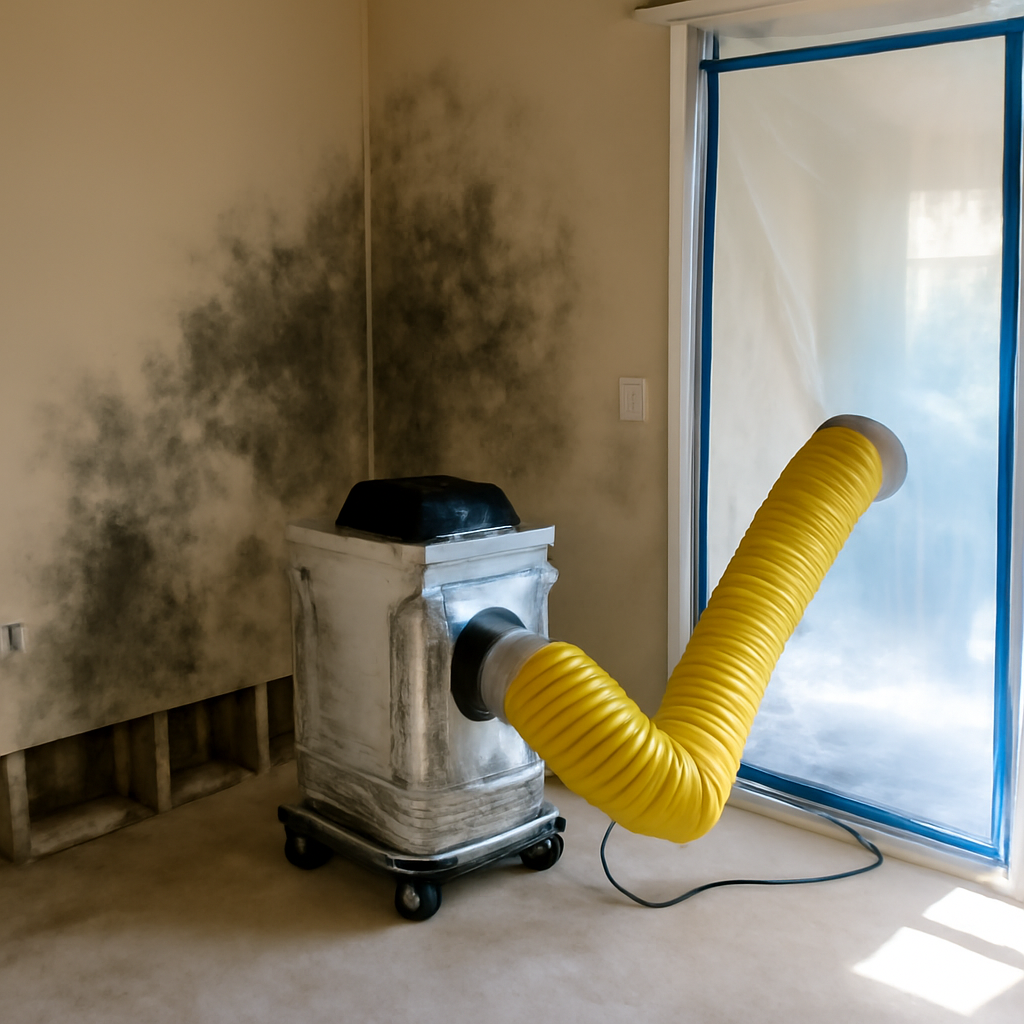
The work area is sealed with polyethylene sheeting, and negative air pressure is established with HEPA-filtered air scrubbers so spores do not migrate into clean rooms. For small areas under about 10 square feet, the EPA says homeowners can often handle cleanup themselves, but larger or recurring growth warrants professional containment.
3. Removal of affected materials
Porous materials that cannot be cleaned, such as saturated drywall, carpet padding, and some insulation, are cut out and bagged. Semi-porous and non-porous surfaces are HEPA-vacuumed and damp-wiped with appropriate cleaners. Structural wood is often cleaned and treated rather than removed.
4. Drying and moisture correction
Commercial dehumidifiers and air movers bring materials back to a normal moisture content. This step is where the underlying leak or humidity problem must be solved, because mold will return to any surface that stays damp.
5. Post-remediation verification
An independent assessor performs a clearance inspection and, often, a final air sample. Passing clearance is what tells you the job is genuinely complete. For a deeper look at how the full cycle plays out, see our companion guide on how mold remediation works.
What mold remediation costs in the Boca Raton area
National figures from industry sources put typical residential remediation between roughly $1,200 and $3,500 for a contained, moderate job, with small isolated areas costing a few hundred dollars and whole-home or HVAC-involved projects running well into five figures. South Florida labor and the frequent need for humidity correction tend to push local quotes toward the higher end of any national range.
Cost drivers include the square footage of growth, whether mold is inside wall cavities or ductwork, the cost of the separate assessment and clearance testing Florida requires, and any build-back of removed drywall and trim. Homeowners should get itemized written estimates and be wary of a single company that offers to both test and remediate a large job, since that arrangement runs against Florida licensing intent.
Insurance treatment varies. Many Florida policies exclude mold or cap mold coverage at a low sublimit unless the growth resulted from a covered sudden event, such as a burst pipe. Read your policy’s mold endorsement carefully and document the water source with photos before remediation begins.
How long remediation takes and what to expect day to day
Timelines depend on the size of the affected area and how much drying the materials need. A small, contained bathroom job may be done in a day, while a moderate single-room project commonly runs two to five days once containment, removal, drying, and clearance are accounted for. Larger jobs involving multiple rooms, HVAC systems, or extensive build-back can stretch to a week or more.
The drying phase is often the part homeowners underestimate. Even after the visible mold and contaminated materials are gone, dehumidifiers and air movers may run for several days to bring wall framing and subfloors back to a normal moisture content. In Boca Raton’s humid air, that drying is harder than in a dry climate, which is one more reason local projects can take longer than national averages suggest. Plan for the work area to be sealed off and possibly unusable during this period, and expect some noise from the drying equipment.
Build-back, the reinstallation of drywall, trim, paint, and flooring, is frequently a separate phase and sometimes a separate trade. Clarify up front whether your remediator handles build-back or hands it off, because that affects both the timeline and the total cost. A clear schedule in the written scope helps avoid the frustration of a home that sits half-finished while waiting on a second contractor.
How to vet a Boca Raton remediation contractor
Before hiring, confirm the company holds the appropriate Florida mold remediator license and carries general liability and pollution coverage. Ask for a written protocol, a clear scope of work, and a commitment to independent post-remediation clearance. A contractor who waves off the moisture-source question or who cannot explain how they will control humidity afterward is a contractor to avoid.
Reasonable questions to ask:
- Are you licensed as a remediator with the state, and can I see the number?
- Who performs the clearance testing, and is that firm independent of you?
- How will you contain the work area and protect the rest of my home?
- What humidity or repair work do you recommend to prevent recurrence?
- Is build-back included, or is that a separate trade?
Mold testing alone does not fix a problem, but it does establish a baseline and verify the work. The mold inspection and testing hub walks through when sampling is worthwhile and how to read the results without overpaying for unnecessary tests.
It is also reasonable to get more than one quote. Because remediation pricing varies widely and the moisture-correction scope can differ from one contractor to the next, comparing two or three itemized estimates protects against both overpaying and underscoping. Make sure each quote covers the same work, since a low headline number that omits build-back or clearance testing is not truly cheaper. A contractor confident in the result will explain the moisture source, the containment plan, and how the job will be verified without resorting to pressure tactics.
Health effects and why species matters less than removal
The CDC and NIEHS describe a consistent picture of indoor mold exposure: nasal and throat irritation, coughing, wheezing, eye irritation, and worsened symptoms in people with asthma or mold allergies. People with weakened immune systems or chronic lung disease can face more serious problems. In a humid market like Boca Raton, where mold can establish itself quietly behind closets and cabinets, these symptoms sometimes appear before the growth is visible.
A common homeowner instinct is to fixate on whether the growth is “toxic black mold.” Federal guidance steers away from that framing. The agencies emphasize that no household mold should be identified by color alone and that the practical response is the same regardless of species: remove the growth and fix the moisture. Spending money on species identification rarely changes the cleanup plan, though a licensed assessor may sample when a real estate disclosure or insurance claim hinges on documentation. Anyone with persistent respiratory or allergic symptoms should consult a physician rather than rely on a home diagnosis.
Preventing mold from returning in a humid climate
Because Boca Raton’s climate is the underlying driver, prevention is an ongoing project rather than a one-time fix. The EPA’s central principle applies year-round: control moisture and you control mold. The most effective measures focus on humidity and the HVAC system, which is the home’s primary moisture-management tool.
Practical steps that hold up in South Florida:
- Keep indoor relative humidity below 60 percent, ideally between 30 and 50 percent, using the air conditioning and a dehumidifier during shoulder seasons when the AC runs less.
- Maintain the HVAC system, including clean coils, a clear condensate drain line, and a properly sized unit, since an oversized system short-cycles and leaves humidity behind.
- Run bathroom and kitchen exhaust fans during and after showers and cooking.
- Inspect after storm season, checking roof penetrations, window seals, and stucco cracks where wind-driven rain enters.
- Address leaks within 24 to 48 hours, the window the CDC cites before wet materials begin growing mold.
A monitoring habit helps too. An inexpensive hygrometer in a closet or guest room reveals whether humidity is creeping up before mold appears, and a moisture meter can confirm whether a suspicious stain is active or historic.
When to call a professional versus handling it yourself
The EPA’s rule of thumb is straightforward. Growth smaller than about a 3-foot-by-3-foot patch on a hard surface can often be cleaned by a homeowner wearing an N95 respirator, gloves, and eye protection. Anything larger, anything inside wall cavities or HVAC systems, and anything tied to sewage or chronic flooding calls for a licensed professional. People with asthma, allergies, or compromised immune systems should not perform their own cleanup and should consult a physician about symptoms.
Florida’s licensing structure adds a practical reason to call a pro for larger jobs: above the state’s size threshold, the separate-assessor-and-remediator requirement and the documentation it produces protect you in a future sale or claim. A do-it-yourself cleanup that misses hidden moisture can also undercut a later insurance argument that the damage was sudden rather than long-term. Given Boca Raton’s humidity, even a successful cleanup needs a maintenance plan: keep indoor relative humidity below 60 percent, service the HVAC system, fix leaks promptly, and watch the usual trouble spots after every storm season.
References
- Mold Cleanup in Your Home — U.S. Environmental Protection Agency
- About Mold and Health — Centers for Disease Control and Prevention
- A Brief Guide to Mold, Moisture and Your Home — U.S. Environmental Protection Agency
If a damp spot or musty smell in your home has you worried, you can contact us through our connection page to be matched with a vetted inspector who can assess the moisture source before you commit to remediation.