How Do Radon Tests Work: The Detection Science Explained
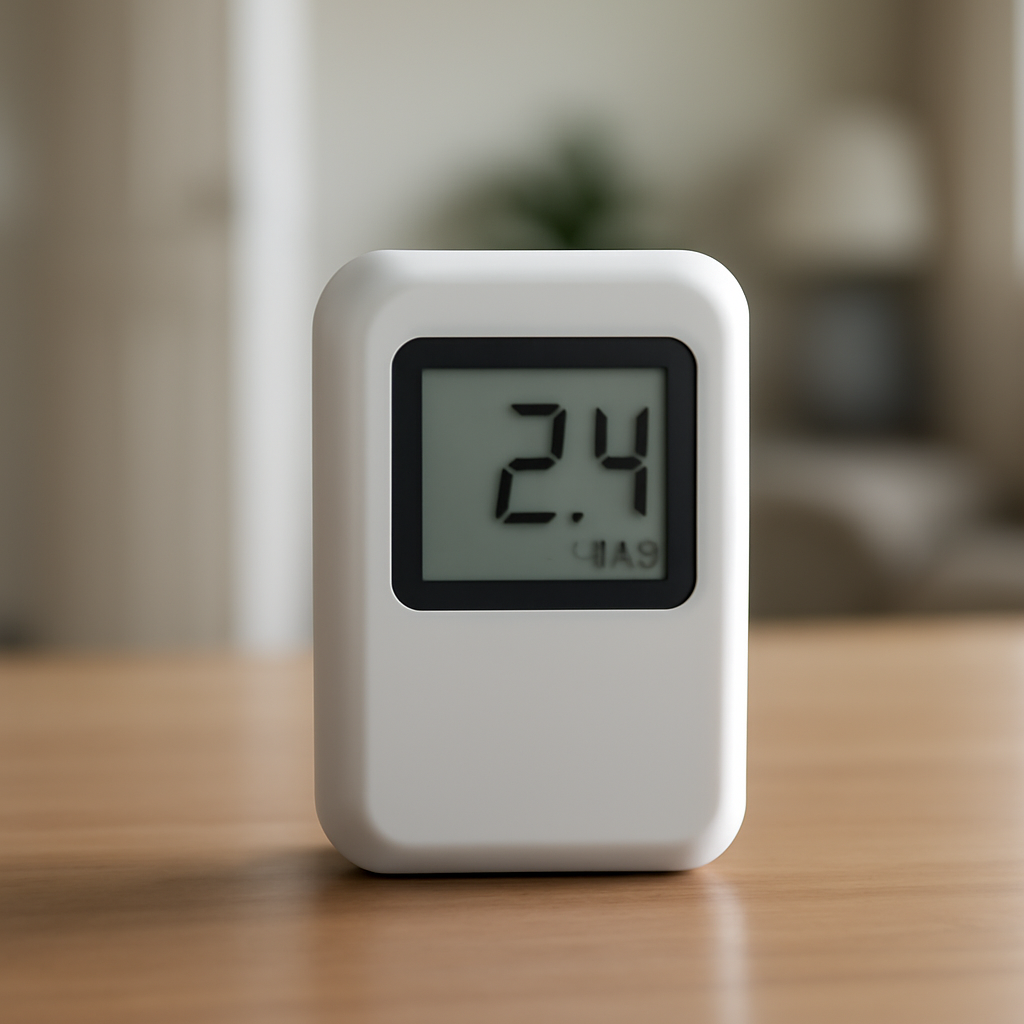
How do radon tests work? The short answer is that every commercial radon test measures the rate of radioactive decay in a small volume of air over a defined time window, then converts the count to a concentration in picocuries per liter (pCi/L). The implementation varies — alpha particle counting in continuous monitors, gamma signature analysis of charcoal canisters, voltage differential in electret ion chambers, microscopic track counting in alpha track detectors — but the underlying physics is the same. This guide summarizes EPA Citizen’s Guide and AARST measurement protocol current as of 2026 to explain what is actually happening inside the various device types. It is a science overview rather than a procedural walkthrough — for the testing process see our sibling article on how radon testing is done.
The radioactive decay being measured
Radon-222 is a noble gas produced by the decay of radium-226 in soil. It has a half-life of 3.8 days and decays through alpha emission to polonium-218, then through a chain of short-lived progeny — polonium-214, lead-214, bismuth-214, polonium-214 — to long-lived lead-210. Every commercial radon test detects either the alpha particles emitted by radon and its short-lived progeny, or the gamma rays emitted by the lead and bismuth decay products.
The picocurie unit is a measurement of activity — radioactive decay events per unit volume per unit time. One pCi/L means 0.037 decay events per second per liter of air. EPA’s 4 pCi/L action level corresponds to roughly 0.15 events per second per liter — a small number but enough to measure with sensitive detectors over hours to days. Pair this with our radon testing pillar guide for the health-decision context that motivates the measurement.
How continuous radon monitors detect alpha particles
The professional-grade continuous radon monitor most often used in real estate transactions counts alpha particles directly. The detector is typically a silicon photodiode, scintillation chamber, or pulse ionization chamber inside a sealed enclosure. The detection chain:
- Radon gas diffuses through a filter into the detection chamber
- Radon-222 decays inside the chamber, producing polonium-218 and an alpha particle
- The alpha particle strikes the detector and produces a charge pulse
- The device’s electronics count the pulses per hour
- Internal calibration converts pulse count to pCi/L
- The hourly value is logged with a timestamp
The filter at the chamber inlet excludes particulate decay progeny, so the device measures radon gas concentration rather than ambient radioactivity. The hourly logging is what makes the continuous monitor useful for transactions — the report shows whether the concentration was stable, climbing, or fluctuating during the deployment, which is part of the tamper-detection logic. Our radon testing machine guide covers the professional CRM category in more detail.
Why alpha particles are easier to count than gamma rays
Alpha particles deposit all their energy in a very short distance — typically less than 5 cm of air or a few microns of detector material. That makes them easy to count in a small chamber. Gamma rays are penetrating and require either large detector volumes or careful shielding to count accurately. Continuous monitors use alpha counting precisely because the geometry is forgiving and the signal-to-noise ratio is high.
How charcoal canisters work
Charcoal canister tests use activated carbon to adsorb radon gas and its decay products during the deployment. The methodology:
- The canister contains activated carbon with a known mass and surface area
- During deployment, radon diffuses into the carbon and is adsorbed
- Radon decays on the carbon, producing the lead-214 and bismuth-214 progeny
- After deployment, the canister is sealed and mailed to the laboratory
- The lab uses a gamma spectrometer to count the lead-214 and bismuth-214 decay signatures
- The lab corrects for the time elapsed between deployment end and counting
- The result is reported as average concentration in pCi/L over the deployment
The gamma counting at the lab works because lead-214 and bismuth-214 emit characteristic gamma rays at specific energies. The lab’s calibrated detector counts those gamma events and back-calculates the radon concentration that produced them. The method is well-established, inexpensive, and reliable when the deployment is properly handled and the post-deployment mailing is prompt.
Why mailing delay matters
The decay products on the carbon have short half-lives — minutes to hours. The longer the canister sits between deployment end and lab counting, the more signal is lost. Most lab protocols require the canister to reach the lab within four to seven days of deployment end. Delayed canisters return higher uncertainty or invalid results.
How electret ion chambers work
Electret ion chambers use a different physical principle. A precharged electret — essentially a high-voltage capacitor — sits inside an open ionization chamber. Radon diffusing into the chamber decays and produces alpha particles that ionize the air. The ions drift toward the electret and partially discharge it. The methodology:
- The pre-deployment voltage of the electret is measured with a calibrated reader
- The chamber is opened and deployed at the test location
- Radon decay events ionize the air over the deployment
- The chamber is closed and returned to the technician
- The post-deployment voltage is measured
- The voltage difference, corrected for deployment time and background radiation, gives the average concentration
Electret ion chambers are widely used by professional measurement providers because they are reusable, accurate, and require no laboratory shipping. The reader unit is the recurring cost. The technique is well-suited to high-volume professional testing rather than DIY use.
How alpha track detectors work
Alpha track detectors use a thin plastic film as the recording medium. Alpha particles striking the film produce microscopic damage tracks that can be revealed by chemical etching. The methodology:
- The detector contains a small piece of plastic (CR-39 or LR-115 are common) in a chamber with a filter
- Radon diffuses into the chamber over the deployment
- Radon and progeny decay events strike the plastic film, producing damage tracks
- After deployment (90 days minimum), the device is returned to the lab
- The lab etches the film with sodium hydroxide solution, revealing the tracks
- An automated microscope or imaging system counts the tracks per unit area
- Track density and deployment time give the average radon concentration
Alpha track detection is the standard method for long-term radon testing. The deployment can run from 90 days to a full year, producing the most representative annual average available. Our best radon detector comparison guide covers the consumer alpha track options.
How consumer continuous monitors compare
Consumer-grade continuous radon monitors use the same alpha-counting principle as professional units but with reduced sensitivity, smaller detection chambers, and lower-precision electronics. Typical consumer units in the $150 to $300 range produce useful screening data within 24 to 48 hours and stable long-term averages within a week. They are appropriate for ongoing homeowner awareness, post-mitigation verification, and screening decisions, but they are not generally accepted for real estate transaction use because they lack the AARST-required tamper detection and chain-of-custody features. Our best home radon detector buyer’s roundup compares consumer devices.
Sensitivity and noise floor
Consumer continuous monitors have a higher noise floor than professional units. A consumer monitor reading 1.5 pCi/L over 24 hours may have measurement uncertainty of plus or minus 1 pCi/L. The same reading over a week brings the uncertainty down to roughly plus or minus 0.3 pCi/L. This is why consumer monitors are generally most useful for long-term ongoing measurement rather than short snapshot decisions.
How calibration keeps results comparable
The physics of radon detection is reliable but the numeric output depends on calibration. Every commercial detector must be calibrated against a known radon source to convert raw counts into concentration in pCi/L. The calibration chain typically runs as follows:
- National Institute of Standards and Technology (NIST) maintains primary radon standards
- EPA or independent laboratories receive secondary standards traceable to NIST
- Calibration laboratories run radon chambers with known concentrations
- Detectors are exposed in the calibration chamber and the manufacturer or service center adjusts the conversion factor
- The calibration is documented with a certificate and date
- Annual or biennial recalibration maintains accuracy over the device’s working life
Professional continuous radon monitors are typically calibrated annually. Consumer continuous monitors are calibrated at the factory and may not be recalibratable — manufacturers vary in their long-term accuracy claims. Charcoal canisters, electret ion chambers, and alpha track detectors are calibrated through the lab’s analytical method rather than per-device calibration.
How interlaboratory proficiency testing works
The accuracy of laboratory analysis is maintained through proficiency testing programs run by NRPP and NRSB. Participating laboratories receive blind samples at known concentrations and report their results. Laboratories that fall outside acceptable accuracy ranges must investigate and correct their methods or lose their listing. The proficiency program produces ongoing data on which laboratories produce reliable results across the relevant concentration range.
For homeowners and measurement providers, the practical implication is to use a laboratory listed by NRPP or NRSB and participating in current proficiency testing. The lab credential is checkable on the program websites.
How temperature and pressure affect the measurement
Radon concentration is reported as activity per unit volume of air. Temperature and pressure change air density, which affects the relationship between the device’s raw signal and the reported concentration. Most professional continuous monitors include temperature and barometric pressure sensors that correct the result in real time. Consumer devices and passive detectors are calibrated for typical indoor conditions and may not include active correction; the residual error is small for typical residential temperature and pressure ranges.
For homes at high elevation — much of the Front Range — atmospheric pressure is meaningfully lower than at sea level. Devices calibrated only for sea-level conditions may under- or over-report by a few percent. Reputable measurement providers use devices with pressure correction or apply altitude-specific calibration factors. Homeowners doing DIY testing at high elevation should confirm the device manufacturer’s altitude specifications.
What can go wrong in detection
Several physical phenomena affect detection accuracy:
- Humidity — high humidity can affect electret discharge rates and some semiconductor detectors
- Temperature — extreme temperatures change electronics behavior; most devices are rated for room conditions
- Air movement — disturbed air around the detector can change the local radon concentration
- Background gamma radiation — affects lab counting of charcoal canisters; corrected by calibration
- Detector saturation — very high concentrations can saturate some short-deployment devices
- Pre-deployment exposure — opening a kit prematurely starts the clock and reduces accuracy
Protocol exists to manage all of these. The most common source of homeowner-side error is not the physics but the placement and the closed-house conditions during the deployment.
From detection to action
Once the device produces a concentration reading, the decision framework follows EPA’s action-level guidance:
- Below 2 pCi/L — routine retest every two to five years
- 2 to 4 pCi/L — consider mitigation; long-term confirmation
- 4 to 10 pCi/L — confirm and mitigate
- Above 10 pCi/L — confirm and mitigate promptly
The detection science is well-validated and the methods agree well across device types. Disagreements between tests usually trace to placement, closed-house conditions, or seasonal timing rather than the underlying physics. Our Colorado radon mitigation guide covers what happens after detection produces an actionable result.
References
- EPA Citizen’s Guide to Radon — U.S. Environmental Protection Agency
- CDPHE Colorado radon program — Colorado Department of Public Health and Environment
- CDC radon health resources — Centers for Disease Control and Prevention
- American Lung Association radon information — American Lung Association
Front Range homeowners ready to schedule professional radon testing or post-mitigation verification can get in touch through our contact page.