Hiring for Crawl Space Mold Removal on the Front Range
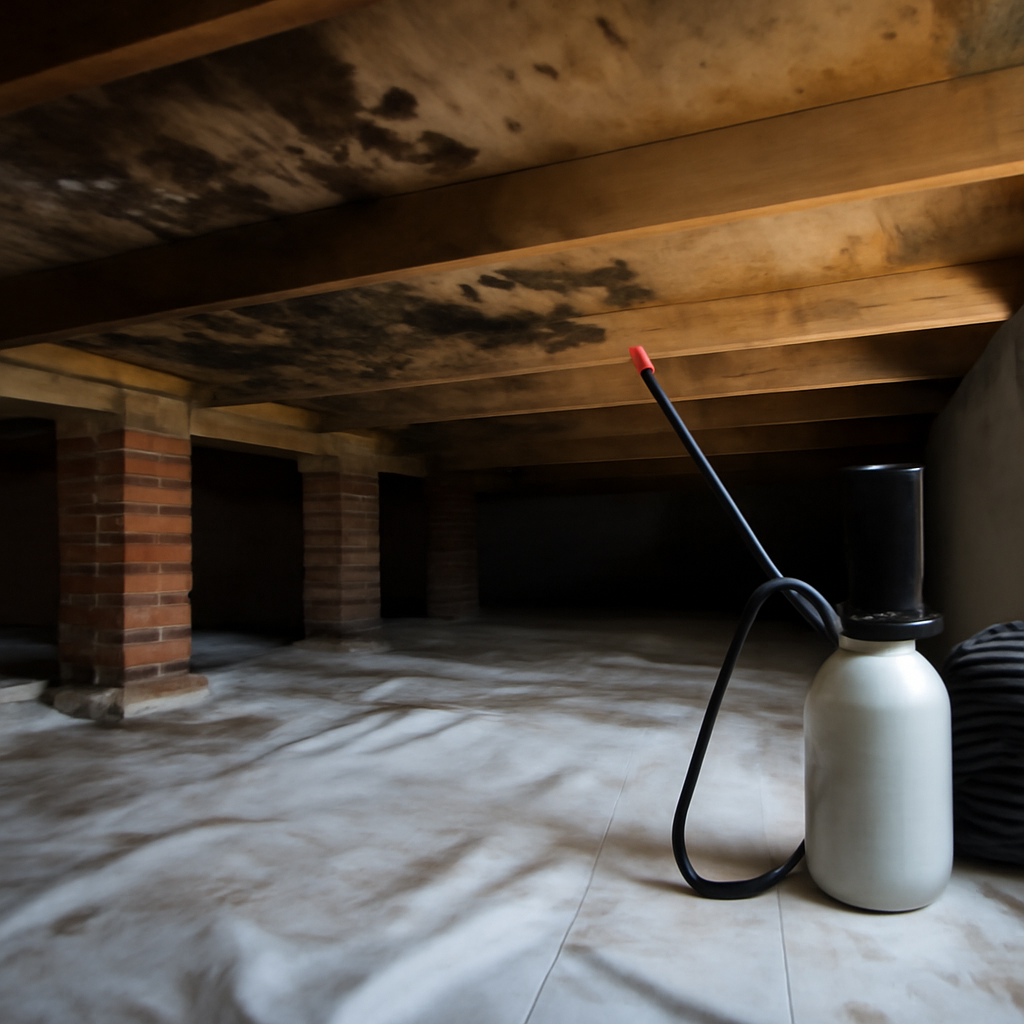
People who search for a crawl space mold remover are usually one step past the discovery: they have already smelled the musty air rising through floor registers, spotted white or gray fuzz on the joists with a flashlight, or had an inspector flag it during a sale. This page is about hiring that job out well — when a contractor is genuinely warranted, what a defensible scope looks like, what it should cost on the Colorado Front Range, and the specific things that separate a lasting fix from a repaint job that molds again in a year.
Is this mold, asbestos, or water damage? Get a free instant screen
Upload a clear photo of the suspect area. You'll get an instant AI screening opinion and what to do next. This is screening guidance, not a professional determination.
Screening guidance only. AI can be wrong. Confirm asbestos, mold type, or lead with lab testing or a licensed professional before acting.
When the job actually needs a contractor
The EPA’s threshold is concrete and worth knowing before you call anyone: for mold covering less than about 10 contiguous square feet, a homeowner can usually clean it themselves; above that, the agency recommends bringing in a professional or someone experienced in mold cleanup, especially where the moisture came from sewage or contaminated water (EPA, Mold Cleanup in Your Home). Most crawl space growth that a homeowner notices is well past 10 square feet by the time it is visible, because the whole underside of the floor shares one humidity envelope. That is the practical reason crawl space mold tends to be a hired job rather than a weekend one.
There is also an access reality: you cannot scrub joists you cannot reach on your back in 24 inches of clearance, and disturbing heavy growth without containment pushes spores up into the living space through gaps around plumbing and duct penetrations. If the affected area is small, isolated, and reachable, our guide on cleaning mold on porous surfaces covers the DIY case honestly.
Why crawl space mold is its own problem
Most pre-2000 Front Range homes were built with vented crawl spaces — foundation vents sized under the old code ratio of roughly one square foot of vent per 150 square feet of floor area. The theory was that outdoor air would dry the framing. Building-science testing over the last two decades found the opposite in cooling season: warm, humid outdoor air enters the cool crawl space and condenses on cold pipes and framing, holding the space at sustained high humidity. Mold does not need standing water to grow — it needs surfaces staying damp and relative humidity that lingers high. The EPA advises keeping indoor humidity below 60 percent, ideally 30 to 50 percent (EPA, A Brief Guide to Mold, Moisture and Your Home). A vented crawl space in July often sits well above that.
So a real fix has three parts, in order: remove the visible growth, kill the moisture source, and hold the space dry long-term. A contractor who quotes only step one is selling a result with an expiration date.
What it costs on the Front Range
Remediation of the growth itself — containment, HEPA vacuuming, antimicrobial treatment of joists and subfloor, and haul-off of contaminated insulation and old sheeting — typically runs $2,000 to $6,000 for a single-family crawl space, driven mostly by square footage and clearance. Low crawls under 24 inches cost more because the work is slower and harder on the crew.
The moisture-control layer is the larger number and the one that prevents a repeat. A full encapsulation — a sealed reinforced liner up the walls, sealed vents, and a dedicated dehumidifier — commonly adds $6,000 to $15,000. A combined remediate-and-encapsulate project on a 1,000-square-foot Front Range crawl space frequently lands between $10,000 and $18,000. Treat any quote far below that for both scopes as a signal that something was left out; ask what.
| Scope element | Typical Front Range range |
|---|---|
| Remediation only (removal, HEPA, antimicrobial, haul-off) | $2,000–$6,000 |
| Encapsulation add-on (liner, sealed vents, dehumidifier) | $6,000–$15,000 |
| Dedicated crawl dehumidifier, installed | $1,200–$2,500 |
| Independent post-remediation verification | $400–$700 |
What a defensible scope includes
A serious proposal names the affected area in square feet, lists exactly what gets removed (insulation, old vapor barrier, organic debris), and states the cleaning protocol reference — look for IICRC S520, the recognized industry standard for mold remediation. It should specify containment and negative air pressure even though the crawl space feels already isolated; that is precisely where lazy crews skip it. It should describe the moisture correction and the new vapor barrier, and it should carve out a separate line for third-party verification before anything gets sealed. If the scope reads like a paragraph with a single price, push back.
Remediation versus encapsulation
Salespeople use the words interchangeably; they are not the same work. Remediation removes existing growth and decontaminates. Encapsulation seals the space against future moisture. You generally need both, in that sequence. Remediate without encapsulating and the humidity that caused the growth is unchanged, so regrowth in 12 to 24 months is common. Encapsulate without remediating and you have trapped contaminated material behind plastic — the odor and spore load stay, now hidden. If a contractor proposes a liner over visibly moldy framing with no removal step, ask directly what happens to the existing growth first.
Vapor barrier and moisture control specs
The cheapest job loosely lays 6-mil polyethylene over the dirt — the code minimum for a ground cover, and little more than a nod at moisture control. Encapsulation-grade work uses 12- to 20-mil reinforced polyethylene, seams overlapped and taped, mechanically fastened to the foundation wall, and sealed around piers and penetrations. A 20-mil sealed liner should last decades; a loose 6-mil sheet often tears within several years. Because the labor to install dwarfs the material cost, over-specifying the liner is usually the right call.
A sealed crawl space still needs active drying. The two paths are a dedicated dehumidifier (commonly 70 to 90 pints per day for 1,000 square feet) or conditioned supply air tied into the home’s HVAC. Colorado’s dry climate means some encapsulated crawls hold fine without active control, but most projects budget a dehumidifier as insurance. The Department of Energy’s insulation guidance is a useful vendor-neutral reference on the trade-offs (energy.gov, Insulation).
Vetting the contractor
Ask for the same credentials you would for any remediation hire — IICRC S520 firm certification, technicians credentialed in applied microbial remediation, general liability with pollution coverage, and workers’ comp. Crawl work adds two items: confined-space training and a respiratory-protection program. OSHA rules can classify a low-clearance crawl with restricted entry as a confined space, and rodent-contaminated crawls raise hantavirus precautions the CDC ties to specific cleanup steps (CDC, Hantavirus Prevention). A crew that shrugs at those questions is a crew cutting corners you cannot see. Get three quotes, and read our checklist for choosing a mold removal company before you sign.
Because crawl space work is hidden the moment the liner goes down, insist on independent verification first: a third-party assessor doing a visual pass, moisture readings on framing, and sampling before encapsulation. That $400-to-$700 report becomes part of the home’s record and matters at resale. If you want an inspector’s read before committing, start at our mold inspection hub.
Front Range patterns and insurance
Local geography shapes the moisture source. Foothill homes in Evergreen, Conifer, and parts of Boulder County are built into hillsides where bulk water intrusion drives the growth. Older Denver bungalows tend to have shallow vented crawls that condense during the summer monsoon. I-25 corridor developments often have unvented conditioned crawls that quietly fail when the original dehumidifier dies and no one notices until the smell returns.
On insurance, most Colorado homeowner policies treat crawl space mold like other interior mold: covered only when a sudden, accidental water event triggered it, and capped under a separate mold endorsement. A burst supply line often qualifies; years of vented-crawl humidity almost never does. If you file, document the cause of loss in writing before any demolition and attach an itemized S520-referenced estimate — adjusters routinely dispute mold scopes.
Frequently asked questions
Guidance here reflects EPA and CDC mold and moisture recommendations current as of 2026; consult a certified professional for testing and your physician for any health symptoms. If you want a vetted Front Range inspector or third-party assessor before signing a remediation contract, reach us through our contact page.
Mold removal & cleanup picks
For a small, contained patch (under ~10 sq ft) these EPA-friendly removers handle surface mold. Larger or recurring growth warrants a professional assessment first.
| Product | Why | Buy |
|---|---|---|
 RMR-86 Instant Mold Stain Remover RMR-86 Instant Mold Stain Remover | Fast-acting on stains; ventilate and wear PPE. | Amazon — $18.38 |
 Concrobium Mold Control Concrobium Mold Control | No-bleach formula that also helps prevent regrowth. | Amazon — $13.48 |
 Mold Armor Mold & Mildew Remover Mold Armor Mold & Mildew Remover | Widely stocked bathroom/surface remover. | Amazon — $22.98 |