Mold Inspection and Testing Near Me: A Buyer’s Guide
Searching for mold inspection and testing near me usually starts with a trigger: a musty smell that will not quit, a stain spreading on a ceiling, a recent leak, or a real estate deadline. The results page then floods with companies promising fast, sometimes free service — and that is exactly where homeowners make costly mistakes. This guide explains what local mold inspection and testing should include, what fair pricing looks like, and how to vet a provider so you pay for objective answers rather than a sales pitch. It summarizes EPA and CDC guidance current as of 2026 and is educational only, not a substitute for a licensed professional or your physician.
Is this mold, asbestos, or water damage? Get a free instant screen
Upload a clear photo of the suspect area. You'll get an instant AI screening opinion and what to do next. This is screening guidance, not a professional determination.
Screening guidance only. AI can be wrong. Confirm asbestos, mold type, or lead with lab testing or a licensed professional before acting.
What does local mold inspection and testing include?
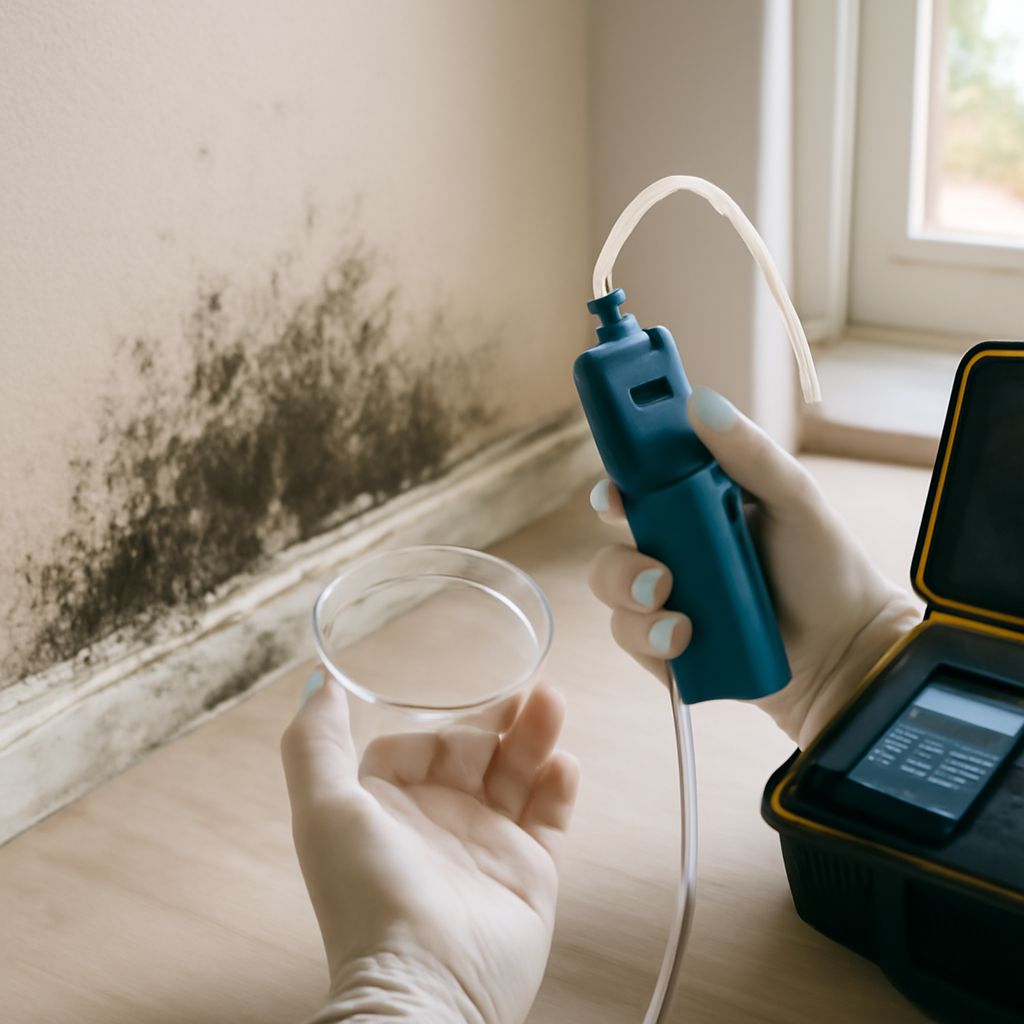
A complete local assessment has two distinct phases. The inspection is a hands-on investigation: a trained inspector walks the property looking for visible growth, water staining, and the conditions that breed mold. They use moisture meters to detect dampness inside walls and floors, and many use a hygrometer to log indoor humidity and sometimes thermal imaging to flag cold, damp areas behind finishes. The testing phase, when warranted, collects samples for an accredited laboratory.
Two sampling methods dominate. Air sampling draws a measured volume of air through a spore trap and compares indoor counts against an outdoor control sample — the standard way to reveal hidden growth shedding into the air. Surface sampling (swab or tape lift) identifies what a specific visible patch is. The EPA is candid that sampling is not always necessary: if mold is visible, the response is the same regardless of species. Testing earns its keep when growth is suspected but unseen, when occupants have symptoms, when documenting a transaction or claim, or when verifying that a remediation succeeded. A good local provider should tell you which of those situations applies to you rather than defaulting to maximum sampling.
Inspection versus remediation: the conflict you must understand
The most important concept when hiring locally is the line between the company that assesses mold and the company that removes it. A firm that does both has a financial incentive to find a large, expensive problem. Independent assessment exists precisely to remove that bias.
The cleaner model is: an independent inspector assesses and writes the scope of work, a separate remediation contractor performs the removal, and the original inspector returns for post-remediation verification — testing the cleaned space against clearance criteria. When one company controls all three steps, the final “clearance” is essentially the contractor grading its own homework. Many consumer guidelines and state frameworks recommend keeping these roles separate for that reason. When a local listing advertises “free mold inspection,” it is almost always a remediation company prospecting for removal work, and the inspection findings will tend to support a sale. Our mold inspection and testing hub lays out this assessor-versus-remediator structure in full, and the companion guide on choosing a mold testing company details what an objective lab report should contain.
What should mold inspection and testing cost near you?
Local pricing varies with home size, number of samples, and market, but national ranges are consistent enough to judge a quote against:
- Visual inspection with moisture readings: roughly $200 to $400 for a standard home.
- Inspection plus laboratory sampling: commonly $300 to $700, with each additional air or surface sample adding to the total.
- Larger homes or multiple suspected areas: can exceed $700 to $1,000.
- Post-remediation clearance testing: often priced like a focused inspection plus the lab samples needed to confirm the area is clear.
Treat a free inspection as a marketing cost the company expects to recoup through a remediation job. A modest fee for genuinely independent testing usually protects you from a far larger, possibly unnecessary, removal bill. The guide on mold tests compares the economics of DIY kits against professional sampling for homeowners weighing the cheapest defensible option.
How to vet a local mold inspector
A short, firm checklist separates qualified local providers from opportunists:
Credentials and licensing
Look for recognized certifications — Council-certified Microbial Consultant or Inspector, or accreditation through organizations such as InterNACHI or the American Council for Accredited Certification. Some states require a mold-assessment license; confirm whether yours does and that the provider holds it. General home-inspector training overlaps here, and the standards bodies that govern inspector conduct are worth knowing; our guide to hiring a home inspector explains how credentials and standards of practice work across the inspection field.
Independence
Ask directly, in writing: “Do you also perform mold remediation?” An independent assessor is preferable for an unbiased scope. If a company does both, decide whether the convenience outweighs the lost objectivity, and never let the same firm verify its own cleanup.
Accredited laboratory
Samples should go to a lab accredited for environmental microbiology — AIHA accreditation is the common benchmark. Ask which lab the company uses and whether you receive the raw lab report, not just a summary.
Clear, useful deliverable
A quality report includes annotated photos, moisture readings by location, sample results presented against the outdoor baseline, a plain-language interpretation, and a recommended scope of work. A page of raw spore counts with no interpretation is not a usable report.
Insurance and local references
Verify liability insurance and request recent references from your area. Local experience matters because regional construction and climate shape where mold hides — Front Range basements and north-facing walls behave differently than Gulf Coast homes.
Red flags in local mold companies
Walk away, or at least slow down, when you see:
- Free inspections tied to remediation sales — the built-in conflict of interest.
- Scare tactics about “toxic black mold” requiring immediate, expensive demolition. The CDC is clear that no single mold is uniquely toxic and that the response does not hinge on species.
- Pressure to sign a remediation contract on the spot, before any lab results are back.
- No written report, or results delivered only verbally.
- Refusal to name the laboratory or unwillingness to share raw results.
- Quotes with no scope — a flat “mold removal” price with no defined area or method.
A trustworthy provider will sometimes tell you that you do not need them. The EPA notes that a small, visible patch under about 10 square feet on a non-porous surface is generally within a homeowner’s ability to clean. A company that respects that, rather than manufacturing urgency, is one to keep.
When local testing is genuinely worth it
Hiring a nearby inspector pays off most clearly in these situations:
- You smell mold but cannot locate it — air sampling and moisture mapping find hidden sources.
- Occupants have unexplained respiratory or allergy symptoms and you want to know whether the home is a factor.
- The property recently flooded or had a significant concealed leak.
- You are buying or selling and need objective documentation for negotiation.
- You need post-remediation verification that a cleanup actually met clearance criteria.
In each case the value is information you cannot reliably get yourself: an objective measurement, a documented baseline, or an independent verification. The CDC reinforces that the health response to mold does not depend on identifying the exact species — controlling moisture and removing growth is what matters — so the best local providers focus your spending on finding and fixing the moisture, not on cataloging spores for their own sake.
What to expect during a local mold inspection visit
Knowing the shape of a typical visit helps you judge whether a provider is being thorough. A competent local inspection usually unfolds in a recognizable sequence. The inspector starts with a conversation about your concern — the smell, the stain, the leak history, any symptoms — because that context guides where to look. They then walk the property, inside and out, examining the obvious suspect areas and the conditions that breed mold: roof and gutter performance, grading and drainage, plumbing fixtures, the basement or crawlspace, bathrooms, and the HVAC system.
Throughout the walk, the inspector takes moisture readings on walls, floors, and ceilings, often guided by a thermal camera that flags cool anomalies worth a closer moisture check. Where sampling is warranted, they collect air samples — including an outdoor control taken the same day — and any surface samples on visible patches, labeling each for the laboratory. A thorough visit for an average home commonly runs one to three hours depending on size and complexity. At the end, expect a verbal summary of preliminary observations, with the formal report and lab results to follow in a few days. A provider who rushes through, skips the outdoor control, or pushes a remediation contract before lab results return is not following good practice.
Local factors on the Front Range that affect mold
Geography shapes where mold hides, and a good local inspector reads those patterns. The Colorado Front Range has a relatively dry climate overall, which leads some homeowners to assume mold is not a concern — but the problems here are specific rather than absent. Basements and below-grade spaces across Denver, Jefferson, Arapahoe, Douglas, and neighboring counties collect moisture from spring snowmelt, summer monsoon rains, and groundwater, and they are the most common mold location in the region.
Other local drivers include north-facing walls that stay cold and prone to condensation through winter, expansive clay soils that crack foundations and admit water, ice-dam and roof-leak damage from heavy snow, and tightly sealed newer homes where humidity from cooking and bathing has nowhere to go without adequate ventilation. Swamp coolers, still common in the area, add indoor humidity that can feed growth if a home is not ventilated to match. A local inspector who understands these regional patterns investigates the right places, rather than applying a generic checklist that might miss a basement seepage problem or a condensation-prone wall. This regional knowledge is one of the strongest arguments for hiring nearby rather than the cheapest distant option.
Insurance, disclosure, and transaction timing
Mold testing often intersects with money and paperwork, and timing it correctly matters. In a real estate transaction, an independent mold assessment during the inspection period gives a buyer objective documentation to negotiate repairs or price, and it protects a seller who wants to disclose accurately. Waiting until after closing forfeits that leverage. If you suspect a problem, schedule the assessment early enough that lab results return before contingency deadlines.
For insurance, the key distinction is usually whether the underlying water event was sudden and accidental (often covered) versus gradual and from deferred maintenance (often excluded). Documentation from an independent assessor — establishing the moisture source, extent, and timing — supports a claim far better than a remediation contractor’s invoice alone. Keep the assessment independent here too: an insurer is more likely to credit findings from a party with no financial stake in the cleanup. Whatever the scenario, the EPA’s underlying message holds — finding and fixing the moisture source is the durable solution, and the paperwork should document that source clearly.
How to make the call near you
A workable process: list three local candidates, confirm each holds appropriate certification or licensing, ask each whether they also remediate, request a sample report, and compare quotes that include a defined scope. Favor an independent assessor with an accredited lab and a clear deliverable, even at a slightly higher price than a free-inspection competitor. Then act on the moisture findings promptly, because the EPA’s central message never changes: control the water and you control the mold.
Questions to ask a local provider before booking
A short phone screen filters out the opportunists. Ask each nearby candidate the same handful of questions and compare:
- “Do you perform remediation as well as testing?” The answer frames how independent the assessment is.
- “What are your certifications and is a state license required here?” Confirms qualifications.
- “Which accredited lab processes the samples?” A specific, accredited lab is the standard.
- “What does the written report include, and how soon?” Expect photos, moisture readings, the outdoor baseline, and a plain-language interpretation within a few days.
- “How do you decide whether sampling is even needed?” A good provider will sometimes say it is not, which signals honesty over upselling.
How a provider answers — directly and without pressure versus evasively or with a hard push toward a same-day contract — often reveals more than the answers themselves. Pair this screen with the vetting checklist above, and you will reliably separate an independent local assessor from a remediation company prospecting for work. The same independence logic appears in our broader guidance on choosing a mold testing company, and the overarching message from the EPA holds throughout: the assessment should ultimately point you toward finding and fixing the moisture source, because that is what resolves a mold problem for good.
DIY screening before you call
Before booking a local provider, a little self-screening can save money or sharpen the conversation. Note where and when you smell mustiness, whether symptoms track with time at home, and any history of leaks or flooding. Walk the likely trouble spots — basement, crawlspace, under sinks, around windows, the HVAC area — and look for visible growth, staining, or persistent dampness. An inexpensive home humidity gauge can tell you whether indoor humidity sits above the 50 percent threshold the EPA flags as conducive to mold.
This screening does not replace a professional assessment, but it helps you decide whether you need one and gives the inspector a head start. If you find an obvious, small, contained patch on a non-porous surface, you may be able to clean it yourself and skip testing entirely. If you find a musty smell with no visible source, symptoms, or a leak history, that is exactly the situation where a local mold inspection and testing visit earns its cost. Bringing those observations to the call lets a reputable provider give you a more accurate scope and a more honest read on whether testing is warranted at all.
References
- Mold Testing or Sampling — U.S. Environmental Protection Agency
- About Mold and Your Health — Centers for Disease Control and Prevention
- Mold Cleanup in Your Home — U.S. Environmental Protection Agency
- A Brief Guide to Mold, Moisture and Your Home — U.S. Environmental Protection Agency
Front Range homeowners who want an objective, independent read before committing to any mold work can reach out through our contact page to connect with a vetted local inspector.