Lead Paint Chips: Cleanup, Risk, and Next Steps
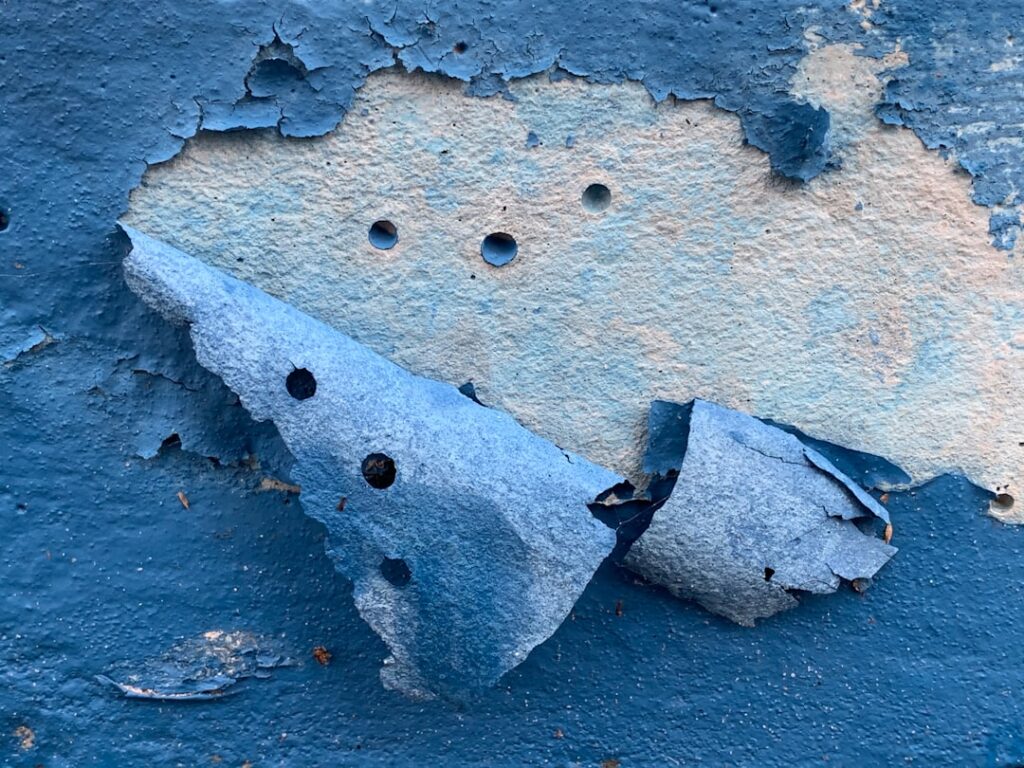
Lead paint chips accumulating on window sills, around door frames, or in soil along the exterior of a pre-1978 home are one of the clearest visible signals that active deterioration is underway. A single chip is usually not an emergency, but a quantity of chips coming off the same surface area indicates the paint has lost its bond and the lead-containing material is migrating into the environment. Children face the highest risk because lead-based paint chips have a faintly sweet taste, and the hand-to-mouth behavior typical of toddlers can produce ingestion. This guide summarizes EPA and CDC guidance current as of 2026, covers safe cleanup steps for small quantities, and explains when EPA RRP-certified contractors must take over. Consult a certified lead-paint professional for testing decisions and your physician for any exposure concerns.
Is this mold, asbestos, or water damage? Get a free instant screen
Upload a clear photo of the suspect area. You'll get an instant AI screening opinion and what to do next. This is screening guidance, not a professional determination.
Screening guidance only. AI can be wrong. Confirm asbestos, mold type, or lead with lab testing or a licensed professional before acting.
What lead paint chips indicate about a pre-1978 home
Lead paint chips falling from a painted surface mean the paint film has lost its bond with the substrate underneath. Deterioration accelerates as moisture penetrates the failed bond line, weather cycles expand and contract the substrate, and friction or impact knocks loose material free. Once chipping starts on one section of a surface, it typically spreads outward over months or years unless the surface is repainted, encapsulated, or removed.
Common locations where lead paint chips first appear in pre-1978 homes:
- Window sashes and frames where paint friction with the sash wears the coating thin
- Exterior siding and trim exposed to sun, wind, rain, and freeze-thaw cycles
- Door frames where repeated door-to-frame contact wears the paint
- Porches, railings, and exterior stairs subject to weather and foot traffic
- Areas near plumbing leaks or roof leaks where water has compromised the paint bond
The pre-1978 housing hazard overview covers the broader context for why these surfaces matter and how the chipping pattern fits into the lead-paint risk picture.
Why lead paint chips matter for children
The CDC identifies childhood lead exposure as a serious public health concern with no safe blood lead level. Children under age 6 face the highest risk because their bodies absorb lead more efficiently than adult bodies, their developing brains are more sensitive to lead’s neurotoxic effects, and their normal hand-to-mouth behavior makes accidental ingestion likely.
Lead-based paint chips have a historically documented faintly sweet taste, which has been a contributing factor in childhood ingestion cases. Children who taste a chip once may seek out more chips, particularly when chips are accessible at child height (window sills, door bottoms, baseboards, exterior porch surfaces). A single small chip ingested once is unlikely to produce a measurable blood lead spike, but repeated ingestion over weeks or months can. Pediatricians in higher-risk areas routinely test blood lead levels in children at ages 12 months and 24 months specifically because elevated levels often trace back to lead-paint chip ingestion or lead-dust exposure in pre-1978 housing.
Beyond children: dust as the secondary exposure pathway
Lead paint chips are the visible part of the deterioration. The invisible part is the fine lead-containing dust generated as paint deteriorates and as chips break down into smaller particles. That dust settles on floors, window sills, and other horizontal surfaces. Hand-to-surface-to-mouth contact in children produces the largest exposure pathway. Adults are also exposed through household dust but absorb lead less efficiently than children.
What to do with a small quantity of lead paint chips
Small quantities (under 6 square feet of disturbed surface and a handful of chips on the floor or sill) can usually be handled by the homeowner using lead-safe work practices. The general protocol involves:
- Keep children and pregnant occupants out of the area during cleanup
- Wet the chips with a fine mist of water to prevent dust release
- Pick up visible chips with damp paper towels, working from outside in
- Double-bag the chips and contaminated paper towels in heavy-duty plastic
- Wet-wipe surrounding surfaces (sills, floor, baseboards) with disposable wipes
- Use a HEPA-filtered vacuum on the area as a final cleanup step
- Wash hands and clothing immediately after the work
- Dispose of bagged waste according to local hazardous-waste guidance
The wet-wipe and HEPA-vacuum approach is what EPA RRP-certified contractors use for larger work. Homeowners cleaning up a small area can use the same techniques to limit dust release and exposure. The goal is to remove the chips without creating airborne lead-containing particles.
What not to do with lead paint chips
Several common cleanup approaches make the problem worse rather than better. Dry-sweeping with a broom releases lead dust into the air. Dry-vacuuming with a standard household vacuum spreads lead dust through the exhaust and contaminates the vacuum bag and filter. Power-washing exterior chipping siding sends lead-containing material into surrounding soil where it persists for decades. Sanding chipped paint without HEPA-vac attachment generates dust that settles on every surface in the room.
The shortest summary is that any dry, dust-generating, or pressurized approach is unsafe. Wet methods with HEPA filtration and contained disposal are the only homeowner-appropriate cleanup techniques.
When EPA RRP-certified contractors must take over
The EPA Renovation, Repair, and Painting (RRP) Rule requires that any work disturbing more than 6 square feet of interior painted surface or more than 20 square feet of exterior painted surface in a pre-1978 home be performed by an EPA-certified renovator using lead-safe work practices. That threshold matters when chipping covers a larger area than a small section of a window or door frame.
RRP-required work includes containment of the work area with plastic sheeting, restriction of high-dust work practices (no open-flame stripping, no dry sanding without HEPA vacuum attachment, no power washing), proper PPE for workers, and a final cleaning verification step. The certified contractor firm must hold current EPA RRP certification, and at least one EPA-certified renovator must be on each job site.
Buyers and homeowners can verify a contractor’s current RRP certification through EPA’s public search tool. Looking at the EPA RRP abatement protocols covers how the certified work practices apply in a typical renovation.
How to tell if chips are actually lead-based paint
Visual inspection cannot definitively identify lead-based paint. Lead paint can be any color. Some homeowners assume only white or off-white paint contains lead, but red, yellow, and green pigments often contained lead at higher concentrations than white pigments. The only reliable identification method is laboratory testing or XRF (X-ray fluorescence) analysis by an EPA-certified inspector.
Two practical options exist for homeowners who want to confirm lead content before deciding on cleanup:
- Consumer-grade lead test swabs (sold at hardware stores) provide a presumptive screening result for accessible chips. False negatives are common, especially on dark or pigmented paint, so a negative swab does not rule out lead.
- Laboratory analysis of a chip sample by an accredited lab provides a definitive result. The homeowner collects a small chip following safe-collection guidance and mails it to a lab for analysis. Cost is typically $25 to $50 per sample.
Pre-1978 homes are presumed to potentially contain lead paint until tested otherwise. Many homeowners proceed with lead-safe cleanup based on the presumption rather than waiting for laboratory confirmation. The lead test kit buyer guide covers the consumer-grade screening options in more detail.
Long-term solutions beyond chip cleanup
Cleaning up chips addresses the immediate exposure but does not solve the underlying deterioration. The paint surface that produced the chips will continue producing chips until the surface is stabilized. Three long-term approaches are commonly used in pre-1978 homes:
- Repainting — Stabilize the surface by scraping loose paint (with lead-safe practices) and applying new primer and topcoat. Works for surfaces in fair condition with limited chipping.
- Encapsulation — Apply an EPA-recognized encapsulating coating designed to seal lead-based paint in place. The encapsulating coating creates a durable barrier that prevents chip and dust release.
- Enclosure — Cover the lead-paint surface with new building materials (drywall, paneling, vinyl siding) that mechanically separate the paint from the living environment.
- Abatement — Remove the lead paint or the entire painted component (window, door, trim) from the home. Performed by EPA-certified abatement contractors.
The right choice depends on surface condition, occupant exposure risk, household budget, and the homeowner’s renovation plans. A typical Front Range pre-1978 home with chipping window sashes might use enclosure (new vinyl window replacement) for the windows and repainting with encapsulation for the trim.
How chips relate to soil contamination
Exterior lead paint chips fall to the ground and accumulate in soil over decades. Soil contamination is a particular concern at the perimeter of pre-1978 homes, in former play areas near painted exterior surfaces, and in garden beds that touch painted siding or trim. Lead in soil persists indefinitely because lead does not break down through natural weathering.
EPA guidance recommends soil testing in any pre-1978 home where children play in the yard or where gardens for edible plants are planned within 10 feet of a painted exterior surface. Soil testing is performed by collecting samples at multiple locations and depths, with laboratory analysis providing lead concentration in parts per million. EPA action levels for residential soil are 400 ppm for play areas and 1,200 ppm for other yard areas. Soil exceeding those levels typically requires capping with clean soil or hardscape, removal and replacement, or restriction of high-contact uses.
How chip accumulation evolves on common surfaces
Different exterior surfaces produce different chip accumulation patterns over time. Wood siding tends to chip in irregular flakes that follow the grain pattern, with the largest pieces breaking loose from edges and corners. Trim around windows and doors chips along the bond line where the trim meets the siding or where the trim meets the window or door unit itself. Porch ceilings and overhangs shed chips downward, creating accumulations on porch floors directly below. Exterior stair treads and railings chip from foot traffic and hand contact, depositing material on adjacent walking surfaces.
Each pattern offers a clue to where to focus the cleanup. A homeowner who notices chips on a porch floor should look up at the porch ceiling and trim, not just the floor itself. A homeowner who finds chips at the base of a wood-sided wall should check the soil immediately below for accumulated material that may have been there for years. Tracing the chips back to their source surface usually identifies the next-priority work item.
What to do during a real-estate transaction
Active chipping discovered during a home inspection of a pre-1978 home is almost always worth flagging in the inspection-objection response. The buyer can request that the seller arrange for lead-safe cleanup or paint stabilization before closing, or the buyer can negotiate a credit at closing to cover the cost of post-closing work. Either approach should be coordinated with the buyer’s real-estate agent because state and local rules sometimes constrain how lead-paint hazards are addressed in active transactions.
Sellers who accept a request to address active chipping should use EPA RRP-certified contractors even for relatively small areas, both because of the regulatory framework and because the documentation of certified work protects the seller from later civil liability. A seller who hires an uncertified contractor to quickly paint over chipping siding can create more risk than they remove, particularly if the disturbance during prep work spreads lead-containing dust without proper containment.
References
- EPA lead exposure sources and chip cleanup guidance — US Environmental Protection Agency
- CDC childhood lead exposure prevention — Centers for Disease Control and Prevention
- HUD guidelines for lead-paint hazard control — US Department of Housing and Urban Development
Active chipping on a pre-1978 home you own or are about to close on? Reach out through our contact page for a referral to an EPA-certified lead-paint inspector and RRP-certified renovation contractor.
Lead paint test kits
Instant swab kits flag lead on painted surfaces in minutes — useful before a renovation in any pre-1978 home.
| Product | Why | Buy |
|---|---|---|
 3M LeadCheck Swabs 3M LeadCheck Swabs | EPA-recognized instant swabs. | Amazon — $208.00 |
 Lead Test Kit (lab-based) Lead Test Kit (lab-based) | Mail-in for a documented result. | Amazon — $35.00 |