FLIR ONE Pro: What Homeowners Need to Know
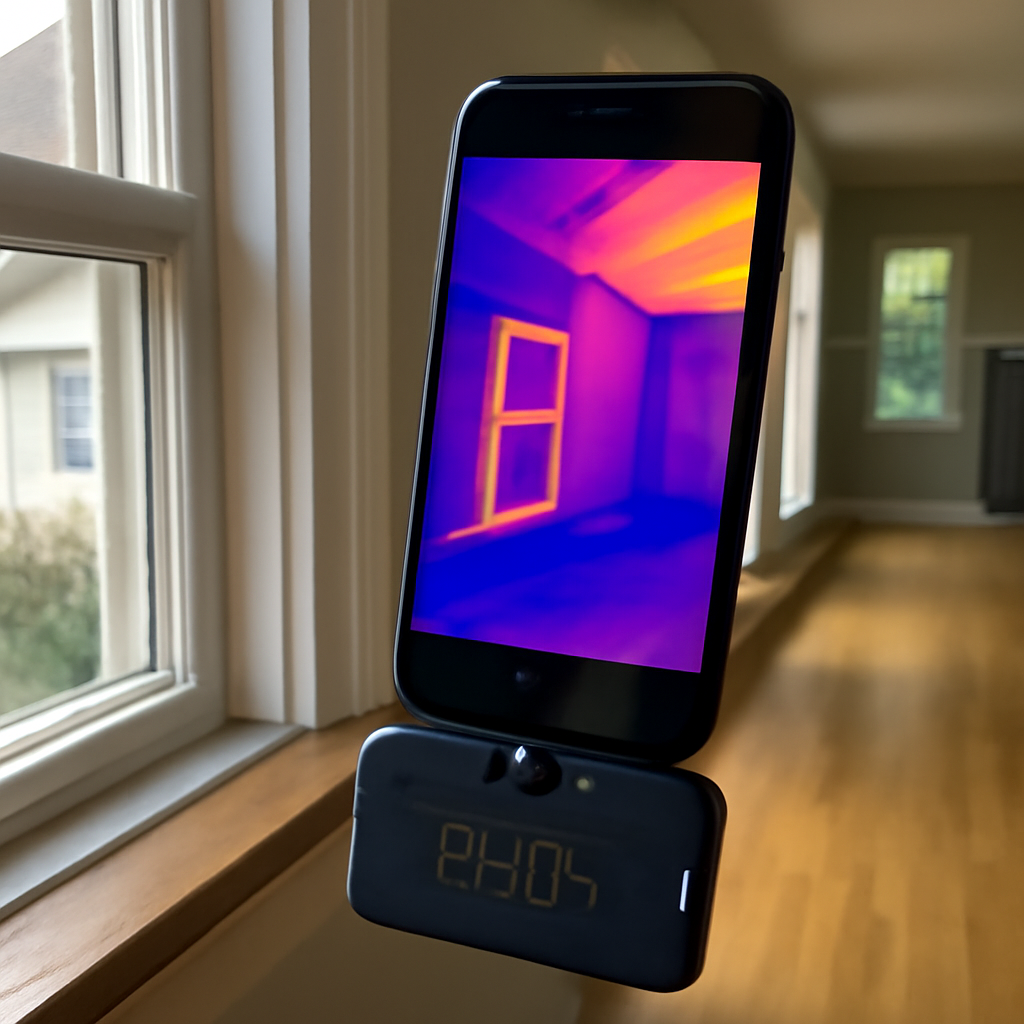
FLIR ONE Pro names a product family rather than a single SKU. Since the line first appeared in 2014, FLIR has shipped multiple hardware generations under variations of the FLIR ONE Pro brand, expanded across iOS and Android connectors, and grown an accessory ecosystem that includes protective cases, lens attachments, and tripod adapters. This brand-level guide walks through the full FLIR ONE Pro lineage, the generation differences buyers encounter on the new and used markets, the compatibility math for various iPhone and Android phones, and the accessory ecosystem that has emerged around the product.
The FLIR ONE Pro lineage: Gen 1 through Gen 3
The original FLIR ONE launched in 2014 as a dual-component case for iPhone 5/5s, before the modular Pro line emerged. The first generation FLIR ONE Pro shipped in 2017 with a 30-pin Lightning or micro-USB connector, an 80 by 60 detector, and an internal battery. The second generation arrived in 2018, jumping detector resolution to 160 by 120, introducing MSX overlay, and adopting USB-C for Android variants. The current third generation refreshed the hardware in 2020-2021, improving the connector reliability, the battery life, and updating the FLIR ONE app’s interface.
For homeowners shopping today, the third generation is what FLIR ships new through authorized resellers. Gen 1 and Gen 2 units circulate on the used market (eBay, Mercari, used-tool dealers) at significant discounts. Gen 1 units are usable but limited by the 80 by 60 detector — the resolution most buyers regret within a few months. Gen 2 units share the 160 by 120 detector with the current Gen 3 and represent the best value in the used market, though battery degradation on a five-year-old module is a real risk.
Connector variants: USB-C, Lightning, micro-USB, and the 30-pin legacy
The FLIR ONE Pro has shipped in four connector variants over its lifetime. The USB-C variant is the current Android standard and also fits the iPhone 15 generation and newer. The Lightning variant fits iPhone 5 through iPhone 14. The micro-USB variant from older Android generations is discontinued but still circulates used. The original 30-pin variant for iPhone 4S and earlier is a museum piece — no longer sold and not compatible with any current iOS version.
When buying new, the buyer picks USB-C or Lightning at checkout based on phone model. The two variants run identical detector hardware and produce identical image quality — the connector is purely the physical handshake. Buyers should not attempt to bridge connector types with USB-C-to-Lightning adapters; the module exchanges data and power simultaneously over a single port, and standard adapters break the protocol. Some FLIR ONE Pro generations ship with a small extender block to clear thick phone cases — verify that accessory is included if a buyer uses a heavy case.
iOS and Android app compatibility
The FLIR ONE app is free on the App Store and Google Play. On iOS, current builds support iOS 15 and newer; older iPhones running iOS 12 or 13 may receive limited functionality through legacy builds. On Android, the app supports Android 9 and newer through the Google Play store, with sideloaded builds occasionally available for special cases (rooted devices, AOSP variants, region-locked phones).
App version compatibility matters when buying used. A Gen 1 FLIR ONE Pro paired with an iPhone 6 running iOS 12 may run an older FLIR ONE app build that lacks the cloud sync features of the current Gen 3 ecosystem. Most homeowners pair the module with whatever current phone they own, so this incompatibility tends to surface only when buying both a used module and an old phone together. The 2026 home inspection tools pillar covers thermal imaging alongside the rest of the homeowner toolkit at a higher level.
Accessory ecosystem: cases, lens attachments, tripod adapters
Several third-party accessories have grown around the FLIR ONE Pro since 2018. Protective cases keep the module attached to a phone without risking the connector pin during a fall — particularly useful for working tradespeople who carry the camera daily. Lens attachments expand the field of view (wide-angle adapters for tight crawl spaces) or narrow it (telephoto adapters for distant electrical scans), though FLIR’s own optical accessories for the ONE line are limited compared to the E-series.
Tripod adapters allow the module-phone combination to be mounted for time-lapse thermal imaging — useful for envelope studies that watch a wall warm or cool over several hours, or for documenting the recovery of a wet ceiling after a leak is stopped. Third-party adapters appear on Etsy, Thingiverse 3D-printable files, and small specialty toolmakers. These accessories are largely unofficial and the buyer takes on responsibility for fit and durability.
Used-market resale value
The FLIR ONE Pro holds resale value reasonably well for a consumer electronics product. A two-year-old Gen 3 in good cosmetic condition with intact battery and original packaging typically resells for 55 to 70 percent of new retail. Older Gen 2 units fetch 30 to 45 percent of original retail depending on battery condition. Gen 1 units at the 80 by 60 detector tier rarely exceed $100 used and are not recommended for first-time buyers.
Two factors drag resale value down: a degraded internal battery (the most common failure point) and an outdated firmware that the current FLIR ONE app no longer supports. Both are check-before-buy items on a used purchase. Sellers who can provide the original purchase receipt and demonstrate a recent firmware update through the FLIR ONE app earn the upper end of the resale range.
Comparing FLIR ONE Pro against FLIR ONE Pro LT and FLIR C3-X
The FLIR ONE Pro sits between the LT and the C3-X in the FLIR consumer lineup. Compared to the LT, the Pro has four times the detector pixels (160 by 120 versus 80 by 60), better thermal sensitivity, and roughly double the retail price ($400 versus $200). Compared to the C3-X, the Pro has fewer detector pixels (160 by 120 versus 128 by 96 — though the resolution gap is actually small), no standalone screen, and a lower price point ($400 versus $700). The C3-X’s main advantages are the standalone form factor and cloud sync; the Pro’s advantage is portability when the user already carries a phone.
Buyers comparing these three options should ask whether the workflow tolerates a phone-attached module or needs a standalone camera. For occasional homeowner use, the phone-attached Pro is fine. For inspection-adjacent work where the camera might get handed to a contractor or a client during a walkthrough, the standalone C3-X removes the awkwardness of asking someone else to hold a phone. For a budget-constrained homeowner who just wants to find missing insulation once, the LT is enough.
Long-term ownership: what to expect over five years
The FLIR ONE Pro’s expected useful life is four to six years for a homeowner using it a few times annually. The two failure modes are battery degradation (the internal battery loses capacity year over year, eventually dropping the per-charge runtime below practical use) and connector wear (the Lightning or USB-C pin endures hundreds of insertions over the module’s life, and eventually loses reliable contact). Neither is field-serviceable — both effectively end the unit’s useful life and trigger replacement.
FLIR’s two-year hardware warranty covers manufacturing defects but does not cover battery aging or connector wear, which the company treats as normal use degradation. The FLIR ONE app itself receives ongoing updates with new palettes, improved cloud sync, and occasional new measurement features. The app’s update cadence has been roughly two major releases per year since 2020. ASHRAE building diagnostics guidance describes infrared imagers as five-to-seven-year capital tools, which matches the FLIR ONE Pro’s realistic ownership window.
The FLIR ONE Pro app workflow over time
The FLIR ONE app has evolved significantly since 2018. Early builds focused on raw image capture with limited annotation. Current builds add cloud sync to FLIR Ignite (FLIR’s cloud platform for image storage and team collaboration), basic measurement tools (spot meter, box average, line profile), palette switching, and direct sharing to email and messaging apps. The cloud sync feature is particularly useful for buyers who want a backup of every captured thermal image without manually exporting.
Software updates have also added compatibility for new phone hardware as phones evolve. When Apple moved iPhone 15 to USB-C in 2023, FLIR updated the FLIR ONE app to recognize the USB-C variant on iOS, eliminating the need to buy a different module for newer iPhones. This kind of forward-compatible update extends the practical life of a FLIR ONE Pro purchase beyond what the hardware alone might suggest.
How the FLIR ONE Pro brand fits into the broader thermal imaging market
The phone-attached thermal camera market includes several brands beyond FLIR. Seek Thermal, InfiRay, and HikMicro all ship competing phone-attached modules at similar or lower price points. FLIR’s advantage is brand recognition (the company has built thermal cameras since 1978 and serves military, industrial, and consumer markets), the MSX overlay feature, and the maturity of the FLIR ONE app’s update cycle. Competitors often match the raw detector spec but lag on app polish and ecosystem.
For a homeowner picking among phone-attached options, the FLIR ONE Pro is the safest default. The accessory ecosystem is larger, the resale value is stronger, and the documentation and community support are deeper than newer entrants. Buyers who already own a competing brand’s module need not replace it on FLIR brand alone — the spec gaps are small, and a working unit from any major brand serves typical homeowner use cases adequately. Working professionals tend to bypass the phone-attached category entirely in favor of a handheld pro camera, as the 2026 thermal camera reviews guide covers in depth.
Front Range Colorado: seasonal patterns for FLIR ONE Pro use
Front Range homeowners often buy thermal cameras after a specific failure — a winter ice dam that ruined a ceiling, a summer HVAC outage that exposed a duct disconnect, a basement flood that left lingering moisture concerns. The FLIR ONE Pro fits those reactive use cases well. It also serves proactive seasonal checks: a January envelope walkthrough in Denver, a March attic check before snow melt drips down through compromised insulation, a September furnace startup check before the heating season ramps up.
Boulder, Douglas, and Jefferson County homes built before 2000 often have inconsistent insulation patterns — original builders skipped tricky transitions, retrofits added blown-in cellulose unevenly, and additions sometimes used different insulation specs than the original structure. A homeowner with a FLIR ONE Pro can map these inconsistencies room by room over a single cold weekend and prioritize which areas to upgrade. The Department of Energy infrared thermography page describes the methodology in more detail.
References
- Using Infrared Thermography for Energy Audits — U.S. Department of Energy
- ASHRAE Standards and Guidelines — ASHRAE
- InterNACHI Standards of Practice — InterNACHI
- NFPA Codes and Standards Index — National Fire Protection Association
Thermal imaging cameras
Infrared cameras reveal hidden moisture, missing insulation, and air leaks. Phone-attachment models are the budget entry point; standalone units have higher resolution.
| Product | Why | Buy |
|---|---|---|
 FLIR ONE Pro (phone) FLIR ONE Pro (phone) | Plugs into iPhone/Android; inspector favorite. | Amazon — $349.00 |
 Topdon TC001 Topdon TC001 | High-res phone module at a low price. | Amazon — $199.99 |
 FLIR C5 Compact FLIR C5 Compact | Standalone pocket camera with Wi-Fi. | Amazon — $449.00 |