Radon Testing in Wellington, Colorado | InspectandTest
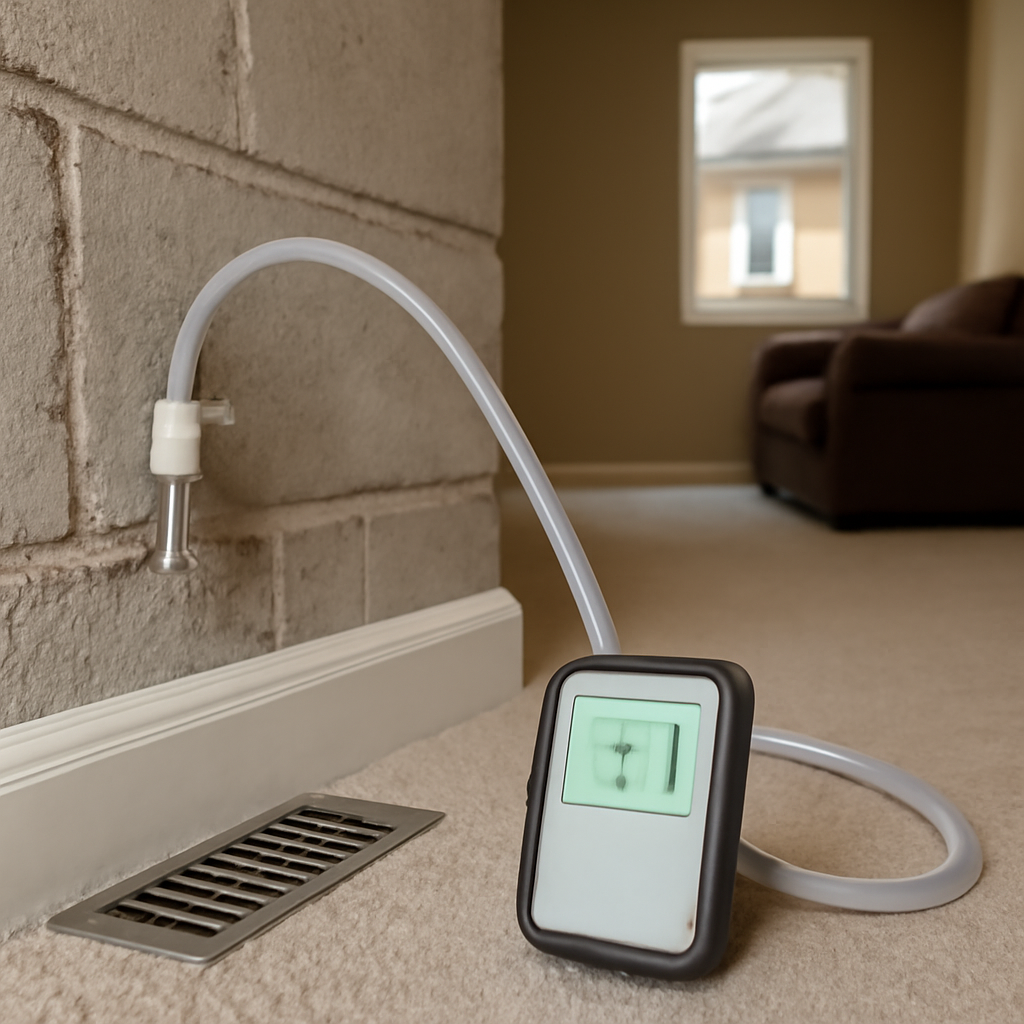
Wellington sits in EPA Radon Zone 1, the agency’s highest-risk category, where the predicted average indoor level meets or exceeds the 4 pCi/L action threshold. This fast-growing Larimer County town, about ten miles north of Fort Collins on the I-25 corridor, sits on uranium-bearing plains soil, and most of its homes are 2000s-to-2020s subdivisions with finished basements, exactly the below-grade living space where radon concentrates. Radon is a colorless, odorless radioactive gas and the second-leading cause of lung cancer after smoking. This page explains how radon testing wellington homeowners should plan, why the local geology and housing demand it, and what testing costs. This summary reflects EPA and CDPHE guidance current as of 2026; consult a certified professional for testing decisions.
Radon testing in Wellington: what to know
Radon testing measures the gas that has accumulated inside a home, reported in picocuries per liter (pCi/L). The EPA recommends action at or above 4 pCi/L, and because Wellington lies in Zone 1, a meaningful share of local homes test at or above that line. Two homes on the same street can read very differently depending on foundation cracks, soil contact, and how the house is heated, so the only way to know your number is to test.
Short-term tests, two to seven days, fit real-estate timelines; long-term tests, ninety days or more, average seasonal swings for a fuller exposure picture. For the underlying science and the device types, our plain-language radon guide for Front Range homeowners walks through both approaches.
Wellington’s rapid growth shapes the testing picture. The town has posted one of northern Colorado’s fastest growth rates, which means newer subdivisions like Sage Meadows, Harvest Village, and Buffalo Creek dominate the housing stock. These tightly built, energy-efficient homes are excellent at sealing conditioned air inside, which also means they are efficient at trapping radon once it enters through the slab. A new home is no guarantee of a low reading; if anything, the tighter envelope can hold radon more effectively.
Radon also changes over time, so a clean test years ago does not guarantee a clean home today. Foundation settling opens new cracks, a basement finish changes airflow, and a new high-efficiency furnace alters the pressure that draws soil gas indoors. EPA guidance is to re-test every couple of years and after any major change. For a Wellington household that finished a basement or replaced an HVAC system since the last measurement, a fresh test is the only way to know the current level.
Why Wellington homes need radon testing
Geology drives it. Radon comes from the natural decay of uranium in soil and rock, and the plains soils beneath Wellington carry the uranium content that produces the town’s Zone 1 status. The dominant housing pattern, subdivision homes with finished basements, puts living space in direct contact with that soil, where radon enters through slab cracks, control joints, and sump openings.
Climate concentrates it. Front Range winters are cold, so Wellington homes stay sealed for months and furnaces create slight negative pressure that pulls soil gas indoors. Finished basements across the newer subdivisions are exactly the lower-level rooms where families spend time and where radon collects. The same Chinook winds and freeze-thaw cycles that work foundation cracks open a little wider each winter also create new entry points for soil gas.
There is a rural wrinkle here that matters more in Wellington than in a dense suburb. Many properties on the agricultural fringe toward Waverly, Nunn, and Severance draw from private wells, and radon can dissolve into groundwater and then release into indoor air when that water is agitated, by a shower, a dishwasher, or a washing machine. Homes on well water in Zone 1 have a second potential radon pathway beyond soil gas, and testing the air captures the combined exposure regardless of source.
The finished-basement-plus-occupancy pattern is what makes radon a genuine concern in Wellington rather than an abstraction. A basement bedroom or home office is both the most soil-contacted space and a place where people spend hours every day. That combination, maximum soil contact plus maximum time, is the worst case for radon exposure, and it describes a large share of Wellington’s housing.
What a Wellington radon test covers
A professional test places a calibrated continuous radon monitor or a passive device in the lowest livable level, usually a finished basement or ground-floor room, under closed-house conditions. The tester documents placement and the closed-house window so the result holds up if it feeds a real-estate negotiation.
Closed-house conditions
For at least twelve hours before and throughout a short-term test, windows and exterior doors stay closed except for normal entry. This keeps a breezy plains afternoon or a Chinook wind from artificially lowering the reading. If a test comes back at or above 4 pCi/L, the next step is mitigation, which our guide to radon mitigation in Wellington details.
Continuous monitors versus passive kits
A continuous radon monitor logs hourly readings, so it can show whether someone opened a window mid-test or whether levels spiked overnight, evidence that protects a buyer from a tampered result. Passive devices like charcoal canisters average exposure and mail to a lab at lower cost. For a Wellington home sale, the continuous monitor’s tamper detection and hour-by-hour record make it the preferred tool. For a homeowner’s own long-term picture, a passive kit left in place for months gives a more representative annual average.
Radon testing cost in Wellington
A professional short-term radon test in the Wellington and northern Larimer County market typically runs about $135 to $250. A do-it-yourself kit costs roughly $15 to $40 plus lab fees, and CDPHE periodically offers discounted kits to Colorado residents. Bundled into a pre-purchase home inspection, radon testing often adds just $100 to $175 rather than a separate trip charge.
For homes on private wells, water radon testing is a separate measurement with its own kit and lab fee, usually a modest add-on. A Wellington property on well water in Zone 1 is a reasonable candidate for both an air test and a water test, since the two pathways are independent and a high water-radon number can keep indoor air elevated even after the soil-gas pathway is sealed.
Weigh the cost against the protection. The EPA links thousands of lung-cancer deaths a year to radon, and Wellington’s Zone 1 status puts local exposure risk among the highest in the state. A $200 air test that catches a 7 pCi/L finished-basement reading lets a family install a mitigation system, often around $1,500, and cut exposure by ninety percent or more. Skipping the test leaves the risk invisible for as long as the family lives there. Few home-safety steps deliver that ratio of cost to lifetime benefit.
Colorado regulations and disclosure
Colorado requires radon disclosure in residential real-estate transactions, and the Seller’s Property Disclosure asks sellers to report known radon results and any existing mitigation system. CDPHE runs the state radon program, references the 4 pCi/L EPA action level, and offers discounted kits to residents. Colorado does not license home inspectors, so for any test tied to a sale, confirm the tester follows recognized national measurement protocols rather than assuming a license guarantees competence.
Disclosure shapes negotiations both ways. A Wellington seller who has tested and mitigated can offer a clean post-mitigation result as reassurance, while a seller who has never tested leaves the buyer to discover the number during the contingency, often resulting in a mitigation credit. Buyers in Zone 1 Wellington should not waive radon testing to sweeten an offer; the modest cost of the test and fix is small against the long-term health stakes of an untreated finished basement.
Neighborhoods and areas served
Radon turns up across Wellington regardless of neighborhood: finished-basement subdivision homes in Sage Meadows, Harvest Village, Buffalo Creek, and the Boxelder-area developments, the historic homes in and around Old Town Wellington, and the rural well-water properties on the agricultural fringe. Service typically extends to adjacent Fort Collins, Timnath, Severance, and the rural stretches toward Waverly and Nunn, all within the same Zone 1 footprint where elevated readings are common.
Because the whole town sits in Zone 1, the regional geology that drives radon does not respect subdivision boundaries. A 2020-built home in a new development and a century-old Old Town house face the same soil-gas risk from the same plains-soil uranium. The broader county picture is covered in the Larimer County radon testing hub, which ties the local towns into the regional pattern. Wherever a home sits in Wellington, treating radon as a default test rather than an optional add-on reflects the reality of the highest EPA risk zone.
Where to place a radon test in a Wellington home
Placement determines whether a radon result reflects real exposure, and in a Wellington home the right location follows a clear principle: test the lowest level that is or could become living space. For most of the town’s subdivision homes, that means the finished basement family room, bedroom, or office, the rooms where families actually spend hours, not an unfinished mechanical corner that no one occupies.
The device belongs roughly twenty inches or more above the floor, away from exterior walls, drafts, direct sun, and any sump or floor drain. Setting a detector right next to a Sage Meadows basement’s sump pit or in a window’s draft can skew the reading, so a careful tester positions it in the representative breathing zone of the occupied space. Testing the lowest livable level captures the worst-case room, which is the conservative and correct approach for a Zone 1 town.
Closed-house conditions matter as much as location for a short-term test. Windows and exterior doors stay closed for at least twelve hours before and throughout the test, which on the Front Range plains means resisting the temptation to open up on a mild Chinook afternoon. A test taken with windows cracked during a warm spell can read artificially low and give a Wellington family false reassurance about a basement that actually concentrates radon all winter.
For rural Wellington homes on private wells, the air test captures combined exposure from both soil gas and any radon released from well water during showers and laundry. If an air result comes back high on a well property, a separate water-radon test helps determine whether the tap is contributing, since mitigating only the soil-gas pathway may not fully resolve a level driven partly by the water. That two-pathway picture is unique to the rural fringe toward Waverly and Nunn and is worth raising with a tester before placement.
How to choose a Wellington radon testing provider
Ask whether the provider uses a calibrated continuous radon monitor and follows EPA or AARST protocols. A good tester documents closed-house conditions, device placement, and test duration so the result stands up in a sale. For a Wellington home on a private well, ask whether they also offer water radon testing, since the two pathways need separate measurement.
Confirm the monitor’s calibration is current and, for a purchase, ask the provider to place and retrieve the device themselves rather than handing you a kit, since a tester-administered continuous monitor carries more weight in a negotiation. If a result comes back borderline, between 2 and 4 pCi/L, a competent provider explains the options, including a follow-up long-term test, rather than pushing an unnecessary mitigation sale. Bundling radon with a full home inspection in Wellington gives buyers one coordinated report on both the structure and the soil-gas risk.
References
- Radon risk and EPA zone maps — U.S. Environmental Protection Agency
- Colorado radon program and kits — Colorado Department of Public Health and Environment
- Radon and lung cancer — Centers for Disease Control and Prevention
Every Wellington home sits in EPA Zone 1, so radon testing is basic due diligence, not optional. To connect with a vetted local tester before your purchase deadline or this heating season, get in touch through our contact page.