Radon Remidiation: What Homeowners Need to Know
This guide summarizes EPA, CDC, and Colorado state guidance on radon mitigation current as of 2026; engage a certified mitigation contractor for any actual system design or installation. The search term “radon remidiation” is a common spelling variant of “radon remediation,” which itself is colloquial wording for what EPA and the industry technically call radon mitigation. Whichever spelling brought you here, the underlying homeowner question is usually the same: what does it take to reduce indoor radon below the EPA action level of 4.0 pCi/L, and what does it cost in a Front Range Colorado home? This guide covers the typical sub-slab depressurization system, alternative approaches for non-standard foundation types, and Front Range pricing.
What radon mitigation actually does
Radon mitigation reduces indoor radon by addressing the entry pathway. The dominant pathway in most homes is soil-gas migration through cracks in the foundation slab, plumbing penetrations, sump pits, and porous foundation walls. Soil gas is typically at slightly higher pressure than indoor air, which drives radon into the home along these pathways.
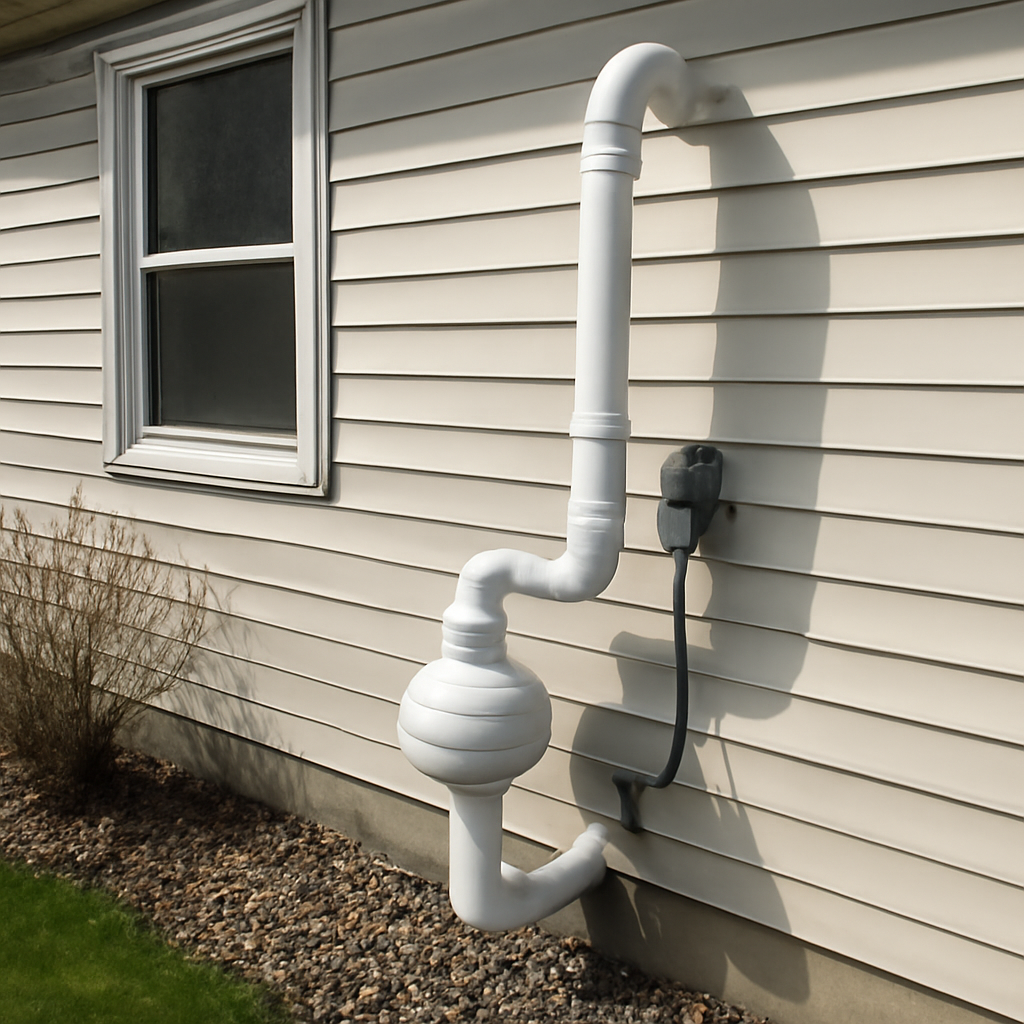
The most common mitigation approach is sub-slab depressurization (SSD), which uses a continuous-duty fan to extract air from beneath the foundation slab and exhaust it above the roofline. The extraction creates negative pressure in the sub-slab area, reversing the pressure differential that was driving soil gas into the home. With proper system design, SSD reduces indoor radon by 70-99% in most Front Range homes.
The technical term EPA and the industry use is “mitigation” rather than “remediation.” Remediation typically refers to cleanup of existing contamination; mitigation refers to ongoing exposure reduction. Radon does not behave like a contamination that can be cleaned up once — the soil gas continuously regenerates as new uranium and radium decay. The mitigation system runs continuously to keep pace with the continuous source.
The sub-slab depressurization system in detail
An SSD system has six main components. A sealed penetration through the foundation slab with a suction pit cleared below the slab provides the air-extraction point. Perforated PVC piping runs from the suction point to the mitigation fan. The fan creates the negative pressure that drives the system. Smooth-wall PVC piping carries exhaust air from the fan to the outdoor exhaust point above the roofline. A manometer pressure gauge confirms the system is creating negative pressure. A system label identifies the installer and installation date.
Installation typically takes 4-6 hours for a standard single-family slab-on-grade or basement home. The contractor drills the slab penetration, clears the suction pit, runs the piping (often through an interior chase wall or up an exterior wall), mounts the fan in the attic or on an exterior wall, terminates the exhaust above the roof, and installs the manometer. Post-installation verification testing happens 30-60 days later.
For broader context on the components and how they interact, see our radon gas removal system guide and our radon system explainer.
Front Range pricing for SSD installation
Typical pricing in the Denver metro market in 2026 runs $1,200-2,500 for an SSD system on a single-family detached home. Pricing varies with home size, foundation complexity, exhaust routing difficulty, and contractor overhead. Smaller homes with simple foundation geometry land at the lower end; larger homes with multi-level foundations or difficult exhaust routing land at the higher end.
Multi-suction-point systems are needed in homes with sub-slab fill that does not communicate well across the foundation footprint. Diagnostic testing during the bid phase identifies whether a single suction point is adequate or whether two or three points are needed. Multi-point installations typically run $2,500-4,000.
Larger homes with mixed foundation types (slab portions plus crawlspace portions) often need two systems — SSD for the slab plus sub-membrane depressurization (SMD) for the crawlspace. Combined system pricing typically runs $3,000-5,000 in the Front Range market.
Mitigation for non-slab foundations
Homes with crawlspace foundations cannot use SSD alone. The crawlspace is mitigated with sub-membrane depressurization (SMD), which installs a sealed plastic membrane over the crawlspace floor and pulls air from beneath the membrane. The system is mechanically similar to SSD but uses the membrane as the sealing layer rather than the foundation slab.
Crawlspace SMD installation is more invasive than slab SSD because of the manual labor required to install the membrane across the full crawlspace floor. Pricing in the Front Range market typically runs $2,000-3,500 for SMD on a typical 1,500-2,500 sq ft single-story home with a crawlspace.
Homes with stone or rubble foundations from the pre-1900 era can be difficult to mitigate effectively. The porous foundation walls leak air into the home around the foundation perimeter, which makes any depressurization-based system less efficient. Mitigation approaches for these older foundations sometimes combine SSD with foundation wall sealing and supplemental sub-floor extraction.
Verification testing after installation
Post-installation radon testing verifies the system is operating as designed. The first post-installation test should happen 30-60 days after installation to allow the home to reach a new equilibrium under the mitigation system. The test typically uses a continuous radon monitor (CRM) under 48-hour closed-house protocol, with results expected at or below the EPA action level of 4.0 pCi/L.
Some installers include the post-installation test in the original installation fee; others charge separately. Best practice is to use a third-party tester for post-installation verification rather than relying on the installation contractor’s own testing. The independent verification avoids the conflict-of-interest concern and produces more defensible documentation.
Periodic retesting every 2 years thereafter is EPA’s recommendation. The retest catches any degradation of system performance — fan failure, manometer leaks, slab seal degradation — before the home returns to pre-mitigation radon levels.
System maintenance over time
Mitigation systems require modest ongoing attention. The manometer pressure gauge should be checked monthly; a visible water-column pressure difference indicates the fan is operating. Zero pressure difference indicates fan failure, piping leaks, or seal degradation. The fan itself typically lasts 10-20 years before requiring replacement at $500-900 for a like-for-like swap.
Slab penetration seals can degrade over time, particularly in homes with active foundation movement that disturbs the sealed connection. Periodic visual inspection of the slab seal and re-sealing as needed maintains system efficiency.
The exhaust point should remain clear of obstructions. Vegetation growth, ice damming during winter, or roof modification work that affects the exhaust termination can reduce system effectiveness. The exhaust should remain at least 10 feet above grade and 10 feet from operable windows.
Alternative or supplemental mitigation approaches
Beyond SSD and SMD, several alternative or supplemental mitigation approaches exist. Heat recovery ventilation (HRV) increases overall home ventilation rates, diluting indoor radon along with other indoor pollutants. HRV is rarely used as a primary radon mitigation strategy because it requires substantial ongoing energy use, but it can supplement SSD in homes where the slab-based system alone is not adequate.
Block-wall depressurization addresses radon entering through hollow concrete block foundation walls. The system extracts air from the hollow block cavities, reversing the pressure differential that was drawing soil gas into the wall interior. This approach is uncommon in modern Front Range homes (where poured concrete is the dominant foundation material) but is occasionally used on older properties.
Drain tile depressurization uses an existing foundation drain tile system as the suction collector. The fan pulls air from the drain tile, which already serves as a pressure-relief pathway around the foundation. Homes with intact and accessible drain tile can be mitigated this way at lower cost than full SSD installation.
When to test and mitigate timing
Timing the mitigation project around the test result matters. Front Range homeowners with a confirmed elevated radon reading should not delay mitigation past the next heating season. Indoor radon is typically higher in winter than in summer due to tighter closed-house conditions, and unaddressed elevated radon during winter heating months produces disproportionately high cumulative exposure.
For real-estate transactions, mitigation timing is usually compressed into the inspection-objection period. Buyers receive the radon test result, file an inspection objection requesting mitigation as part of the contract, and the seller arranges installation before closing (or the buyer takes a closing credit and arranges installation post-closing). The seller-installed approach is more common but requires verification testing before closing to confirm system effectiveness.
Owner-occupants without transaction urgency have flexible timing but should not let the mitigation slip indefinitely. The lifetime lung cancer risk from radon exposure accumulates with time at elevated concentrations, so every year of delay at 8 pCi/L is roughly equivalent to two years at 4 pCi/L in cumulative dose terms.
Cost financing options
Several financing pathways can help Front Range homeowners afford mitigation. Some local utility companies offer rebate programs that partially offset mitigation cost. The Colorado state radon program occasionally has grant funding for income-qualified households. Energy-efficiency loan programs sometimes include radon mitigation as an eligible improvement.
For real-estate transactions, the mitigation cost is often negotiated into the closing terms. Sellers may install the system before closing, may credit the buyer at closing to arrange post-closing installation, or may split the cost as part of broader inspection-objection negotiations. The specific arrangement depends on local market norms and the broader objection list.
Tax treatment of mitigation costs varies. Mitigation expenses are typically not deductible on personal federal tax returns for owner-occupied housing, but may be capitalizable as a basis adjustment that affects future capital gains calculation. Property owners should consult a tax professional for specific tax treatment guidance.
Choosing a certified mitigation contractor
Mitigation contractors should be certified by the National Radon Proficiency Program (NRPP), the American Association of Radon Scientists and Technologists (AARST), or CDPHE state certification. All three credentials require initial training, examination, and continuing education. Front Range homeowners can search the NRPP and CDPHE public databases to verify credentials before engaging a contractor.
Beyond certification, property owners should request 3-5 references from recent installations, review sample post-installation test results from prior projects, confirm the contractor carries appropriate insurance, and verify the proposed system design is appropriate for the home’s foundation type and size. A contractor who proposes a single-suction-point SSD without diagnostic testing on a complex foundation is cutting corners.
For deeper guidance on the mitigation process, see our residential radon mitigation guide covering the Front Range market in detail.
Common contractor selection mistakes
Three mistakes recur in contractor selection. The first is choosing on price alone. The lowest bid often comes from a contractor cutting corners on diagnostic testing, slab sealing quality, or post-installation verification. The middle-of-the-pack bid from a properly certified contractor usually produces a better outcome.
The second is skipping the diagnostic test. Some contractors will bid an installation without performing the smoke-tube communication test or measuring baseline sub-slab pressure differential. The bid may be lower, but the resulting system is more likely to need redesign or additional suction points after the initial installation fails to reduce radon to acceptable levels.
The third is bundling testing and mitigation with the same individual. When the contractor who installed the system also tests it after installation, the conflict of interest weakens the verification. Best practice is a third-party tester for both pre-installation baseline measurement and post-installation verification.
References
- EPA Consumer Guide to Radon Reduction — US Environmental Protection Agency
- CDC radon mitigation and exposure guidance — Centers for Disease Control and Prevention
- Colorado CDPHE radon mitigation program and certified contractors — Colorado Department of Public Health and Environment
Front Range homeowners weighing radon mitigation can get in touch through our contact page for a referral to a certified mitigation contractor in the Denver metro area.