Mold Testing in Niwot, CO | InspectandTest
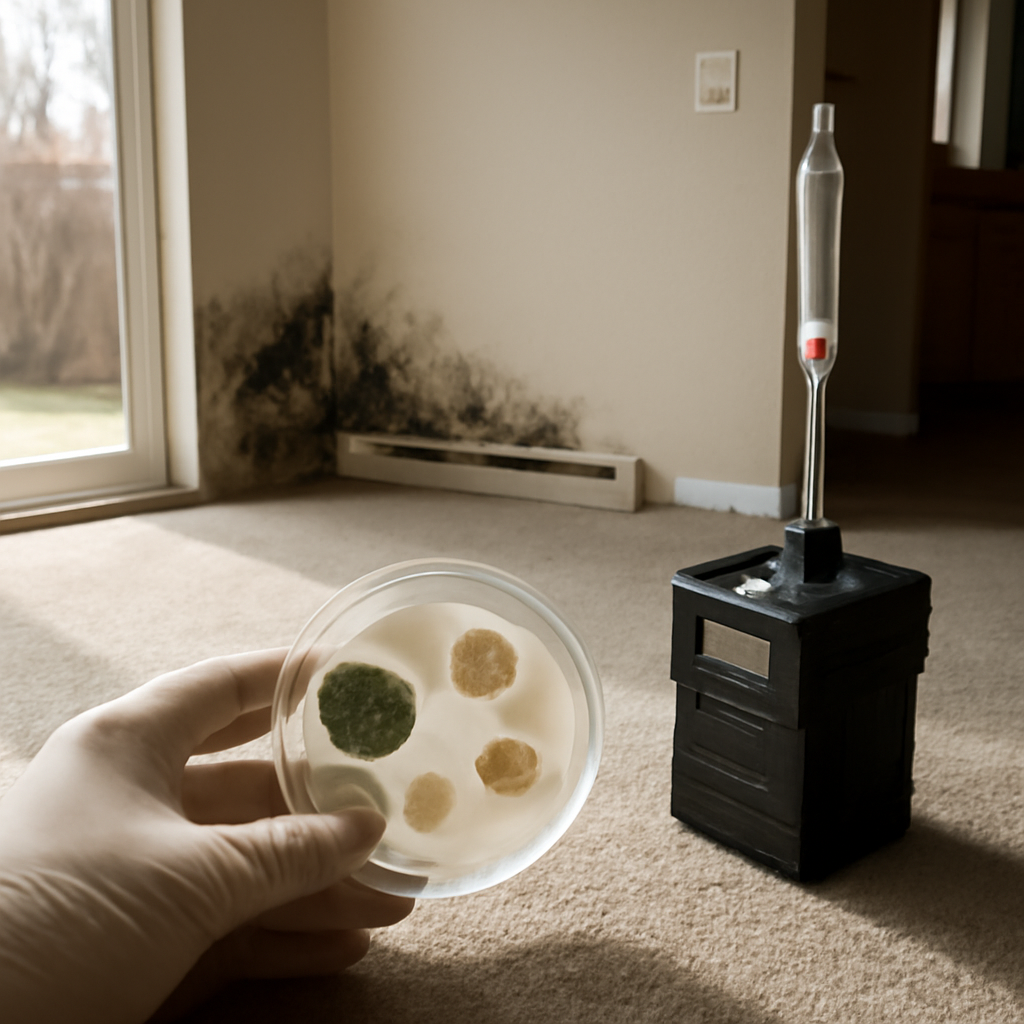
Niwot, the affluent unincorporated Boulder County community southeast of Longmont, blends late-1800s Old Town buildings with upscale subdivisions like Somerset and Lake Valley and rural acreage on private wells and septic. Where a mold inspection finds moisture and visible growth, mold testing measures what is in the air or on a surface and identifies it through a laboratory. This page explains how mold testing niwot homeowners should approach the process, when sampling is worth it, and what the results mean. This summary reflects EPA and CDPHE guidance current as of 2026; consult a certified professional for decisions about your home.
Is this mold, asbestos, or water damage? Get a free instant screen
Upload a clear photo of the suspect area. You'll get an instant AI screening opinion and what to do next. This is screening guidance, not a professional determination.
Screening guidance only. AI can be wrong. Confirm asbestos, mold type, or lead with lab testing or a licensed professional before acting.
Mold testing in Niwot: what to know
Mold testing collects samples, typically air or surface, and sends them to a laboratory that identifies the mold types present and estimates their concentration. Testing answers questions a visual inspection cannot: what species is growing, whether airborne spore counts indoors exceed outdoor baseline, and whether a hidden source is releasing spores into living space. The EPA is clear that testing is not always necessary, since any visible mold should be cleaned up regardless of type, but sampling has real value in specific situations.
In Niwot, those situations come up often. A buyer purchasing a restored Old Town Niwot cottage may want confirmation that a previously remediated area is truly clean. A homeowner in Niwot Highlands with a musty basement and an occupant who has asthma may want to know whether airborne spore counts are elevated. A rural property owner on Left Hand Creek acreage who suspects a hidden crawl-space source may use testing to confirm whether spores are migrating upstairs. For the broader framework on when sampling helps, our mold inspection and testing hub lays out the decision plainly.
Testing is most useful when paired with a moisture investigation, not as a substitute for it. A spore count is a snapshot of one moment, and Niwot’s seasonal swings, dry winters, wetter spring snowmelt, mean a single air sample reflects the conditions on the day it was taken. Interpreting that number against an outdoor control sample and the home’s moisture findings is what turns raw lab data into a useful conclusion.
Why Niwot homes need mold testing
Local moisture sources make sampling worthwhile in many Niwot homes. Properties near Left Hand Creek and its irrigation ditches face seasonal high groundwater that pushes dampness into crawl spaces, where mold can grow unseen and release spores that travel upward through the home. Testing the air on the main floor against an outdoor baseline can reveal whether a hidden crawl-space colony is affecting living space.
Well and septic systems on rural Niwot acreage add another reason. A slow leak from a well pressure tank or a saturated septic field can feed persistent dampness in utility rooms and basements, and where that moisture has fed growth behind finishes, air sampling helps confirm the extent before a wall is opened. Climate plays a role too: Chinook winds and freeze-thaw cycles crack flashing and foundations, admitting water that supports hidden growth in wall cavities the eye cannot reach.
Older Old Town Niwot construction is the strongest case for testing. Late-1800s and early-1900s homes often have wall assemblies with poor vapor control and decades of patched leaks, conditions that can hide mold deep in cavities. The CDC links damp indoor environments to respiratory symptoms, so for a household with a sensitive occupant, confirming whether the indoor air carries elevated spore counts can guide both cleanup priorities and medical conversations. Mold testing in Niwot turns a vague musty smell into specific, actionable data.
What a Niwot mold test covers
A mold testing visit combines sampling with the moisture context that makes the results meaningful. The tester decides where to sample based on the suspected source and the spaces occupants actually use.
Air sampling
Air samples capture airborne spores indoors and compare them against an outdoor control taken the same day. A result showing indoor counts well above the outdoor baseline, or showing water-damage indicator species, points to an active indoor source. In a Niwot home with a finished basement or a suspect crawl space, air sampling on the occupied level is the most common test because it reflects what people actually breathe.
Surface and lab analysis
Surface samples, taken by swab or tape lift from visible growth or staining, confirm what a discolored patch actually is. The laboratory identifies the mold genera present and notes whether they are common outdoor types or water-damage indicators. The tester then interprets the lab report alongside the moisture findings, because a number alone, without the context of where the moisture comes from, does not tell a Niwot homeowner what to fix.
Mold testing cost in Niwot
Mold testing in the Niwot and Boulder County market is usually priced per sample plus a base visit fee. A single air or surface sample with laboratory analysis commonly runs about $100 to $200, and a typical home assessment uses two to four samples, so a full testing visit often lands in the $300 to $700 range depending on the number of locations.
Larger rural homes, properties with multiple suspected sources, or homes where the tester recommends sampling several rooms sit at the higher end. Many providers bundle testing with a visual mold inspection, which is the more cost-effective path because the inspection identifies exactly where sampling will be most informative rather than testing blindly.
Spending on testing makes the most sense when the result will change a decision. For a Niwot buyer weighing a contingency, a sensitive occupant evaluating whether a home is safe, or a homeowner verifying that a remediation worked, lab confirmation is worth the cost. The EPA cautions against routine testing where visible mold already justifies cleanup, so a provider who tells you when testing is unnecessary saves you money and is more trustworthy for it.
Niwot regulations and disclosure
Colorado’s Seller’s Property Disclosure asks sellers to report known water damage, prior mold, and moisture problems, but it does not require testing. A buyer who wants documented air-quality data must arrange testing independently, which is the practical route when a disclosure is silent or vague. Colorado does not license mold assessors, so the laboratory’s accreditation and the tester’s adherence to recognized sampling protocols carry the weight that a state credential might elsewhere.
Because Niwot is unincorporated, any repair or remediation work that follows a positive test falls under Boulder County permitting rather than a city department. CDPHE guidance for Colorado residents emphasizes moisture source control over testing for testing’s sake, and points homeowners toward fixing the water problem first. A Niwot homeowner who uses testing to confirm a suspicion, then corrects the moisture source, follows the sequence the state recommends.
Neighborhoods and areas served
Mold testing serves Niwot’s full range of homes: the historic stock of Old Town Niwot, the upscale subdivisions of Somerset, Lake Valley, and Niwot Highlands, and the rural well-and-septic acreage along Left Hand Creek. Coverage commonly extends to adjacent Longmont, Boulder, Gunbarrel, and Hygiene, which share Niwot’s Boulder County climate and seasonal moisture patterns.
For the wider regional picture, our Boulder County mold testing hub explains how the county’s geology and weather shape indoor moisture, and pairing testing with a mold inspection in Niwot gives you both the visual source-finding and the lab confirmation in a single coordinated visit.
How to choose a Niwot mold testing provider
Ask whether the provider uses an accredited laboratory, collects an outdoor control sample for comparison, and interprets the results alongside a moisture assessment rather than handing you a raw spore count with no context. A number without an outdoor baseline and a source explanation is nearly impossible for a homeowner to act on, so the interpretation is as important as the sampling.
For a rural Niwot property, confirm the tester will sample crawl spaces and well-equipment areas where hidden growth is most likely, not just the obvious finished rooms. A good provider also tells you honestly when testing is unnecessary, when visible mold already justifies cleanup, rather than selling samples by default. That candor, combined with proper protocol and a credible lab, is what separates useful mold testing from an expensive guess.
How to read a Niwot mold test report
A laboratory report can look intimidating, but its logic is straightforward once you know what to compare. The central comparison is indoor against outdoor. The lab reports spore counts and the genera identified for each sample, and a tester interprets your indoor result against the outdoor control taken the same day. Outdoor air always carries mold spores, so the question is never whether spores are present indoors but whether indoor counts are elevated relative to outside and whether the species composition differs in a way that points to an indoor source.
Certain genera carry more weight than others. Common outdoor types like Cladosporium appear in nearly every sample and, when indoor and outdoor levels track together, suggest normal infiltration rather than an indoor problem. Water-damage indicator species, including Stachybotrys, Chaetomium, and certain Aspergillus and Penicillium types, are more concerning when they show up indoors at levels above the outdoor baseline, because they typically grow on chronically wet building materials rather than blowing in from outside. In a Niwot home with a groundwater-prone basement or a damp crawl space on Left Hand Creek acreage, finding these indicators on the occupied level is a signal that a hidden source is feeding the air.
Context turns the numbers into a conclusion. A tester weighs the lab data against where the samples were taken, the home’s moisture findings, and the season, since Niwot’s drier winter air and wetter spring snowmelt shift the baseline. A single elevated reading near an obvious source means something different than uniformly elevated counts throughout the home. A good report does not just list numbers; it explains what they mean for your specific home and what, if anything, to do next.
When to retest a Niwot home for mold
Testing is a snapshot, so there are clear moments when a follow-up makes sense. The most common is after remediation. Clearance testing, performed once the moisture source is fixed and the affected materials are cleaned or removed, confirms that indoor spore counts have returned to a level consistent with the outdoor baseline. For a Niwot household that invested in remediating a basement or crawl-space problem, that post-work test is the proof the cleanup actually worked rather than simply hiding the visible growth.
Retesting also makes sense after a new water event, a basement that flooded during heavy snowmelt, a plumbing failure, or a roof leak from freeze-thaw damage, since these can establish fresh growth that an earlier clean test would not reflect. A household with a member whose respiratory symptoms persist despite an apparently dry home may also retest to confirm whether a hidden source remains. Because Niwot’s seasonal moisture swings change indoor conditions, a homeowner who tested in dry winter conditions and later suspects a problem during irrigation season has good reason to sample again rather than relying on the earlier result. The EPA and CDPHE both stress that the underlying goal stays the same: keep moisture controlled, and the mold problem, and the need for repeated testing, largely takes care of itself.
References
- Mold testing and sampling guidance — U.S. Environmental Protection Agency
- Mold and your health — Centers for Disease Control and Prevention
- Mold guidance for Colorado residents — Colorado Department of Public Health and Environment
From Old Town Niwot’s aging stock to creek-side acreage on well and septic, mold testing turns a musty suspicion into data you can act on. To connect with a vetted Boulder County provider who tests only when it genuinely helps, reach out through our contact page.