Mold in Air Test Kit: How They Work and What They Cost
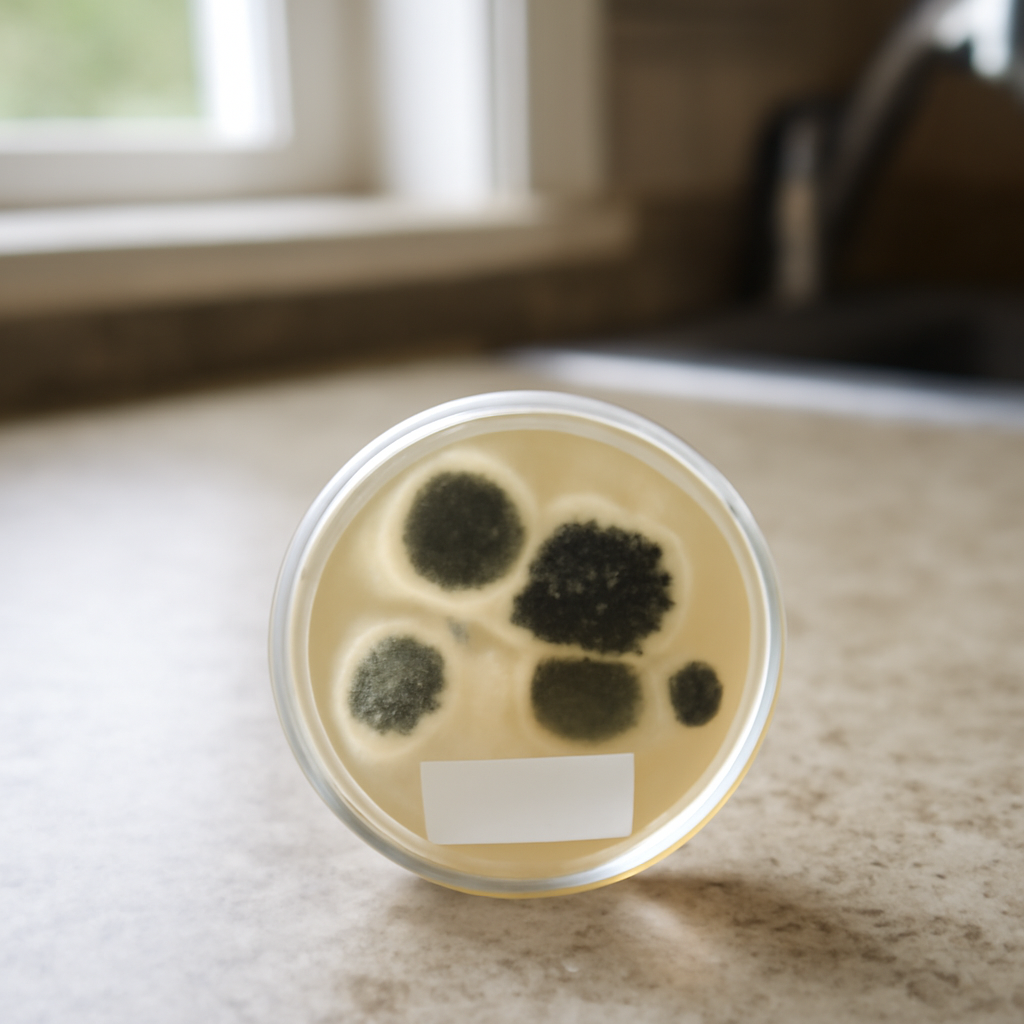
A mold in air test kit answers a specific question that surface swabs cannot: how many fungal spores are circulating in the room you actually breathe in. This guide summarizes EPA and CDC indoor-air guidance current as of 2026 and walks through the kit categories, sampling protocol, lab interpretation, and the situations where homeowners genuinely benefit from air testing versus where the money is better spent on remediation. Consult a board-certified allergist for symptom evaluation and a Certified Microbial Investigator (CMI) for any sampling tied to insurance claims, litigation, or post-remediation clearance.
Is this mold, asbestos, or water damage? Get a free instant screen
Upload a clear photo of the suspect area. You'll get an instant AI screening opinion and what to do next. This is screening guidance, not a professional determination.
Screening guidance only. AI can be wrong. Confirm asbestos, mold type, or lead with lab testing or a licensed professional before acting.
What a Mold in Air Test Kit Actually Measures
Air sampling kits pull a measured volume of indoor air through a spore-trap cassette over a defined time window, typically 5 to 15 minutes per sample. A laboratory then opens the cassette, stains the sample, and counts fungal spores by genus under a microscope. The output is a spore-per-cubic-meter number for each fungal type identified, plus a comparison to outdoor or other indoor samples you submit. The EPA does not publish national indoor-air spore thresholds because background levels vary by climate, season, and building type, but most industrial hygiene practitioners flag indoor counts that exceed paired outdoor controls by a meaningful margin.
What air test kits cannot do: locate hidden growth behind walls, identify species below the genus level, or measure viable versus non-viable spores. A cassette counts everything that lands on the trap, dead or alive. For species-level identification, a culturable air sample (Andersen impactor) is required, and that hardware is rented from industrial supply houses, not sold to homeowners.
The Two Main Kit Categories
Pump-Powered Spore Trap Cassettes
The professional-grade approach uses a calibrated air pump that draws air at a known flow rate (typically 15 liters per minute) for 5 to 10 minutes per sample. Cassette brands like Air-O-Cell, Allergenco-D, and Micro-5 attach to the pump intake. Rental cost for a homeowner is $50 to $100 per day, plus $35 to $75 per cassette for lab analysis. Total cost for a basic three-sample survey (one indoor problem area, one indoor control, one outdoor control) runs $200 to $400, which approaches the cost of a professional inspection.
Passive Settling Plates
The DIY consumer category is the agar settling plate. You expose the open plate to room air for one hour, then close and incubate. Brands like Mold Armor, ImmunoLytics, and DIY Mold Test sell these for $10 to $20 with optional lab analysis at $30 to $50. Passive plates cannot give a spore-per-cubic-meter count because they sample by gravity over an unmeasured volume, but they do provide a presence/absence read that is meaningful when paired with outdoor control plates. For a methodical workflow, our airborne mold testing guide covers the limits in detail.
How to Use a Mold in Air Test Kit Properly
Sampling protocol matters more than which brand you buy. Run all samples on the same day. Always pair indoor samples with one outdoor control taken at the same time, 10 to 20 feet from the building envelope, away from mulch or compost piles. Avoid sampling during HVAC cycling, vacuuming, or any activity that stirs settled dust. Take samples at breathing height (three to five feet above floor) in the center of the room rather than at corners or near surfaces. Keep the home in its normal state (windows closed, occupants present, HVAC at typical settings) rather than artificially preparing the space.
Document everything: room dimensions, sample time, temperature, humidity, recent water events, visible growth locations. Labs return more useful interpretations when the chain-of-custody paperwork is complete. Most lab turnaround is five to ten business days for non-expedited service.
Where to Place Samples Inside the Home
The highest-yield sampling locations in Front Range homes are basement living spaces, crawl-space access points, bathrooms with mechanical ventilation issues, and any room with a documented water-damage history. Take a sample in the suspect room, a second in a control room with no symptoms or history, and the outdoor control. If the suspect-room count exceeds both indoor control and outdoor control by 3x or more, you have meaningful evidence of an indoor amplification source.
For homes where occupants report symptoms in specific rooms, sample where they spend the most time. Bedroom and primary-living-room samples have more clinical relevance than utility-room samples because exposure duration matters more than peak concentration. The mold inspection and testing hub provides context on when in-room sampling is enough and when wall-cavity sampling is needed.
How to Read Air Test Results
Lab reports list each fungal genus identified with a spore-per-cubic-meter count for each sample. Look for three signals. First, the indoor-to-outdoor ratio: indoor counts higher than outdoor for the same genus indicate amplification inside. Second, water-damage indicators: Stachybotrys, Chaetomium, Fusarium, and Ulocladium indoors without outdoor presence suggest a moisture source on a porous building material. Third, total spore load: indoor totals above 5,000 spores per cubic meter generally warrant investigation regardless of genus mix.
Common environmental fungi like Cladosporium, Penicillium/Aspergillus, and Alternaria are present in nearly all indoor and outdoor air. Their presence is not the question; the question is whether indoor levels exceed the outdoor baseline meaningfully. The American Industrial Hygiene Association considers 10x indoor-to-outdoor ratios significant; some practitioners flag at 3x for vulnerable occupants.
When an Air Test Kit Is the Right Tool
Air sampling has the highest value in three scenarios. First, when occupants report symptoms with no visible mold and no obvious moisture source, sampling can identify hidden amplification. Second, post-remediation clearance after a documented water event, where you need to verify that remediation actually worked. Third, real-estate or insurance documentation where third-party numerical results carry more weight than a visual inspection.
Air testing is less useful when you can see and smell mold growth on a wall. In that situation, the EPA’s stance is straightforward: skip the sampling and remediate. Knowing that the visible patch is Cladosporium rather than Penicillium rarely changes the cleanup approach for an area under 10 square feet.
Cost Comparison
DIY passive plates: $10 to $20 per kit, $30 to $50 lab analysis optional. Pump-powered cassette rental: $200 to $400 for a three-sample survey. Professional indoor air quality assessment with CMI report: $300 to $700 in the Denver metro area, including site walk, equipment, lab fees, and written interpretation. For homeowners committed to DIY, three passive plates with lab analysis costs about $80 to $150 and answers most yes-or-no questions. For litigation, insurance claims, or clearance testing, the professional route is what reviewers accept.
Common Errors That Invalidate Air Test Results
The number-one error in DIY mold-in-air testing is omitting the outdoor control. Without paired outdoor data, indoor counts have no comparison and the result is uninterpretable. Some mold spores exist in nearly all outdoor air, especially during spring tree pollination and fall leaf decomposition. The question is always whether indoor levels exceed the outdoor baseline, not whether spores are present at all.
The second error is sampling during HVAC startup, vacuuming, or recent dust activity. These conditions artificially elevate spore counts for hours and produce false-positive results. Wait at least 24 hours after any cleaning, dust-stirring activity, or HVAC service before sampling.
The third error is sampling at the wrong location within a room. Air at the ceiling level reads differently from breathing-zone air, and corners hold static air that does not represent occupant exposure. Place the cassette or plate at three to five feet height in the center of the room, away from walls and furniture.
The fourth error is single-sample decision making. One sample is a snapshot under specific conditions. Reliable conclusions usually require at least three samples (suspect room, control room, outdoor) and ideally multiple sampling events on different days for symptom-driven investigations. Cross-reference with our broader how to test for mold in the air guide for multi-sample workflow.
Reading Lab Reports Without a Hygienist
Most labs return PDF reports that list each fungal genus detected with a numerical count or category indicator per sample. Three sections matter for any interpretation. First, the indoor-to-outdoor comparison table: look for genera where indoor counts exceed outdoor controls by 3x or more. Second, the water-damage indicator section if the lab provides one: Stachybotrys chartarum, Chaetomium, Fusarium, and Ulocladium indoors without outdoor presence are significant findings regardless of count. Third, the total spore-load summary: indoor totals above 5,000 spores per cubic meter generally warrant investigation.
Common environmental fungi (Cladosporium, Penicillium, Aspergillus, Alternaria) appear in nearly every sample. Their identification is expected; their elevation above outdoor controls is what matters. Cladosporium outdoor counts in Colorado often run 2,000 to 8,000 spores per cubic meter in spring and summer, so indoor counts in that range are not automatically concerning if outdoor counts are similar.
Lab interpretation narratives vary widely. Reputable labs add a written summary that translates raw counts into actionable guidance. Self-interpretation labs that return only raw numbers leave the homeowner to figure out significance, and that is where many DIY surveys go wrong.
Front Range Considerations
Colorado homes face specific air-quality variables that affect mold-in-air sampling. Wildfire smoke season (typically July through September) elevates outdoor particulate counts and can include fungal spores liberated from burned vegetation. Sample during smoke-free periods when possible, or document smoke conditions in collection notes so the lab can interpret outdoor controls appropriately.
Front Range humidity is generally low year-round (20% to 40% indoor without humidifiers), which suppresses mold growth in most living spaces but can create surprises in basements where ground moisture migrates through perimeter walls. Summer monsoon weeks push basement humidity above 60% and trigger most homeowner mold concerns.
Denver-metro homes built before the 1980s typically have minimal exterior waterproofing and seasonal basement moisture patterns. Air sampling in these basements without paired sampling in upper floors misses the gradient that helps identify the source. Run a sample on each floor plus outdoor for whole-home assessment. The mold inspection hub covers regional patterns.
What to Do With Results After Lab Analysis
A positive air test result that shows elevated indoor levels compared to outdoor controls leads to one of three response paths. For small visible patches under 10 square feet on non-porous surfaces, EPA guidance allows homeowner cleanup with appropriate PPE and detergent. For larger areas or porous-material involvement, professional remediation working to IICRC S520 standard is the appropriate response. For positive results without visible growth, investigate hidden moisture sources via borescope inspection, moisture-meter surveys, or wall-cavity air sampling before remediation.
A negative result paired with no visible growth and no occupant symptoms suggests the home is likely fine for the moment. Mold conditions can develop after the sampling event, so prevention measures (humidity below 50%, exhaust fans running, leaks repaired) matter regardless of test results. Periodic re-testing or continuous humidity monitoring catches conditions that develop later.
Ambiguous results (counts above outdoor controls but below 3x ratio thresholds) warrant either a second sampling event under different conditions or a professional inspection that integrates moisture mapping with sampling. Single-sample ambiguity often resolves with additional data.
References
- Mold Course Chapter 5: Mold Sampling — U.S. Environmental Protection Agency
- Mold: Basic Facts — Centers for Disease Control and Prevention
- Mold and Indoor Air Quality — National Institute of Environmental Health Sciences
- Mold Air Sampling Standards — InterNACHI
Front Range homeowners who want pump-grade air sampling without renting equipment can request a quote through our contact page and we will connect you with a local certified inspector.