Lead Paint Testing Companies Near Me: 2026 Service Guide
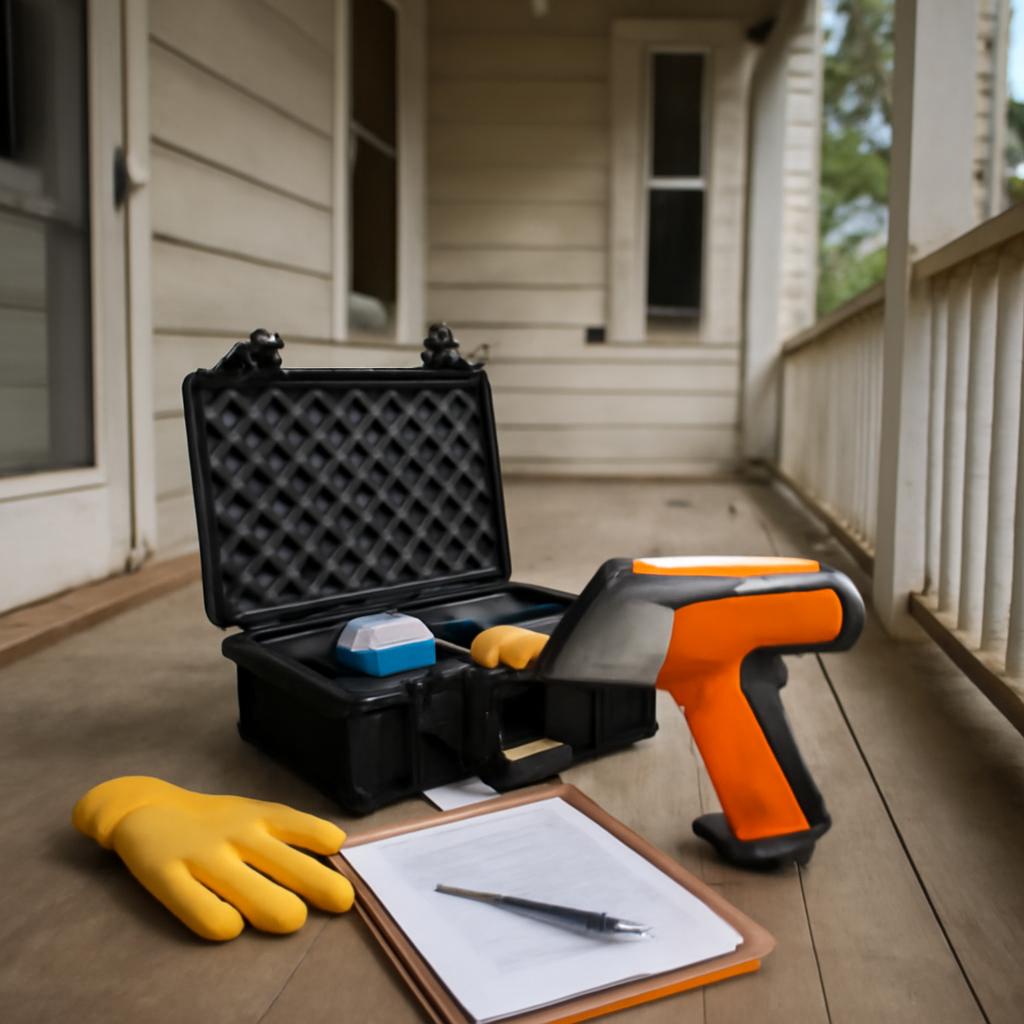
The search for lead paint testing companies near me almost always starts with the same situation: a buyer is under contract on a pre-1978 home, the seller disclosed peeling paint or there is a small child in the household, and the buyer needs to confirm whether the surfaces actually contain lead before deciding what to do next. The companies that can answer that question carry a specific federal credential — EPA-certified Lead Inspector or EPA-certified Risk Assessor — and the price for a typical Front Range single-family home runs $300 to $600 depending on the scope. This guide explains who is qualified, how to verify them, and what the service looks like from booking through report delivery. This guide summarizes EPA and HUD guidance current as of 2026 — consult a certified professional for testing decisions specific to your property.
Is this mold, asbestos, or water damage? Get a free instant screen
Upload a clear photo of the suspect area. You'll get an instant AI screening opinion and what to do next. This is screening guidance, not a professional determination.
Screening guidance only. AI can be wrong. Confirm asbestos, mold type, or lead with lab testing or a licensed professional before acting.
What does a lead paint testing company actually do?
A lead paint testing company performs one of three federally-recognized assessment types: a lead inspection (surface testing only), a lead risk assessment (surfaces plus dust and soil sampling plus written hazard control plan), or a combination inspection-and-risk-assessment that pulls both reports. The choice depends on what the homeowner needs from the result. A buyer who only wants to know whether painted surfaces contain lead orders an inspection. A landlord with a child tenant with elevated blood lead orders a risk assessment.
The testing itself happens on-site. The technician uses either an X-ray fluorescence (XRF) analyzer — a handheld device that reads lead content through paint layers without damaging the surface — or collects paint chip samples and ships them to an accredited laboratory. XRF is faster and non-destructive; lab chip testing is sometimes required for negative XRF readings to confirm or for thin paint layers where XRF accuracy drops. Dust wipe sampling, used in risk assessments, collects floor and windowsill dust onto pre-moistened wipes that get lab-analyzed for lead loading in micrograms per square foot.
Who is qualified to test in 2026?
Federal law restricts paid lead testing to individuals certified by EPA or by an EPA-authorized state program. The two relevant credentials are Lead Inspector (surface testing only) and Risk Assessor (surface plus dust/soil plus hazard control plan). Both certifications require initial training (16 to 32 hours), a proctored exam, and a state license filing in EPA-authorized states. Colorado is an EPA-authorized state; the Colorado Department of Public Health and Environment maintains the state’s certified-inspector list.
A homeowner verifying a company’s qualifications should ask for two things: the EPA certification number of the on-site technician (not just the company), and the state license for any EPA-authorized state where they work. Both should match. The Colorado Department of Public Health and Environment publishes a public lookup. EPA maintains a regional certified-firm database for non-authorized states.
Anyone considering testing should also read the broader asbestos and lead hazard guide to understand the regulatory backdrop. Companies that lack EPA certification cannot legally perform paid lead testing in target housing (pre-1978 housing where children may live) — that is a federal restriction, not a recommendation.
How do you find lead paint testing companies near you?
EPA’s regional certified-firm finder
The EPA’s Lead Renovation, Repair, and Painting program maintains a public-facing lookup for certified firms. While the tool is primarily used to find RRP renovators, it also includes certified Lead Inspector and Risk Assessor firms in many regions. The lookup is searchable by ZIP code and produces a list of certified firms with contact information. EPA does not endorse specific firms — the list is a credential registry, not a quality ranking.
State authorized-program directories
EPA-authorized states maintain their own certified-firm lists, which are usually more complete than the federal lookup. Colorado, Massachusetts, Oregon, and several other authorized states publish active lists. For Colorado homeowners, the CDPHE list is the authoritative source.
HUD-recognized environmental consultants
The HUD Lead Safe Housing Rule applies to federally-assisted housing. HUD maintains a network of recognized environmental consultants who perform risk assessments and clearance testing for HUD-funded properties. These firms also serve private clients and tend to have rigorous quality systems. The HUD Office of Healthy Homes and Lead Hazard Control publishes information about the rule and recognized testing approaches.
National testing chains and independent inspectors
Independent inspector-operated firms typically run $300 to $500 per single-family inspection in the Front Range market. National environmental-consulting chains (EMSL, Eurofins, and others) often run $500 to $800 because their pricing includes a larger lab-and-administration overhead. For most residential buyers, a verified independent inspector delivers the same federally-compliant result at lower cost.
What does a Front Range lead paint test cost in 2026?
The Denver-metro and broader Front Range market shows the following 2026 pricing patterns. A basic XRF surface scan of a 1,500-square-foot single-family pre-1978 home runs $300 to $500. Adding dust wipe sampling for a full risk assessment pushes the total to $500 to $750. A clearance test after lead-abatement work (different from initial assessment) runs $400 to $700. Lab-only chip testing without on-site service is the cheapest option at $30 to $80 per sample, but it requires the homeowner to collect samples correctly, which is a legitimate skill barrier.
Pricing variables include square footage (each additional 500 square feet typically adds $50 to $100), number of painted surfaces tested (a comprehensive scan of 20+ surfaces costs more than a targeted 5-surface scan), and travel distance (firms based in Denver charge more for jobs in Park County, Larimer County, or Pueblo). Same-week service typically costs no premium; same-day rush service adds 25 to 50%.
Front Range buyers comparing costs should also look at general lead paint test service options in their area to understand the range. For homeowners specifically wanting an inspector-as-professional perspective, the lead paint inspector service overview covers credentials and verification in depth.
How does the service actually flow?
Booking typically happens by phone or web form. The company asks for the property address, year built, square footage, number of painted rooms of interest, and the reason for testing (buyer-side due diligence, landlord compliance, child blood-lead follow-up, or renovation pre-work). Most firms can schedule within three to seven business days. Rush appointments are available at most firms for a 25 to 50% premium.
The on-site visit typically takes one to three hours. For a basic XRF inspection of a single-family home, expect 60 to 90 minutes. For a risk assessment with dust wipe sampling and exterior soil testing, expect two to four hours. The technician walks each room with the XRF analyzer, takes readings on representative painted surfaces (typically 4 to 8 readings per room), photographs each tested location, and collects any required chip or dust samples.
Lab turnaround for chip or dust samples runs three to seven business days in standard service, one to three days rush. The final report combines XRF readings, lab results, photographs, and a written interpretation. The report identifies surfaces that meet the EPA “lead-based paint” threshold (0.5 percent by weight or 1.0 milligram per square centimeter) and surfaces below the threshold. Risk-assessment reports add a hazard control plan with recommended actions.
How do you read the report and decide what to do?
The report’s key data point is whether tested surfaces exceed the federal “lead-based paint” threshold. Surfaces that exceed the threshold AND are deteriorated, friction surfaces (windows, doors), or impact surfaces are considered “lead hazards” under the HUD Lead Safe Housing Rule. Surfaces that exceed the threshold but remain intact and undisturbed are technically lead-containing but not necessarily lead hazards.
This distinction matters for the action decision. A buyer with confirmed lead hazards typically faces three options: walk away from the purchase, negotiate a price concession funded toward remediation, or proceed and plan lead-safe renovation. A landlord with confirmed lead hazards faces federal compliance obligations under the EPA RRP rule for any renovation work and under the HUD rule if the property accepts federal assistance.
The risk-assessment report’s hazard control plan is the action roadmap. It identifies which surfaces need attention, what the recommended interim controls are (paint stabilization, friction-surface enclosure), and which surfaces warrant full abatement. Interim controls are typically a fraction of the cost of abatement and often appropriate for surfaces that do not meet hazard criteria but are aging.
What about DIY lead test kits?
DIY test kits sold at hardware stores cost $10 to $30 and produce a yes/no color result. They are useful as a preliminary screen — if a kit returns positive, the surface almost certainly contains lead. They are unreliable for negative results because the chemistry can produce false negatives on dark-colored paints or thick paint layers. The EPA recognizes some DIY kits for screening purposes but does not accept them for federally-required risk assessment or clearance testing.
Most real-estate transactions involving lead testing require an EPA-certified professional’s report, not a DIY kit result. Buyers under contract on pre-1978 housing should plan for the $300 to $600 professional test rather than relying on $20 hardware-store kits. The DIY kit can be useful for low-stakes situations — a homeowner trying to decide whether a particular trim board is worth professional testing — but not for transaction-grade evidence.
What questions should you ask before hiring a testing company?
The screening conversation typically lasts 10 to 15 minutes and covers technical, scheduling, and pricing dimensions. The technical questions confirm credentials and method. Ask for the on-site technician’s individual EPA certification number (Lead Inspector or Risk Assessor) and the expiration date. Ask which XRF analyzer model the technician uses and confirm it appears on EPA’s Performance Characteristic Sheet (PCS) recognized list. Ask which NLLAP-accredited laboratory the firm uses for any chip or dust samples.
The scheduling questions confirm timing fit. Ask the earliest available appointment date, the typical on-site duration, the lab turnaround for chip and dust samples (rush vs standard), and the report delivery format and timing after the lab results return. Buyers under contract should verify the schedule fits inside their 10-day testing window with margin for lab analysis.
The pricing questions confirm the deliverable. Ask for the total quoted price including all on-site work, lab analysis, report delivery, and travel. Ask what triggers a price change (square footage above a threshold, additional sample requests, return visits). Ask about discounts for bundling with adjacent environmental services like radon, asbestos sampling, or water testing.
Companies that hesitate on any of these questions or refuse to provide the technician’s certification number in writing are appropriate to exclude. The federal credential framework is specifically designed to be verifiable in advance, and reputable firms understand that homeowners verifying credentials are doing the right thing.
What documentation should the final report include?
A complete Lead Inspector report should include the property address and inspection date, the technician’s certification number and signature, the XRF analyzer model and last calibration date, a property diagram showing each tested surface, the XRF reading for each tested surface in either mg/cm² or percent-by-weight, photographs of representative tested surfaces, and a written interpretation that identifies which surfaces meet the federal lead-based-paint definition.
A Risk Assessor report adds dust wipe sample locations and lab results (in micrograms per square foot), soil sample locations and lab results (in milligrams per kilogram for soil), and a written hazard control plan. The hazard control plan identifies recommended interim controls (paint stabilization, friction-surface treatment) and recommended abatement actions for each identified hazard. The plan is the action document for landlords or owners facing federal compliance obligations.
Both report types should include the laboratory chain-of-custody forms for any chip or dust samples, the original XRF readings file (digital export from the analyzer), and a signed statement from the certified technician affirming the work followed federal protocols. Reports lacking the chain-of-custody or certification statement may be insufficient for transaction or federal compliance purposes.
How does this fit into the overall pre-1978 home buying process?
Federal Title X requires sellers of pre-1978 housing to provide a lead-paint disclosure and the EPA “Protect Your Family From Lead in Your Home” pamphlet to buyers. The buyer then has a 10-day window to test for lead before closing, although the parties can waive or extend that window by mutual agreement. Most buyers who want testing schedule it in the first week of contract.
The standard home inspection does not include lead testing — that is an environmental hazard outside the typical SOP. Buyers wanting a comprehensive pre-purchase environmental review typically stack lead testing with radon testing, asbestos testing if popcorn ceilings or vinyl asbestos tile are present, and water testing if the home is on private well. Most testing firms can bundle two or three of these services into a single visit at a discount of 10 to 20% versus separate visits.
If you are in the Front Range and want to talk with a vetted inspector who can coordinate lead and adjacent environmental testing before your purchase, reach out through our contact page for a referral. We help connect buyers with EPA-certified professionals across Denver, Douglas, Jefferson, Arapahoe, and Boulder counties.
What does the post-test action timeline look like?
For most pre-purchase buyers, the action timeline starts the moment the report arrives. If the report shows no surfaces above the lead-based-paint threshold, the buyer typically proceeds with the transaction without further lead-related action. If the report shows lead-based paint but no current hazards (intact surfaces), the buyer typically proceeds with awareness — planning to avoid disturbing the painted surfaces during ordinary occupancy and to budget for lead-safe renovation when modifications eventually happen.
If the report identifies active lead hazards (deteriorated paint, friction surfaces, high dust loadings), the buyer faces a more substantial decision. Options include walking away from the purchase, negotiating a price concession funded toward remediation work, proceeding with the purchase and planning interim controls, or proceeding with the purchase and planning full abatement. Each option carries cost implications and risk implications that the buyer typically discusses with their agent and possibly an environmental consultant.
The 10-day federal testing window provides the time for testing and initial interpretation, but it does not provide time for full negotiation of remediation scope. Most transactions extend negotiation beyond the testing window through mutual agreement when lead hazards are identified. The buyer’s agent typically drafts the response document referencing the test results and proposed action.
What ongoing relationships do testing companies maintain with renovation contractors?
Reputable Lead Inspector and Risk Assessor firms typically maintain working relationships with EPA RRP-certified renovators and Lead Abatement Contractors. The testing company does not perform renovation or abatement (that would be a conflict of interest — separate from the testing function), but they can provide referrals to certified contractors who handle the action side.
The referral network is useful for homeowners new to the process. The testing company has typically worked with the local renovator and abatement community for years and can identify contractors with reliable practice. The buyer can verify any referred contractor’s EPA certification independently before signing.
Some testing firms also perform clearance testing — the post-abatement verification that confirms work was completed correctly and lead dust is below federal thresholds. Clearance testing must be performed by a Lead Inspector or Risk Assessor independent of the abatement contractor, so it remains a separate engagement from the abatement work itself.
References
- EPA Lead Renovation, Repair, and Painting Program — U.S. Environmental Protection Agency
- HUD Office of Lead Hazard Control and Healthy Homes — U.S. Department of Housing and Urban Development
- Colorado Department of Public Health and Environment — CDPHE
- CDC Childhood Lead Poisoning Prevention Program — Centers for Disease Control and Prevention
Front Range homeowners and buyers looking to coordinate lead paint testing with broader pre-purchase environmental work can connect with a vetted local inspector through our directory.
Lead paint test kits
Instant swab kits flag lead on painted surfaces in minutes — useful before a renovation in any pre-1978 home.
| Product | Why | Buy |
|---|---|---|
 3M LeadCheck Swabs 3M LeadCheck Swabs | EPA-recognized instant swabs. | Amazon — $208.00 |
 Lead Test Kit (lab-based) Lead Test Kit (lab-based) | Mail-in for a documented result. | Amazon — $35.00 |