FLIR Technology: Microbolometer, MSX, and Radiometric Files
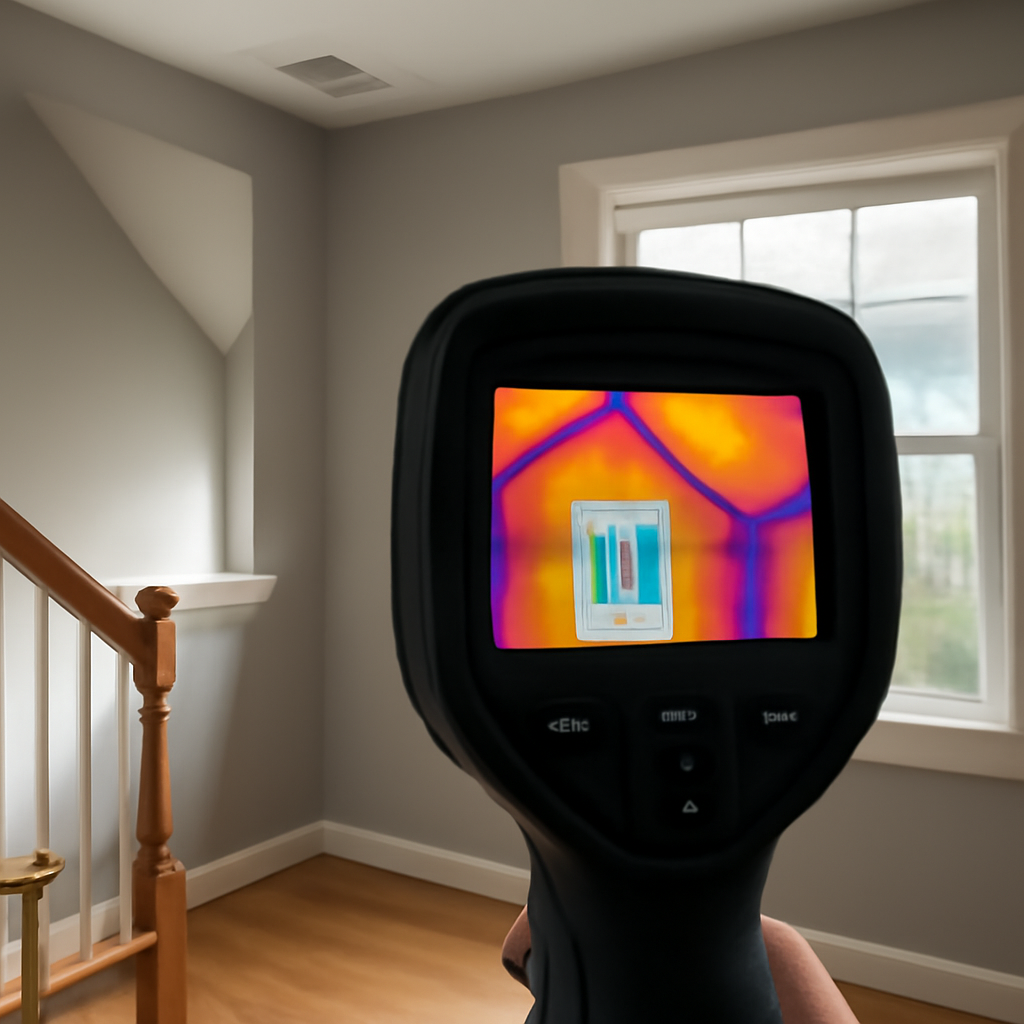
FLIR technology underpins most thermal cameras a homeowner or inspector encounters in residential work, but the brand name often obscures the underlying engineering. Three pieces of FLIR’s technology stack do most of the practical lifting: the microbolometer detector array, the MSX visible-light image fusion overlay, and the radiometric file format. Understanding what these technologies actually do clarifies why FLIR-branded cameras command a price premium, when that premium is justified, and which technologies competing manufacturers have closed the gap on. This guide treats FLIR technology as a vendor-neutral subject and routes citations to building-science authorities rather than the manufacturer.
What FLIR technology actually means inside a thermal camera
Every thermal imaging camera converts long-wave infrared radiation (roughly 8 to 14 micrometers) into a visible-light false-color image. The conversion happens at the microbolometer detector, a grid of tiny resistive elements that change resistance as they absorb infrared photons. FLIR’s distinctive technologies layer on top of that fundamental detection: MSX merges a visible-light camera image with the thermal frame; radiometric files embed full per-pixel temperature data; UltraMax and similar processing pipelines enhance effective resolution above the raw detector count. Department of Energy guidance on building thermography references these capabilities (resolution, sensitivity, image clarity) as the practical specs that determine whether a camera can document a real-world envelope defect.
Microbolometer detector arrays
The microbolometer is the heart of any uncooled thermal camera, including all FLIR consumer and prosumer cameras. Pixel count determines resolution. NETD (Noise Equivalent Temperature Difference) determines sensitivity, the smallest temperature delta the detector can resolve. FLIR uses Vanadium Oxide (VOx) microbolometers across most of its lineup; competing manufacturers use VOx or amorphous silicon. The detector technology itself is not uniquely FLIR; the integration, calibration, and signal-processing pipeline around it is what distinguishes the FLIR product.
MSX image fusion
MSX (Multi-Spectral Dynamic Imaging) is FLIR-patented and unique to FLIR cameras. The technology takes the edge-detection output of a small visible-light camera mounted alongside the thermal detector and overlays the visible edges onto the thermal image in real time. The result is that text on an electrical panel breaker, the outline of a door frame, or the edge of a ceiling stain remain readable in the thermal image. Without MSX, thermal images can be hard to interpret weeks later when context has faded. Competing manufacturers like Hikmicro and Topdon offer similar image-fusion features under different names, but the implementations are not identical.
Radiometric file format
A radiometric image embeds the full temperature measurement for every pixel rather than just the false-color rendering. When a thermographer opens a radiometric file later in FLIR Thermal Studio, they can change emissivity, span, level, and reference temperatures, and add measurement areas, all without re-shooting. This is the technical capability that makes FLIR the preferred brand for insurance-grade and litigation-grade work. Consumer FLIR cameras like the FLIR One Gen 3 store radiometric data; cheap off-brand cameras often store flat JPEGs only. The FLIR thermal imaging system workflow guide walks through how radiometric files move through the inspector’s report pipeline.
What FLIR technology lets you detect in a home
The practical residential applications of FLIR technology fall into four categories. Air-leakage detection uses the thermal pattern of infiltrating or exfiltrating air around windows, doors, rim joists, and electrical penetrations. Moisture detection identifies cool zones from evaporative cooling on wet drywall, sheathing, or insulation. Missing-insulation detection shows the stud-bay grid in exterior walls and the framing pattern in ceilings under attics. Electrical hotspot detection identifies overheating breakers, lugs, splices, and motors. InterNACHI and ASHRAE both describe these as qualitative findings that require physical confirmation by another method, typically a moisture meter for water and a licensed electrician for hotspots. The FLIR thermal camera images interpretation guide covers what these patterns look like in actual scans.
How FLIR technology differs from competing manufacturers
The competitive gap has narrowed in the last five years. Hikmicro, Topdon, and Klein Tools now ship cameras with detector resolution and NETD comparable to FLIR at similar price points. The remaining FLIR-only advantages are MSX image fusion (genuinely better than competing edge-overlay implementations), Thermal Studio software (more polished and more widely accepted by insurance carriers), and the FLIR-trained installed base of certified Level I, II, and III thermographers. Brand familiarity also matters: an inspection report with a recognizable FLIR camera in the metadata reads as more credible to non-technical clients and insurance adjusters, even if the underlying images would be indistinguishable from a Hikmicro shot.
What FLIR technology cannot do
Several common misconceptions about thermal imaging persist. FLIR cameras do not see through walls; they read surface temperatures only. They cannot see moisture directly; they see the evaporative cooling pattern that wet material creates against drier surroundings, which is why confirmation with a moisture meter is mandatory. They cannot reliably read temperatures through reflective surfaces like polished metal, glass, or shiny paint without applying high-emissivity tape. They are also bad at outdoor scans during direct sunlight because solar loading creates thermal noise that overwhelms the underlying signal. The home inspection tools 2026 buyer’s guide covers how thermography fits alongside moisture meters and borescopes to compensate for these limitations.
FLIR technology spec tiers across the product lineup
Detector resolution: 80×60 on FLIR One Gen 3, 160×120 on FLIR One Pro and C5, 320×240 on E54 and E76, 640×480 on E96 and T865. NETD: 50 to 70 mK on consumer cameras, 30 to 40 mK on prosumer and commercial. Spectral range: 7.5 to 14 micrometers across the lineup. Frame rate: 9 Hz on most consumer models (export-controlled threshold), 30 to 60 Hz on commercial. Temperature range: -20 to 250 C on consumer, -40 to 1500 C on commercial-spec cameras with multiple range settings.
Software ecosystem built on FLIR technology
FLIR Thermal Studio is the desktop software that handles radiometric image analysis. The free Standard version reads files, adjusts emissivity and span, and generates basic reports. Thermal Studio Pro adds batch processing, advanced report templates, and team collaboration. FLIR Ignite is the cloud companion. The FLIR mobile app handles phone-attach workflows. This software stack is where the FLIR price premium actually shows up; the camera hardware is increasingly commoditized, but the report pipeline is where insurers, courts, and certified thermographers still expect FLIR-branded deliverables.
When competing thermal technology is enough
For a homeowner doing personal walkthroughs, a Hikmicro or Topdon camera at half the price of an equivalent FLIR delivers usable images. For a landlord doing seasonal maintenance, the Hikmicro Pocket or Klein TI250 offer 90 percent of the FLIR value at 60 percent of the cost. For a working inspector building paid services, the report workflow and insurance recognition usually still justify staying inside the FLIR ecosystem, especially the E54 or higher.
MSX Image Fusion Explained
MSX, the Multi-Spectral Dynamic Imaging technology used in FLIR consumer and prosumer cameras, is one of those features that becomes obvious in importance the first time an inspector tries to read a six-month-old thermal image without it. A flat false-color thermal frame, viewed weeks after capture, can be genuinely difficult to localize. Is that warm patch in the upper-right corner of the bedroom or the living room? Which breaker is the bright pixel on? Without contextual reference, the image loses interpretability quickly.
MSX fixes the problem by running a visible-light edge-detection pipeline on a small companion camera mounted alongside the thermal detector. The edge map — outlines of windows, breaker labels, ceiling-tile grids, door frames, electrical-receptacle screws — is overlaid onto the thermal image in real time. The thermal data stays as the dominant color information; the visible-light edges add contextual reference that makes the image readable later. Department of Energy thermography guidance for building energy audits implicitly relies on this kind of image clarity when describing the documentation workflow for envelope and electrical findings.
What MSX is not: it is not a true thermal-visible composite (those are sometimes called “blended” images and they work differently). It is not visible to the thermal detector itself — the visible camera and the thermal detector are physically separate. It does not affect radiometric data accuracy; the per-pixel temperature values remain unchanged by the overlay. And it requires reasonable lighting to function; in pitch dark, the visible-light edge-detection pipeline has nothing to work with, and MSX falls back to a thermal-only image.
Alternatives in other brands: Hikmicro offers a similar feature marketed as Adaptive Fusion that uses edge-detection from a visible-light companion camera. Topdon’s Super-IR mode and Klein’s image-blending modes work along similar lines. None of these implementations is identical to MSX, and certified thermographers report that MSX retains a noticeable edge in clarity and contrast at typical inspection distances. For homeowner use, any of the major-brand fusion technologies produces interpretable images; the differences matter most in evidentiary-grade work where every detail of the image has to remain legible months later.
Vivid IR Color Palettes
The false-color palette a thermographer chooses dramatically affects what becomes visible in an image. The same underlying radiometric data, displayed through different color mappings, can highlight different features. FLIR cameras ship with a standard palette set that is broadly aligned with industry conventions; understanding when to use each palette is part of the operator-skill curve that InterNACHI thermography certification covers.
Iron. The Iron palette maps cold temperatures to dark purple and black, mid-range to red and orange, and hot temperatures to bright yellow and white. It is the default on most FLIR cameras and is the most intuitive for general-purpose work: hot spots leap off the image. It is the typical choice for electrical-panel scans, hot-plumbing-line tracing, and general moisture work where contrast at the warm end of the scale matters most.
Rainbow. The Rainbow palette spreads color across the full visible spectrum, with blue at the cold end and red at the hot end. It provides the highest temperature-step resolution in the middle of the dynamic range, which makes it useful for subtle thermal patterns — building-envelope air-leak surveys with modest temperature differentials, condensation-pattern mapping on cool walls. The trade-off is that Rainbow can produce visually busy images that less-experienced viewers find harder to interpret.
Grayscale. The Grayscale palette uses only black-to-white tonal range. It produces images that read like a photograph and is often the preferred palette for documentation-grade work where the image will be reproduced in monochrome reports or printed documents. Some certified thermographers use Grayscale during analysis to remove color bias from their pattern interpretation, then switch to Iron for the final report image.
Lava. The Lava palette compresses the cold end of the range into deep purple and emphasizes the warm end with red, orange, and yellow. It is similar in spirit to Iron but with more saturation at the warm end, making it useful when the area of interest is a localized hot spot against a uniform cooler background. Electrical-panel scans are a typical use case.
Hot Iron. Hot Iron is a variant of Iron that compresses the cold end into a tighter dark band and gives more dynamic range to the warm portion of the scale. ASHRAE building-diagnostic resources and InterNACHI continuing-education materials describe Hot Iron as a useful palette for industrial-electrical and steam-trap inspections where the operator is hunting one hot spot among many cooler reference surfaces.
Arctic. Arctic inverts the typical convention by emphasizing the cold end of the scale with strong blue and cyan colors. It is useful in summer water-leak investigations where the area of interest is a cool wet patch against warmer dry surroundings — the leak shows up vividly while uninteresting warm areas fade into neutral tones. Air-leak surveys in summer air-conditioned spaces also benefit from Arctic for the same reason.
References
- DOE home energy audits and thermography — U.S. Department of Energy
- InterNACHI infrared thermography — International Association of Certified Home Inspectors
- ASHRAE standards and guidelines — American Society of Heating, Refrigerating and Air-Conditioning Engineers
- ICC building codes and standards — International Code Council
Thermal imaging cameras
Infrared cameras reveal hidden moisture, missing insulation, and air leaks. Phone-attachment models are the budget entry point; standalone units have higher resolution.
| Product | Why | Buy |
|---|---|---|
 FLIR ONE Pro (phone) FLIR ONE Pro (phone) | Plugs into iPhone/Android; inspector favorite. | Amazon — $329.00 |
 Topdon TC001 Topdon TC001 | High-res phone module at a low price. | Amazon — $199.99 |
 FLIR C5 Compact FLIR C5 Compact | Standalone pocket camera with Wi-Fi. | Amazon — $610.06 |