FLIR Scout TK: What Homeowners Need to Know
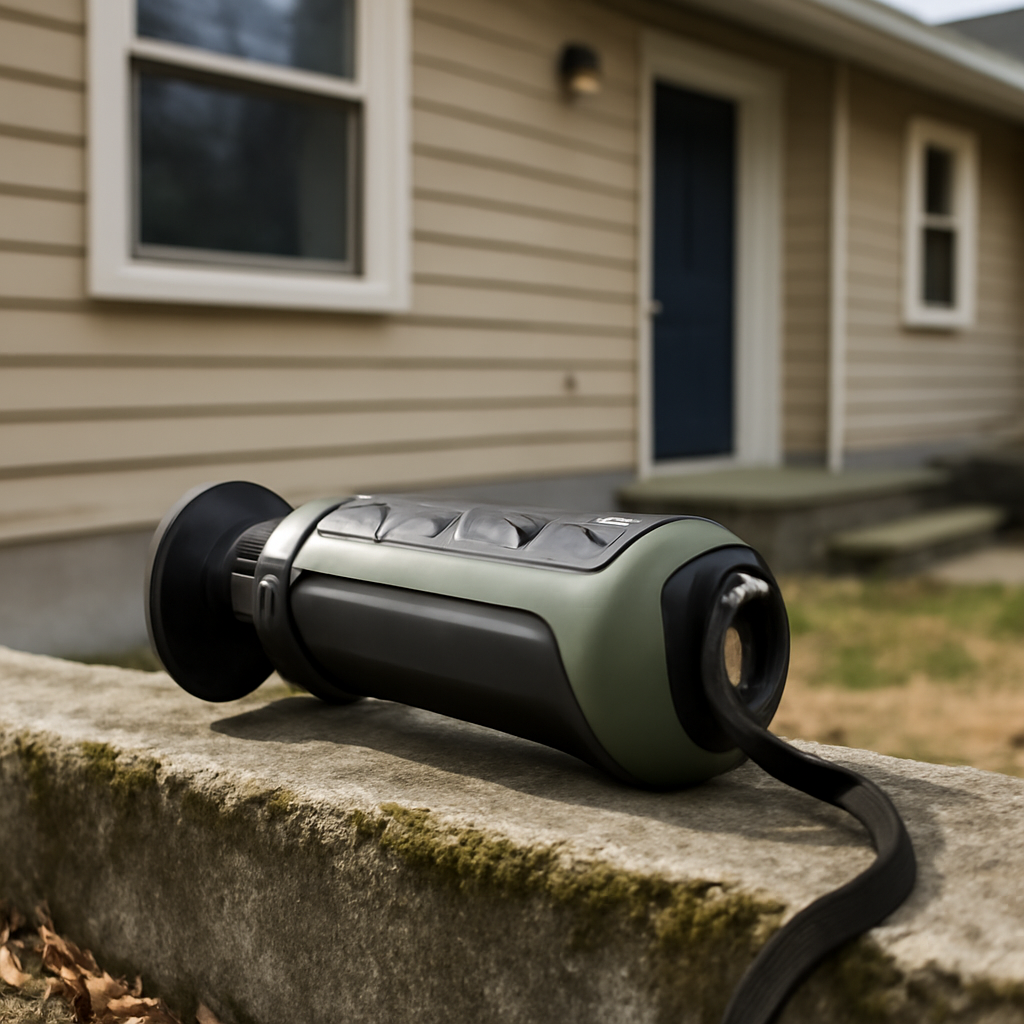
The FLIR Scout TK shows up constantly in homeowner searches because it is one of the least expensive ways to own a pocket thermal device. It is worth understanding clearly before buying, because the FLIR Scout TK was designed for outdoor observation and wildlife spotting, not for the close-range diagnostic work a home inspection demands. This guide explains what the device is, what its specifications mean in practice, and where it fits — and does not fit — in a home-maintenance toolkit.
What is the FLIR Scout TK?
The Scout TK is a handheld thermal imaging monocular: a single-eyepiece, look-through device that detects heat radiating from objects and renders it as a visible image on a small built-in screen. You hold it up like a small spotting scope, point it at a scene, and see warm objects glow against cooler surroundings. It was marketed primarily for nighttime situational awareness, hunting, and detecting animals or people in the dark at distances of dozens of meters.
That design purpose is the key to understanding its limits for home use. A monocular built to spot a deer at 100 meters is optimized for range and contrast at distance, not for measuring the precise temperature of a damp spot on a wall a few feet away. It is a heat viewer, not a measurement instrument. The American Society of Home Inspectors and InterNACHI both frame thermal imaging as a method for finding temperature anomalies that warrant further investigation — and the Scout TK can technically reveal an anomaly, but with significant caveats covered below.
The “monocular” form factor itself shapes how the device behaves. Unlike a camera you hold at arm’s length and review on a bright screen, a monocular is meant to be held to the eye while you scan. That is comfortable for walking a property line at night and awkward for documenting a finding you want to photograph, annotate, and email to a contractor. Understanding that ergonomic mismatch up front saves disappointment.
FLIR Scout TK specifications that matter
The numbers tell the story of what this device can and cannot do:
- Thermal resolution: 160 x 120 microbolometer detector. That is a low resolution by current standards — fewer than 20,000 thermal pixels — producing a coarse, blocky image compared with higher-end inspection cameras.
- Display: a small built-in LCD viewed through the eyepiece, not a large bright touchscreen.
- Detection range: rated to detect a human-sized heat source out to roughly 100 meters, reflecting its observation focus, with recognition (telling what the object is) at a much shorter distance.
- No radiometric temperature readout: the Scout TK shows relative heat but does not give a calibrated temperature value for a specific spot. This is arguably the single biggest limitation for inspection-style use.
- Refresh rate: a modest frame rate suitable for scanning a static scene; fine for slow panning, not for fast motion.
- Color palettes: several selectable palettes (white-hot, black-hot, and color options) that change how heat differences are displayed but do not add measurement capability.
- Image capture: the ability to save still images and short clips to internal storage for later transfer.
- Battery: internal rechargeable lithium cell, with runtime measured in a few hours of continuous use.
- Price: historically one of the lowest entry points into thermal, typically in the low hundreds of dollars.
Two specifications deserve extra weight for anyone thinking about home use. Resolution determines how small a thermal feature you can resolve; at 160 x 120, a narrow gap in insulation or a thin moisture plume can blur into the surrounding pixels. And the absence of radiometric measurement means you can see that one area is “warmer” but cannot say by how many degrees — which is exactly the data inspectors rely on to separate a real defect from normal variation. For comparison, dedicated inspection imagers commonly offer radiometric measurement, higher resolution, and an on-screen temperature scale.
Can the FLIR Scout TK be used for home inspection?
In a limited, qualitative way, yes — with realistic expectations. Because it visualizes relative temperature differences, the Scout TK can sometimes reveal:
- Gross missing insulation, where a large wall section reads noticeably colder or warmer than adjacent areas in winter or summer.
- Obvious air leaks around doors and windows that create a visible thermal plume, the kind of energy loss the Department of Energy describes in its guidance on finding drafts.
- Large temperature contrasts that hint at a problem worth a closer look, such as a radiant-floor loop or an overheating fixture.
What it does poorly is everything requiring precision. Tracing the subtle thermal signature of moisture behind drywall, pinpointing an electrical hot spot at a breaker, or documenting a finding with a measured temperature differential all benefit from radiometric data and higher resolution that the Scout TK lacks. Thermal imaging also only ever shows surface temperature patterns — it never “sees through” walls — so interpretation always requires confirmation with another method. Our explainer on what thermal imaging is covers why a thermal camera detects surface heat rather than hidden objects, and the broader home inspection tools buyer’s guide places thermal monoculars in the wider equipment landscape.
Confirming what you see
A thermal anomaly is a lead, not a diagnosis. A cold patch could be moisture, missing insulation, or simply a stud behind the drywall. Seasoned inspectors confirm suspected moisture with a moisture meter and verify electrical concerns with appropriate testing rather than acting on the thermal image alone. The Scout TK gives you the first clue; other tools give you the answer. This two-step discipline matters more, not less, with a low-resolution non-radiometric device, because the image is more ambiguous to begin with.
Alternatives worth comparing
If your goal is genuine home diagnostics rather than outdoor observation, two categories deserve a look. Phone-attachment thermal cameras add a thermal sensor to a smartphone and often include radiometric measurement and image annotation at a comparable price point — our overview of the FLIR One thermal imaging camera describes that class. Standalone pocket thermal cameras designed for building diagnostics typically pair higher resolution with on-screen temperature scales and a spot-temperature crosshair. The closely related FLIR Scout family overview compares the observation-focused models against one another.
The honest framing: the Scout TK is a capable observation monocular at a low price, but it is the wrong starting point for someone whose real aim is diagnosing a home. A buyer focused on moisture, insulation, and electrical issues is better served by a radiometric device, even an inexpensive one. A buyer who genuinely wants night observation and treats occasional home use as a bonus may find the Scout TK fits, as long as expectations stay modest.
Reading thermal images correctly
One reason inexpensive thermal devices frustrate new owners is reflection and emissivity. Shiny surfaces like polished metal, glass, and glossy tile reflect the thermal signature of other objects, producing misleading readings. Sun-warmed surfaces hold heat for hours and can mask or mimic a defect. The best results come from scanning when there is a meaningful temperature difference between inside and outside — typically early morning, evening, or any time the home’s heating or cooling has created contrast. These principles apply to every thermal tool, but they bite harder on a coarse-resolution device where there is less detail to interpret.
Realistic home use cases, season by season
For an owner who already has a Scout TK or buys one mainly for observation, several household tasks are genuinely within reach. In winter, scanning interior walls and ceilings on a cold morning can expose large insulation gaps, which show as cold streaks or patches against warmer, well-insulated areas. Drafty windows and doors reveal themselves as cool plumes spilling inward, and an attic hatch or recessed light fixture that leaks conditioned air often glows differently from the surrounding ceiling. The Department of Energy notes that air sealing and insulation are among the highest-return home efficiency upgrades, and a thermal scan helps prioritize where to spend.
In summer, the contrast flips: sun-baked walls and poorly insulated ceilings read hot, and an air-conditioning supply that is not reaching a room can show as a warm zone. Year-round, a Scout TK can sometimes flag an unusually warm electrical panel cover or a recessed fixture running hotter than its neighbors, which is a cue to bring in a qualified electrician — never to start probing live components yourself. What the device cannot do well in any season is fine moisture work, where the temperature differences are small and a coarse image hides the detail. For that, a moisture meter is the right companion tool, and our buyer’s guide covers how those two instruments work together.
What it will not replace
It helps to be blunt about boundaries. The Scout TK will not give you a measured temperature delta to put in a report. It will not resolve the tight thermal patterns of a slab leak or a pinhole pipe failure. It will not document a finding with the clarity a contractor or insurer expects. And it cannot confirm that a thermal anomaly is moisture rather than a framing member. None of that makes it useless — it makes it a screening tool whose findings you verify with better-suited instruments. Treating it as a definitive diagnostic device is where buyers go wrong.
Maintenance and care
Thermal monoculars are relatively low-maintenance but not maintenance-free. Keep the germanium lens clean with a proper optical cloth — never wipe it with paper towels or shirt fabric, which can scratch the coating. Store it in a dry case to protect against the dust and moisture that degrade electronics. Charge the internal battery periodically even during storage, since lithium cells degrade if left fully depleted. The device has no field calibration the homeowner can perform; if image quality drifts, that is a manufacturer service matter. Avoid pointing any thermal optic directly at the sun, which can permanently damage the sensor. Following these habits keeps a thermal device usable for many years, since the electronics themselves rarely wear out under normal handling.
Buying criteria: should you choose the Scout TK?
Weigh the decision against your actual purpose. Buy the Scout TK if you primarily want a low-cost outdoor thermal monocular for property walks, wildlife, or general night observation, and you accept that any home use is a secondary bonus. Look elsewhere if your main motivation is diagnosing the home — energy audits, moisture investigation, or electrical screening — because the lack of radiometric measurement and the 160 x 120 resolution will frustrate that work.
A short checklist for any thermal purchase: confirm whether the device is radiometric (gives real temperatures) or just a viewer; check the detector resolution, since more thermal pixels mean clearer anomalies; consider how you will review and share images, since a monocular eyepiece is poor for documentation; and match the detection range to your need, because long-range observation specs add nothing to short-range wall scanning. Trade bodies that certify thermographers, including InterNACHI, stress training as much as equipment — a better camera in untrained hands still produces misleading results, and a modest device used carefully can still surface real problems. The instrument is only half the equation; interpretation is the other half.
References
- Infrared Thermography Inspection Standards — International Association of Certified Home Inspectors
- Standard of Practice — American Society of Home Inspectors
- Detecting Air Leaks and Energy Loss — U.S. Department of Energy
Thermal imaging cameras
Infrared cameras reveal hidden moisture, missing insulation, and air leaks. Phone-attachment models are the budget entry point; standalone units have higher resolution.
| Product | Why | Buy |
|---|---|---|
 FLIR ONE Pro (phone) FLIR ONE Pro (phone) | Plugs into iPhone/Android; inspector favorite. | Amazon — $349.00 |
 Topdon TC001 Topdon TC001 | High-res phone module at a low price. | Amazon — $199.99 |
 FLIR C5 Compact FLIR C5 Compact | Standalone pocket camera with Wi-Fi. | Amazon — $449.00 |