How Does Black Mold Happen: A Plain-Language Guide
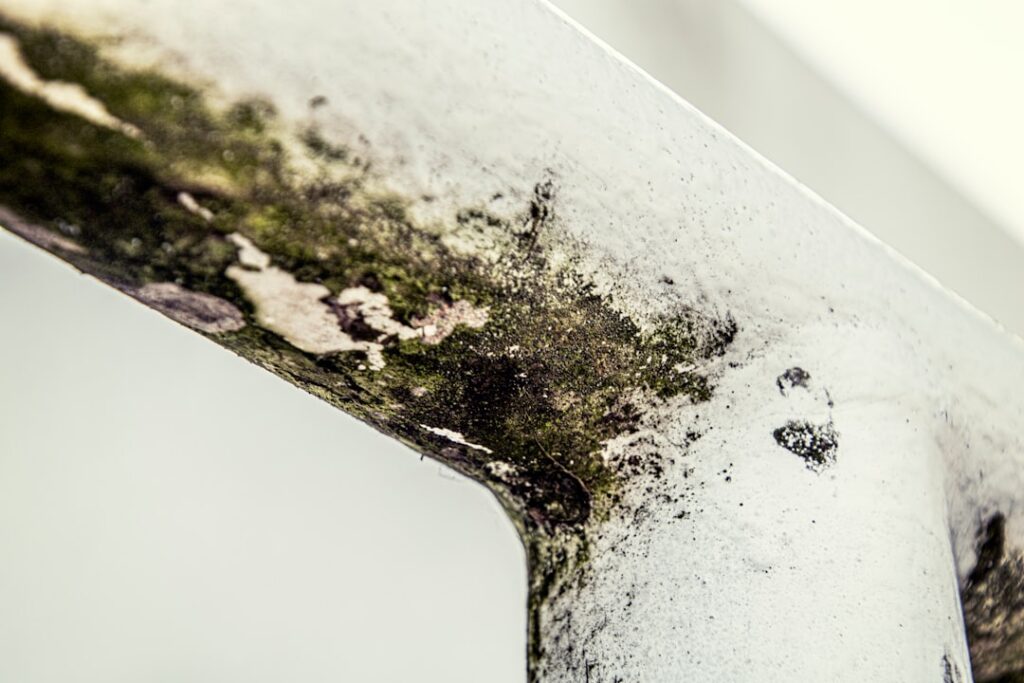
Where the “what does black mold come from” question looks at origins, “how does black mold happen” is about the chain of events that turns a wet drywall corner into a visible colony two weeks later. This guide summarizes EPA, CDC, and NIEHS guidance on residential mold for homeowners current as of 2026. It is not medical advice; symptoms believed to be related to mold exposure deserve a physician’s evaluation. The aim here is to make the timeline visible so homeowners recognize the early-warning windows they otherwise miss.
Is this mold, asbestos, or water damage? Get a free instant screen
Upload a clear photo of the suspect area. You'll get an instant AI screening opinion and what to do next. This is screening guidance, not a professional determination.
Screening guidance only. AI can be wrong. Confirm asbestos, mold type, or lead with lab testing or a licensed professional before acting.
How does black mold happen, step by step
The process happens in roughly five stages: spore deposition, germination, hyphal extension, sporulation and colony maturation, and visible expansion across a surface. The full cycle on cellulose substrate with sustained moisture can complete in days to weeks. Black mold doesn’t appear overnight as a finished product — the surface a homeowner notices on day fourteen has been growing since day one or two of the wet event, just below visibility.
Stage one: spore deposition
Mold spores are airborne and ubiquitous. Outdoor air, indoor dust, HVAC filters, and shoe traffic distribute spores onto every horizontal surface in a house every day. Deposition is constant. Deposition itself is not the problem — dry spores on dry surfaces do nothing for as long as conditions stay dry. This is why a slightly dusty unused room with no leaks does not develop visible mold despite the constant deposition.
Stage two: germination (24-48 hours after moisture)
When liquid water or sustained high humidity reaches a deposited spore sitting on an organic surface, germination begins. EPA’s residential guidance and ASHRAE’s indoor environmental quality literature both cite a 24-48 hour window — wet organic materials must be dried within that window to prevent germination. Germination is not yet visible to a homeowner. The spore has produced a hyphal tube, but the structure is microscopic.
Stage three: hyphal extension (day two through roughly day seven)
The hyphae extend through the cellulose substrate, drawing nutrients and water as the colony establishes. During this phase the surface may smell musty before anything is visible — odor is often the earliest sign of indoor mold growth. Some species form visible discoloration earlier, others not until later. The substrate matters: paper-faced drywall is fast, painted wood is slower, sealed concrete and ceramic resist colony establishment.
Stage four: sporulation and color development (day seven through roughly day fourteen)
The mature colony begins producing new spores. This is the stage where dark pigmented species like Stachybotrys chartarum, Aspergillus niger, and various Cladosporium species develop the characteristic black, brown, or greenish-black appearance homeowners recognize. The colony is now self-sustaining as long as moisture continues. New spores release into the air and onto adjacent surfaces, where the cycle can restart.
Stage five: visible expansion (week two and beyond)
Without intervention, the colony expands radially across the substrate and through the substrate. On drywall, a colony that began on one side of a paper face can colonize the gypsum core and emerge on the opposite face — meaning the visible spot on a finished wall is often smaller than the actual colonized area inside the wall cavity. The black mold spread guide in our cluster covers the expansion phase in more detail.
The conditions that drive the timeline faster or slower
The 24-48 hour germination window assumes typical residential conditions. The actual speed depends on temperature, moisture level, substrate, and species.
Temperature
Most common indoor molds grow fastest between approximately 70 and 85 degrees Fahrenheit. Below 50 degrees, growth slows significantly. Above 100 degrees, most species are inhibited. Front Range basements at 65 degrees in winter slow but do not stop the process. A warm, humid summer attic above the ceiling accelerates it.
Moisture intensity
Standing water on cellulose germinates spores fastest. High relative humidity above 60 percent, without liquid water, also supports growth but more slowly. A wall that gets briefly damp and dries within hours is far less likely to grow mold than a wall that stays at 70 percent surface humidity for a week.
Substrate
Paper-faced drywall, untreated wood, paper-backed insulation, and cardboard are the fastest substrates. Painted drywall is slower but still vulnerable. Mold-resistant (paperless) drywall is significantly slower. Glass, ceramic, sealed concrete, and stainless steel essentially do not support mold growth directly — though dust accumulation on those surfaces can.
Species
Cladosporium and Aspergillus are often the first colonizers and can become visible within a week on wet drywall. Stachybotrys chartarum typically requires longer sustained moisture — often 7-14 days of continuous wetness before it dominates a colony. This is why Stachybotrys is more common in homes with chronic, slow leaks than in homes with a single quickly-dried water event.
The most common ways black mold “happens” in real homes
Translating the biology into homeowner-recognizable events: the patterns below are the recurring scenarios in remediation case logs.
The slow under-sink drip
A supply-line fitting at a sink develops a slow drip that wets the cabinet base over weeks. The homeowner doesn’t notice because the cabinet is closed and items are stacked inside. Cabinet bottom swells, fragrant cleaning products mask the early musty smell, and by the time anyone looks the colony has established on cabinet bottom, subfloor, and lower drywall.
The bathroom fan that vents into the attic
Older construction sometimes terminates the bathroom exhaust ducting in the attic rather than outside the roof or soffit. Every shower deposits moisture into the attic. Over a season, the underside of the roof sheathing above the bathroom develops a colony invisible from the living space. An attic visit reveals it.
The post-flood basement that wasn’t fully dried
A washing-machine hose fails. The homeowner mops up visible water within hours and runs a fan. Drywall and baseboards look dry on the surface. Inside the wall cavity, framing and insulation stay damp for days. Mold establishes behind the wall while the visible surface looks clean.
The chronic humidity problem
A finished basement in a humid summer climate runs at 65-70 percent relative humidity. There is no leak. Mold colonies appear on stored cardboard boxes against the wall, on the back of fabric furniture, and along the bottom edge of finished walls. The cause is humidity alone — no event, no leak, just sustained dampness.
The cold-surface condensation cycle
A single-pane window or a poorly insulated rim joist creates a surface that drops below the indoor dew point in winter. Water condenses on that surface daily. Window sills, wall-to-floor corners at exterior walls, and cold-water supply pipes wrapped in cellulose insulation can develop mold from condensation alone. The home’s infrared and moisture inspection tools identify these cold spots.
Where homeowners break the chain
The process has multiple intervention points. Earlier intervention requires less work and prevents more damage.
Before germination: the 24-48 hour drying window
Any water event — burst pipe, dishwasher leak, sewer backup, snowmelt intrusion — has a roughly 48-hour window in which thorough drying prevents mold establishment. Drying means moving the moisture out of the affected materials, not just off the surface. Industrial fans, dehumidifiers, raising the indoor temperature, removing soaked porous materials, and exposing concealed framing all help. The mold inspection pillar covers post-water-event drying in more detail.
During hyphal extension: the early musty smell
If the 48-hour window was missed but homeowners notice a musty smell in the following week, the colony is established but small. Source repair, removal of small affected materials, and HEPA-vacuum cleaning of adjacent surfaces typically resolve the problem with minimal disruption. Our early black mold guide walks through this catch-it-fast phase.
After visible appearance: the standard remediation phase
Once visible growth appears, EPA guidance scales the response by size. Under 10 square feet of affected surface is generally homeowner-manageable on hard, non-porous materials with appropriate PPE. Larger affected areas, hidden colonies suspected from smell or hidden damage, HVAC contamination, or any sewage-related water damage warrant a professional remediation contractor following IICRC S520 standards.
What “doing nothing” produces
Without intervention, a small mold colony in a continuously wet environment continues to expand for as long as moisture and substrate are available. Structural damage from prolonged moisture — rotted framing, delaminated subfloor, compromised drywall — eventually exceeds the cost of the original leak repair. Indoor air spore concentrations increase. Sensitive household members may develop or worsen respiratory symptoms (a clinical determination by a physician). Resale disclosures become more complicated. Insurance claims become harder to substantiate.
The realistic homeowner timeline: drying within 48 hours saves the most money. Catching the smell within the first two weeks saves the next-most. Visible growth caught within a month is still manageable. Multi-month chronic problems are the expensive ones.
How “black mold” differs from other mold colonies in the timeline
The popular search term “black mold” usually refers specifically to Stachybotrys chartarum, though several other dark-pigmented species (Aspergillus niger, certain Cladosporium strains, Alternaria) also produce dark colonies. Each species has a slightly different timeline, which matters when interpreting what a homeowner is seeing.
Stachybotrys chartarum timeline
Stachybotrys typically requires longer sustained moisture than many faster-colonizing species. Research and remediation case studies cite 7-14 days of continuous wetness on cellulose substrates before Stachybotrys dominates a colony. This means a single quickly-dried water event rarely produces Stachybotrys growth; a chronic slow leak or extended high-humidity exposure produces the conditions where Stachybotrys thrives.
Aspergillus and Cladosporium timeline
These genera include species that establish faster — sometimes within days of moisture exposure. They are often the first colonizers on wet drywall, with visible growth appearing in the first week. Cladosporium in particular is a common early indicator on slightly damp surfaces.
The mixed-colony reality
Most actual residential mold colonies contain multiple species. Surface sampling at accredited labs often returns mixed identification. The implication for homeowners: trying to identify “what species this is” from appearance alone is unreliable. The species mix matters less for cleanup decisions than the moisture source and the substrate. EPA guidance treats visible growth as treatment-worthy regardless of species.
What a working inspector documents during the start phase
When a homeowner suspects mold has started but is uncertain, professional documentation supports cleanup decisions and insurance interactions.
Moisture readings on affected and adjacent materials provide objective data on substrate conditions. Thermal imagery maps temperature anomalies that often indicate wet areas inside walls. Photo documentation captures the current state for before/after comparison. Sketches or measurements define the affected area. When laboratory confirmation is part of the scope — typically for insurance documentation or contested-claim purposes — surface tape lifts or air samples processed at accredited labs add species and concentration data to the file.
The documentation also feeds the remediation scope. A scope built from objective measurements (X square feet affected, moisture readings of Y, hidden cavity confirmation via borescope) is more defensible than a scope built from visual observation alone. For larger projects, this documentation supports contract scope and post-remediation verification.
References
- A brief guide to mold, moisture, and your home — U.S. Environmental Protection Agency
- Basic facts about mold and dampness — Centers for Disease Control and Prevention
- Indoor environmental quality guidance — American Society of Heating, Refrigerating and Air-Conditioning Engineers
If a recent leak has dried but a musty smell persists, Front Range homeowners can reach out through our contact page for a moisture and source assessment from a vetted local inspector.