FLIR Thermal Camera: Why the Brand Dominates in 2026
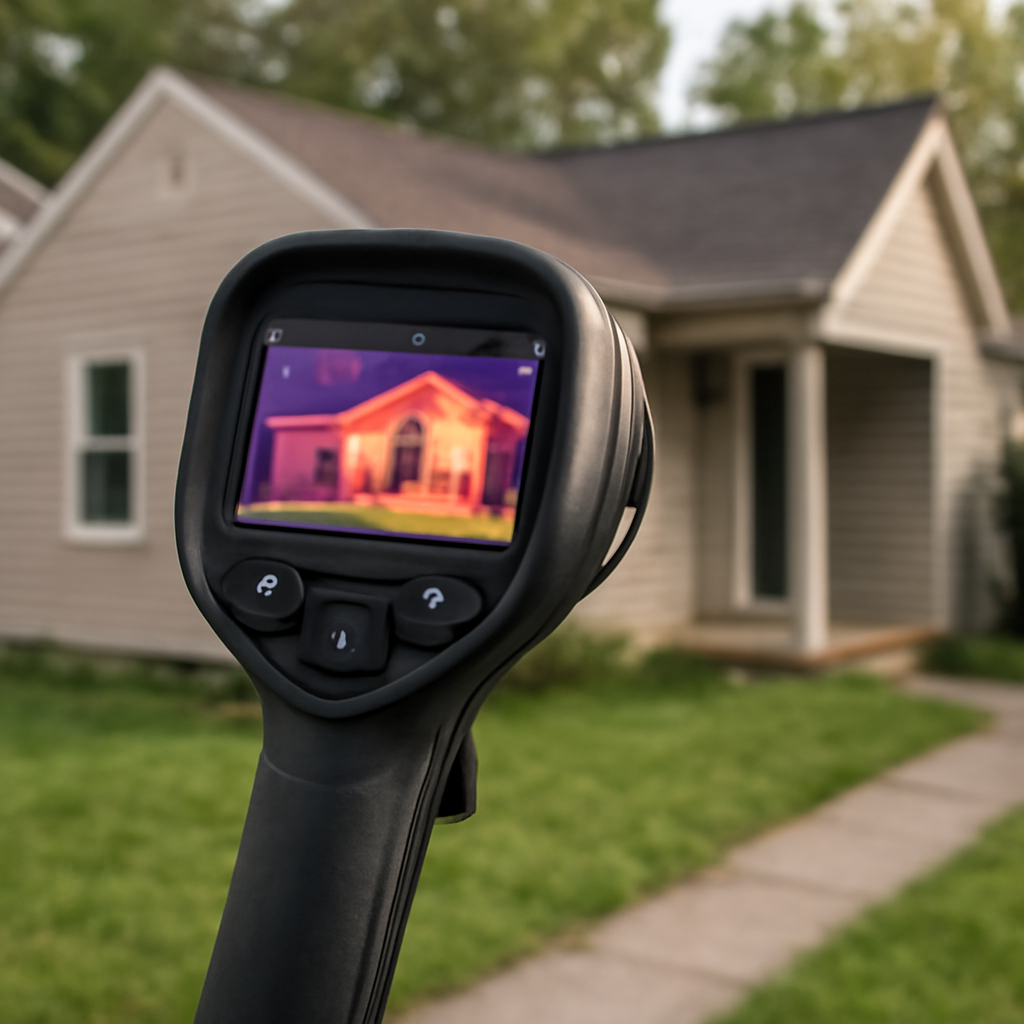
A FLIR thermal camera dominates the home-inspection and energy-audit market for reasons that go beyond brand recognition. FLIR Systems built early advantage in detector technology, expanded into the consumer space before competitors, and now anchors a software ecosystem that competing brands struggle to match. The market-positioning question that matters for buyers is not whether FLIR is “the best” abstractly, but whether the FLIR premium over Fluke, Hikmicro, or Topdon delivers value in the specific use case. This guide walks through the market-share landscape, the brand-versus-brand trade-offs, and how to decide whether the FLIR premium is worth paying for a thermal camera purchase in 2026.
The Market-Share Reality
FLIR holds an estimated 40-50 percent share of the U.S. consumer and prosumer thermal-imaging market as of 2026, according to industry trade-press estimates. Fluke holds the next-largest slice at 15-20 percent, driven by Fluke-loyal electricians and HVAC technicians who already own Fluke multimeters and clamp meters. Hikmicro, a Chinese manufacturer growing aggressively, accounts for 10-15 percent, while Topdon, Seek Thermal, and smaller brands divide the remainder.
Market share alone does not determine product quality, but it influences software ecosystem maturity, accessory availability, used-market liquidity, and client recognition. Inspectors handing clients a FLIR-branded thermal report face fewer “what is this brand” questions than those using lesser-known equipment. The home inspection tools pillar guide covers brand selection across thermal cameras, borescopes, and moisture meters. The thermal imaging camera cost guide walks through pricing across the broader category.
Why FLIR Versus Fluke
FLIR and Fluke target overlapping users with different value propositions. Fluke’s TiS and Ti-series thermal imagers price 10-30 percent above comparable FLIR models and integrate with Fluke’s electrical test ecosystem (Fluke Connect software, Fluke 87V multimeters, Fluke i-series clamp meters). For an electrician already paying Fluke prices for test equipment, adding a Fluke thermal imager produces a unified workflow.
FLIR’s pricing advantage at equivalent resolution, broader software customization (FLIR Thermal Studio supports more annotation types than Fluke Connect), and denser refurbished/used market give it the edge for home inspectors and energy auditors. A FLIR E54 at $4,295 new offers similar imaging performance to a Fluke Ti401 at $5,995, with the FLIR ecosystem better suited to building-diagnostic reporting.
Why FLIR Versus Hikmicro
Hikmicro produces capable thermal cameras at 40-60 percent of FLIR pricing for comparable resolution. The Hikmicro Pocket 2, for example, offers 256×192 resolution at around $400 against a FLIR C5 at $699 with 160×120 resolution. On raw pixel count, Hikmicro wins; on overall ecosystem, FLIR retains advantages including longer software support history, established calibration service network, U.S.-based warranty service, and inspection-industry familiarity.
For homeowners doing one-time projects, Hikmicro’s pricing makes strong sense. For working inspectors who depend on consistent service support, FLIR’s mature U.S. presence reduces operational risk. Hikmicro warranty service requires international shipping in many cases, which means longer downtime if a camera fails mid-season.
Why FLIR Versus Topdon
Topdon originally built reputation in automotive diagnostic scanners and has expanded into thermal imaging with the TC003, TC005, and TC008 lineup. Topdon thermal cameras price aggressively against FLIR — the TC005 at around $349 offers 256×192 resolution comparable to FLIR cameras costing twice as much. Topdon’s automotive-market origin gives the brand recognition among mechanics and technicians but less penetration in the home-inspection community.
For diagnostic work where the buyer already operates within the Topdon automotive ecosystem, the TC-series adds thermal capability at low marginal cost. For home inspectors building credibility with real-estate clients, the FLIR badge still carries weight that Topdon has not yet matched. InterNACHI’s infrared certification program trains on FLIR camera operation as the de facto standard.
The Software Ecosystem Argument
FLIR Thermal Studio is the reporting software that converts captured thermal images into client-ready PDFs. The free tier handles basic annotation and single-image processing; the paid Pro tier ($199 annually) supports batch processing, custom report templates, multi-image comparisons, and white-label branding. The Pro tier transforms reporting time from minutes per image to seconds per batch.
Competing brands offer similar reporting software but with smaller annotation libraries, less template flexibility, or weaker integration with inspection report platforms. Fluke Connect targets electrical workflow rather than building-diagnostic reporting. Hikmicro’s reporting tool is functional but lacks the template library FLIR has built over fifteen-plus years. For working inspectors generating multiple thermal reports per week, the software ecosystem alone often justifies the FLIR premium.
Resolution and Sensitivity Comparison
Thermal cameras specify resolution as detector pixel count (80×60, 160×120, 256×192, 320×240, 640×480) and sensitivity as NETD (noise-equivalent temperature difference) measured in millikelvin (mK). Lower NETD detects subtler temperature differentials; sub-50 mK is professional building-diagnostic grade.
FLIR One Gen 3 (80×60, ~100 mK)
The entry FLIR offering pairs with a smartphone. 80×60 resolution covers spot leak detection but does not produce client-ready imagery for professional reports. Best suited to homeowner DIY troubleshooting.
FLIR C5 (160×120, 70 mK)
The current pocket FLIR. Adequate for moisture and insulation surveys, with onboard WiFi and cloud upload. 70 mK NETD detects most building-envelope anomalies. Sometimes paired by inspectors as a secondary camera.
FLIR E54 (320×240, 40 mK)
The professional inspector workhorse. 320×240 resolution produces report-quality imagery at distance; 40 mK NETD detects subtle moisture and air-leak signatures. Battery runtime 4 hours typical.
FLIR E76 / E86 / E96 (320×240 to 640×480, 30-40 mK)
Higher-resolution professional units for energy auditing, commercial inspection, and forensic work. Pricing scales from $5,500 (E76) to $11,000+ (E96).
What FLIR Cameras Excel At
The applications where FLIR cameras outperform consumer alternatives include moisture intrusion detection behind walls (visible as cool wet spots), missing or compressed insulation (visible as warm/cool patterns versus expected), air infiltration around windows and doors (visible as cold streaks indoors during heating season), electrical hot spots in panels (visible as warm components against ambient), and rodent or pest nests (visible as warm body-heat clusters in attics and wall cavities).
The DOE thermal anomaly detection guidance documents these applications in building science. ASHRAE building diagnostic standards incorporate thermal imaging into envelope and HVAC commissioning protocols.
Where FLIR Cameras Have Limits
FLIR thermal cameras measure surface temperature emission, not internal moisture content. They show where a wall is cool but cannot confirm whether the cause is wet drywall, missing insulation, or recent air-conditioning bias. Confirming the cause requires pairing thermal imaging with a moisture meter, borescope inspection, or invasive testing.
Thermal imaging also performs poorly through metal (which reflects rather than emits) and through glass (which is opaque to long-wave infrared). Buyers expecting to look “through walls” misunderstand the technology — what FLIR cameras see is surface temperature, which often correlates with hidden conditions but does not directly visualize them.
Resale Value Across Brands
Used FLIR cameras retain 50-60 percent of original purchase price at 3-5 year resale, compared to 30-40 percent for Hikmicro and Topdon. The denser FLIR used market, combined with stronger brand recognition among buyers, sustains pricing. For a working inspector who upgrades every 5-7 years, the resale value differential can offset 10-20 percent of the original FLIR premium.
The Total Cost of Ownership Question
Comparing FLIR to alternatives requires looking past the initial purchase price. Factor in software costs (FLIR Thermal Studio Pro $199/year vs included basic software with Hikmicro), accessory availability (FLIR-branded cases, batteries, lenses available through more channels), service network (FLIR’s U.S. authorized service centers vs international ship-back for Hikmicro), training resources (FLIR’s training library and InterNACHI integration), and resale value at upgrade time.
Across a 5-year ownership horizon, the FLIR premium often shrinks to a 5-10 percent differential when all costs are tallied. For high-use professional applications, FLIR often produces lower total cost. For occasional homeowner use, the upfront savings on competitor brands typically prevail because total-cost factors carry less weight in low-utilization scenarios.
The Bottom-Line Recommendation
Working home inspectors, energy auditors, and HVAC technicians generating thermal reports for clients should buy FLIR for software ecosystem, brand recognition, service network, and resale value. Homeowners doing one-time diagnostic surveys can confidently buy Hikmicro or Topdon for 50-60 percent of FLIR pricing without sacrificing imaging capability for their use case. Electricians embedded in the Fluke ecosystem should stay with Fluke for workflow continuity. The market-share dominance is real, but FLIR is not automatically the right answer for every buyer.
Battery and Calibration Long-Term Cost
Battery replacement on FLIR handhelds runs $150-$300 every 3-5 years depending on use frequency. Annual or biennial calibration costs $150-$400 per service. For a professional FLIR camera, total maintenance cost across a 7-year ownership lifecycle typically runs $1,000-$2,000 in batteries and calibration. Competitor brands have lower battery replacement costs (Hikmicro and Topdon batteries typically $50-$150) but the calibration cost differential is smaller because the underlying detector technology imposes similar service requirements regardless of brand.
FLIR’s Software Customization Advantage
FLIR Thermal Studio supports custom report templates that let inspectors brand reports with company logo, contact information, and report-specific formatting. The Pro tier supports batch annotation, multi-image comparison views, and export to multiple file formats including DOCX for editable reports. Competing software platforms (Fluke Connect, Hikmicro Analyzer, Topdon Thermography Studio) offer subsets of these features but none yet match FLIR Thermal Studio’s full template flexibility. For inspectors generating 5+ thermal reports weekly, this software gap drives a meaningful productivity advantage worth $1,000-$2,000 annually in time savings.
Image Capture Workflow Comparison
FLIR cameras capture both the thermal image and a visible-light image simultaneously, allowing fusion modes that overlay temperature data on a normal photo. This dual-capture is standard across the FLIR lineup from C5 upward. Hikmicro Pocket 2 also offers fusion imaging. Topdon TC-series includes visible-light capture on most models. Lower-end Fluke imagers omit fusion. For inspection reporting, fusion imagery dramatically improves client understanding because the thermal anomaly is anchored to recognizable physical features (window frame, electrical panel, wall switch) rather than abstract temperature blobs.
Field Reliability Across Brands
Working inspectors operate in temperature extremes, dusty attics, damp basements, and exterior conditions ranging from freezing to 100°F-plus. FLIR’s IP54 environmental rating on the E-series Pro and IP65 on some industrial models handles standard inspection conditions. Hikmicro Pocket 2 rates IP54 similarly. Topdon TC-series rates IP54 on TC005 and TC008. Fluke’s professional imagers typically rate IP54 with drop protection up to 2 meters. The field-reliability differences across brands at the same price tier are smaller than marketing suggests; all major brands engineer for the rough field conditions of professional inspection work.
Brand Recognition in Real Estate Transactions
Real-estate transactions move on tight timelines and client confidence matters at every step. An inspector showing up with a recognizable FLIR camera at the closing inspection encounters less client skepticism than one with an unfamiliar brand. Buyers’ agents and seller’s agents both recognize FLIR; few recognize Topdon or Hikmicro. This recognition factor does not affect imaging quality but it affects perceived credibility, which translates into client confidence in the thermal-imaging report. For inspectors charging $200-$300 for the thermal add-on, perceived credibility supports the price.
FLIR Training and Certification Ecosystem
FLIR maintains the most developed training ecosystem in the thermal-imaging industry. The FLIR Training Center offers Level I, Level II, and Level III thermographer courses aligned with ASNT standards. InterNACHI’s infrared certification curriculum trains on FLIR equipment. Continuing-education credits for ASHI and InterNACHI member inspectors include FLIR-led workshops. This training depth means a FLIR camera purchase comes with an established learning pathway. Competing brands offer training but with less depth and fewer institutional partnerships.
Real Cost of Brand Switching
An inspector who builds workflow around FLIR Thermal Studio over several years accumulates report templates, annotation libraries, and client-facing report styles that do not transfer to other brands. Switching to Hikmicro or Topdon requires rebuilding these workflow assets, which can consume 20-40 hours of working time. The switching cost effectively raises the price differential a competitor brand must offer to justify the change. For inspectors three or more years into FLIR usage, the practical brand-lock-in argues against switching even when competitor pricing looks attractive.
References
- DOE thermal anomaly detection in buildings — U.S. Department of Energy
- ASHRAE Standards and Guidelines — ASHRAE
- InterNACHI Infrared Certified Inspector Program — InterNACHI
Thermal imaging cameras
Infrared cameras reveal hidden moisture, missing insulation, and air leaks. Phone-attachment models are the budget entry point; standalone units have higher resolution.
| Product | Why | Buy |
|---|---|---|
 FLIR ONE Pro (phone) FLIR ONE Pro (phone) | Plugs into iPhone/Android; inspector favorite. | Amazon — $329.00 |
 Topdon TC001 Topdon TC001 | High-res phone module at a low price. | Amazon — $199.99 |
 FLIR C5 Compact FLIR C5 Compact | Standalone pocket camera with Wi-Fi. | Amazon — $610.06 |