Borescope Home Depot: What Homeowners Need to Know
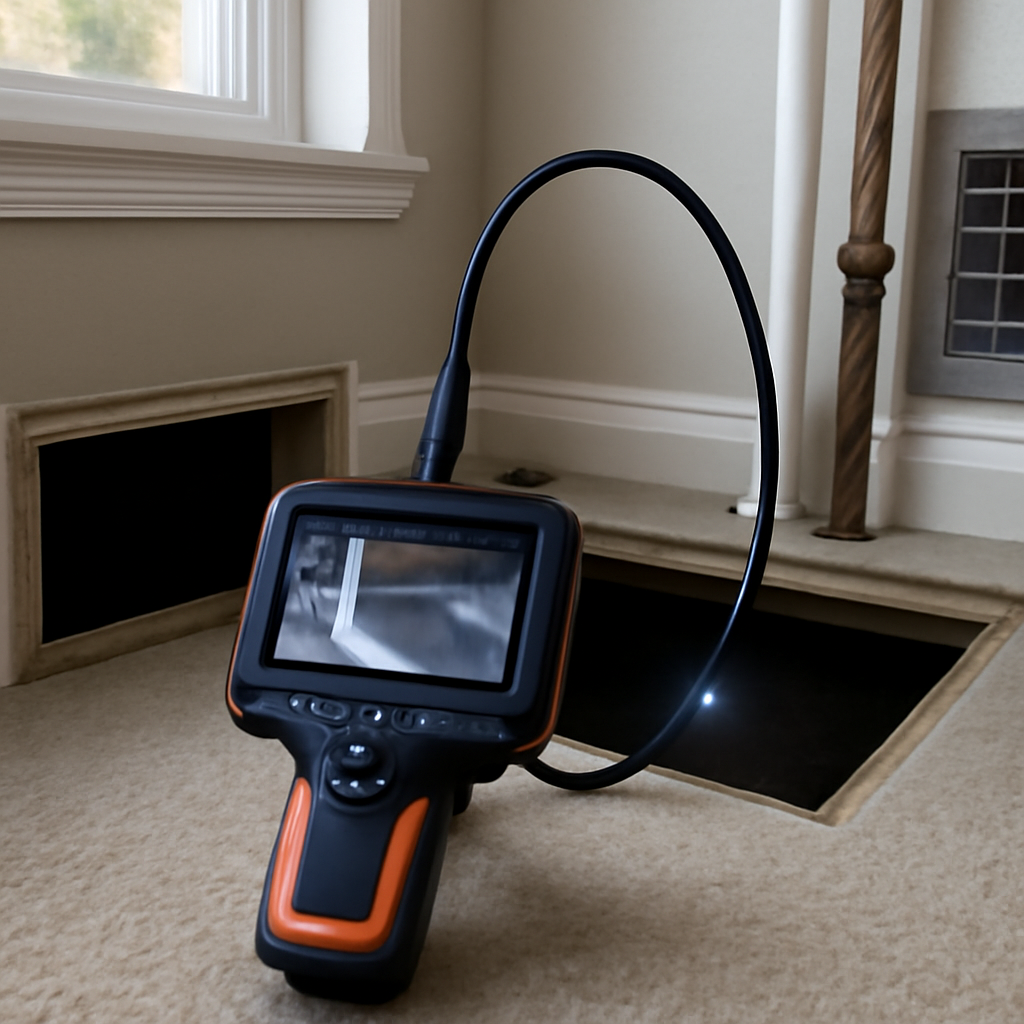
Homeowners search “borescope Home Depot” when they are trying to figure out whether a basic inspection camera from a big-box retailer can solve a specific problem — looking inside a wall cavity, behind a refrigerator, into a drain line, or down into HVAC ductwork. The answer is conditional. Entry-tier borescopes in the $30 to $100 range carried by big-box retailers handle simple visual inspection tasks adequately. Specialty applications (deeper resolution, longer reach, articulating tips, professional documentation workflows) require tools in the $300 to $2,000 range that are not typically stocked on retail shelves. This guide is written for homeowners deciding which tier matches their problem.
What a borescope actually does
A borescope is a small camera on a flexible cable that lets the operator see into spaces that cannot be reached directly with the eye — wall cavities, drain pipes, the inside of appliance components, narrow ductwork, behind permanent cabinetry, into engine cylinders. The camera transmits a live image to a handheld display screen or to a smartphone via Wi-Fi. Most include integrated LED illumination at the camera tip because these are typically dark spaces. The cable diameter sets the minimum opening the borescope can fit through (typically 5.5 to 8.5 mm for consumer tools).
Industry vocabulary distinguishes borescopes (rigid cable, traditional industrial tool) from videoscopes or endoscopes (flexible cable, modern consumer and pro tools). The big-box retail products labeled “borescope” are almost always flexible-cable endoscopes; the industry term carryover is just marketing convention. The InspectandTest tools pillar covers the full tool landscape, and the borescope rental guide covers daily-rate options for pro-tier tools.
What big-box retailers actually stock
The $30 to $100 tier dominates retail shelves. Cable lengths run 3 to 5 meters, cable diameters 5.5 to 8.5 mm, image resolution 480p to 720p with some 1080p models at the top of the tier. Most connect to a smartphone via USB-C or Wi-Fi. Tip articulation is rare at this price; what you see is wherever the rigid camera head happens to be pointing as it travels down the cable. Storage is via the connected phone. Common brands include Depstech, Teslong, Bebird, Anesok, and various private-label store brands.
What they handle adequately
Entry-tier consumer borescopes work well for several common homeowner tasks. Looking inside a wall cavity through an existing electrical box knockout to check for insulation or framing. Inspecting the inside of a clothes dryer vent for lint buildup. Looking down a slow drain to identify a clog. Checking the inside of a pellet stove or chimney cleanout. Visualizing the interior of a refrigerator compressor compartment behind the back panel. Looking into the floor between joists from a basement crawl access. For any task where “I just want to see what is in there” is the question and 720p image quality is sufficient, the retail tier is adequate.
What they do not handle well
Five categories of task exceed the retail tier. HVAC ductwork inspection over more than 3 meters of run — the cable is not long enough. Inspection of small pipes (under 6 mm interior diameter) — the cable is too thick. Documentation-grade images for insurance or real estate disclosures — the resolution and lighting are not professional. Articulating-tip inspections where the camera needs to look around a corner or upward into a cavity above its travel path — entry-tier tools have no tip steering. Inspection in wet environments (drain lines with active flow) for extended periods — most retail-tier camera tips are water-resistant rather than waterproof.
What the professional tier offers
The $300 to $2,000 professional tier (Milwaukee M-Spector, Ridgid SeeSnake micro, Extech BR250 family, FLIR VS70 series) adds longer cables (5 to 15 meters), better optics (1080p to 4K, higher dynamic range), tip articulation (steering the camera head with a joystick or dial), better lighting (often dual-zone illumination), waterproof tips suitable for sustained drain or HVAC condensate-pan inspection, and onboard recording (the unit stores video and still images directly without a phone). Documentation includes timestamp and the ability to annotate. Pro borescopes are sold through industrial suppliers, plumbing wholesalers, and some online specialty retailers — generally not big-box stores.
When to rent rather than buy
Several use cases lean toward rental rather than purchase. A one-time HVAC duct inspection in preparation for a sale. A pre-purchase wall cavity inspection for a single property. A drain camera survey for a sewer-line evaluation. Daily-rate rental of a pro-tier borescope through equipment rental houses runs $50 to $150 per day in 2026 Front Range pricing, sometimes less for weekly rentals. For homeowners who will use the tool once, rental is more economical than purchase even of an entry-tier consumer unit.
Borescope use in residential home inspection
Certified home inspectors increasingly carry a borescope as a standard kit item. Common inspection-day uses include checking behind washer/dryer hookups for hidden plumbing leaks, inspecting attic accesses too small to safely enter, looking inside chimney flues from a thimble or cleanout opening, examining the inside of unfired flues for cracks or obstructions, and verifying wall-cavity insulation through existing penetrations. The borescope does not replace the inspector’s destructive-investigation refusal — the inspector still does not cut into finishes — but it extends what can be observed during a non-invasive inspection.
Image interpretation and lighting reality
Borescope images are harder to interpret than the marketing suggests. The narrow field of view (60 to 90 degrees on most consumer units) means the operator sees a small slice of the space at a time. The strong LED illumination at the tip creates harsh shadows just beyond the camera’s view; dark areas often hide as much as bright areas reveal. Distinguishing between mold, dust, fiber insulation, and shadow on a 480p screen takes practice. For homeowners using a borescope for the first time, expect a learning curve of several attempts before the images become reliably useful.
Safety and limitations
A borescope does not detect gas leaks, electrical hazards, or radon — it is a visual tool only. Never insert the camera into live electrical equipment; de-energize panels and equipment before inspecting interior cavities. Do not use a borescope as a substitute for professional plumbing or HVAC diagnosis when the underlying problem requires repair work — visual confirmation of a clog still requires a plumber to clear it. And recognize that “I didn’t see anything” on a borescope is not the same as “there is nothing there” — the small field of view and limited reach mean the camera missed many things.
Specific Front Range use cases
Front Range homes with older construction (pre-1980 ranches in Lakewood, mid-century homes in Englewood, bungalows in Denver’s near neighborhoods) often have undocumented wall cavities, abandoned plumbing chases, and hidden mechanical penetrations that a borescope helps visualize before a remodel or repair. Newer homes typically have less to find but also benefit from borescope inspection of any concealed return-air pathways or chimneys in homes with original wood-burning fireplaces.
Pre-purchase use of borescopes
A growing number of home inspectors integrate borescope work into routine pre-purchase inspections. Common pre-purchase borescope checks include looking inside dishwasher base cabinets for hidden leaks, inspecting behind clothes washer hookups for chronic dampness, viewing inside chimney flues from below for cracks or obstructions, checking inside HVAC plenums and return-air ducts for cleanliness, and looking through small holes drilled in soffit boxes to verify whether they are enclosing insulation, ducts, or dead space. Buyers requesting borescope-equipped inspections typically pay $50 to $150 more than a standard inspection, and the additional visibility can identify issues that would otherwise not surface until after closing.
Borescope work and home inspector standards
InterNACHI and ASHI standards of practice do not require borescope use during a standard home inspection, but they do not prohibit it either. The borescope is treated as an optional supplementary tool — useful when conditions warrant but not part of the minimum scope. Inspectors who routinely use borescopes typically note their use in the inspection contract and identify which cavities or systems were inspected with the tool.
Borescope features beyond resolution
Beyond pixel count, three features distinguish higher-tier borescopes from retail-tier units. Lighting quality matters because dark cavities are the typical work environment — dual LED zones, dimmable brightness, and matched color temperature produce more interpretable images than single-LED retail units. Cable stiffness affects what the camera can reach — too stiff and the cable cannot bend around tight corners, too soft and the camera tip drifts unpredictably. And waterproofing rating (IP67 or higher) determines whether the camera survives extended use in drain or condensate-pan environments. Retail-tier products often skimp on these features even when pixel resolution looks competitive.
Cable diameter and what fits where
Cable diameter determines the minimum opening the borescope can navigate. Most retail-tier borescopes have 5.5 to 8.5 mm diameter cables, which fit through standard 3/8-inch and 1/2-inch holes drilled in drywall, plumbing access points, or HVAC service ports. Smaller diameter borescopes (3 to 5 mm) exist at higher price points and fit into narrow plumbing lines, instrument applications, and tight industrial spaces. For typical homeowner use the standard retail diameter is appropriate; trying to use an oversized cable in a tight space risks getting the camera stuck or damaging the tip.
Drilling exploratory holes
Some borescope work requires drilling small access holes through finished surfaces. A 1/2-inch hole drilled in drywall to inspect a wall cavity is easily patched after the inspection — fill with drywall compound, sand smooth, paint to match. The hole leaves no visible record after a season of paint cure. Homeowners doing this themselves should locate studs and electrical wiring before drilling (a stud finder with electrical detection is sufficient). Drilling into ceiling tile is similarly low-impact and recoverable. Avoid drilling into surfaces where exposed insulation or electrical wiring is suspected just behind the surface.
Storage and image capture
Retail-tier borescopes save images and short video clips to the connected smartphone via the manufacturer’s app. App quality varies significantly — some are well-maintained with regular updates, others appear abandoned with declining compatibility on newer phones. Before buying, homeowners should check recent app store reviews and confirm the manufacturer still actively supports the model. For one-time inspection tasks the app quality matters less; for ongoing use, abandoned apps are a real problem when a phone update breaks compatibility and renders the borescope unusable.
Working in confined spaces with a borescope
Most borescope use happens in dark, confined, and sometimes awkward spaces. Crawl space access. Behind appliance backs in tight kitchen alcoves. Looking up into a soffit cavity. Inspecting a chimney from the firebox. Each environment presents specific challenges. In crawl spaces, the operator needs sufficient room to hold the camera, view the screen, and manipulate the cable. In appliance cavities, hot or sharp components may damage the cable if not handled carefully. In chimneys, soot residue can foul the camera tip and require post-use cleaning. Anticipating these conditions and bringing the right supplementary equipment — kneepads for crawl space work, gloves for hot or sharp environments, lens cleaning supplies for sooty contexts — makes the work more effective.
The two-person inspection approach
Borescope work often benefits from a second person. One person manipulates the cable and camera tip while the other monitors the display and takes notes. For inspections in restricted spaces, this division of labor allows the camera operator to focus on cable position while the screen watcher catches anomalies that might be missed when the operator is also trying to interpret the live feed. For homeowner DIY borescope use, having a family member help often produces a more thorough inspection than working alone.
Comparing borescopes to other inspection tools
Several tools overlap with borescope use cases, each with different strengths. A thermal imaging camera shows surface temperature patterns that can suggest hidden moisture or insulation gaps without requiring an access opening. A moisture meter confirms wet areas at specific probe points but requires the operator to know where to check. A drain camera (a borescope variant with a heavier cable and larger camera head) handles longer pipe inspections than a residential borescope. A telescoping mirror with a flashlight covers some of the same inspection use cases (looking behind walls through electrical box openings) without requiring the technology and battery management of an electronic camera. The borescope’s unique value is in cavities that are too dark or distant for a mirror but too small or restricted for direct visual inspection.
References
- Borescope and Endoscope Inspection Guidance — InterNACHI
- Home Energy Assessment Tools — U.S. Department of Energy
- Inspection Tools for HVAC Diagnostics — ASHRAE
- Visual Inspection Tools for Home Inspectors — InterNACHI
Borescopes & inspection cameras
A borescope lets you see inside walls, ducts, drains, and crawlspaces without opening anything up.
| Product | Why | Buy |
|---|---|---|
 DEPSTECH Wireless Borescope DEPSTECH Wireless Borescope | Wi-Fi to your phone; semi-rigid cable. | Amazon — $48.99 |
 Teslong Dual-Lens Borescope Teslong Dual-Lens Borescope | Side + front view; good for ducts. | Amazon — $159.99 |
 Ridgid micro CA-150 Ridgid micro CA-150 | Rugged handheld with screen. | Amazon — $295.05 |